


Characteristics of ocular injuries associated with mortality in patients admitted with major trauma
- PMID: 38504178
- PMCID: PMC10949718
- DOI: 10.1186/s12886-024-03392-y
Characteristics of ocular injuries associated with mortality in patients admitted with major trauma
Abstract
Background: Few ocular trauma studies have addressed mortality outcomes. We sought to determine characteristics of mortality-related ocular trauma admissions and compared them with non-fatal injuries.
Methods: A retrospective study was conducted using de-identified data of patients admitted with major trauma from the National Trauma Data Bank (2008-2014). Patients with ocular injury were identified using ICD- 9CM codes. Demographics, intention and mechanism, types of ocular and head injuries, and injury severity were documented. Mortality was determined using post-admission disposition. Statistical analysis using student t-test, chi-square, and odds ratios (OR) calculations were performed with STATA-17 software. Significance was set at P < 0.05.
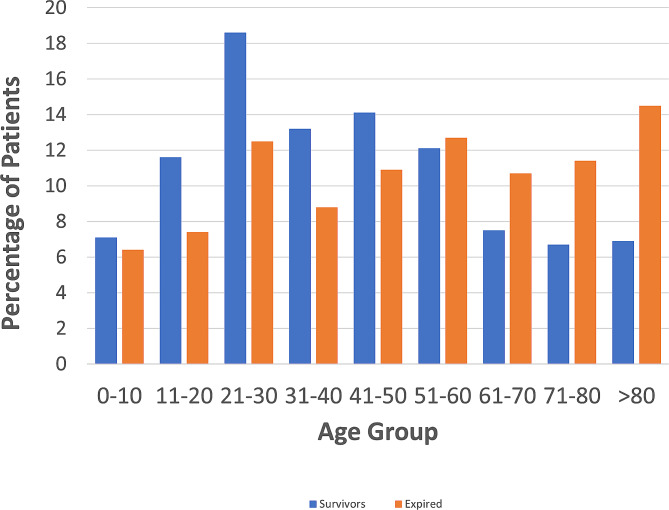
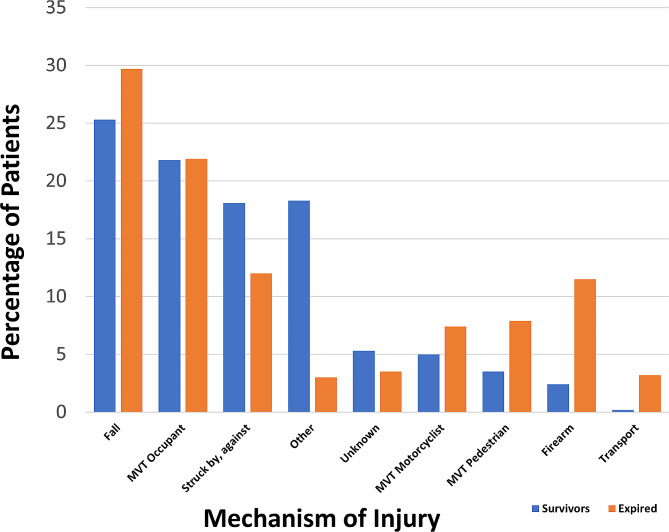
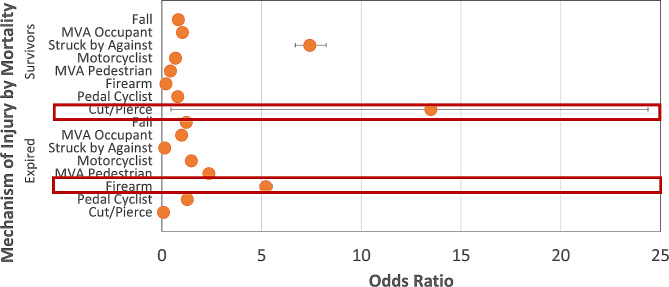
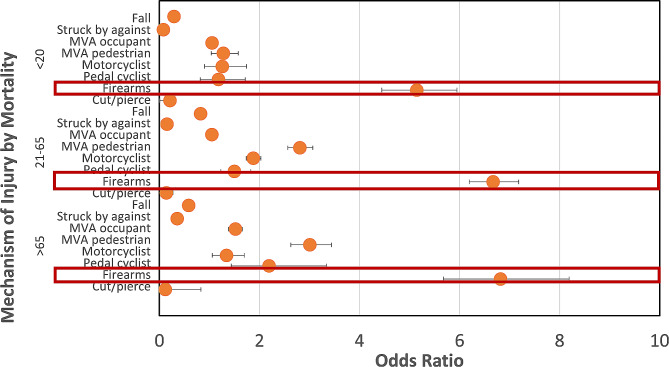
Results: Of 316,485 patients admitted with ocular trauma, 12,233 (3.86%) were mortality related. Expired patients were older than survivors: mean (SD) of 50.1(25.5) vs. 41.5(22.8) years. White (OR = 1.32; P < 0.001), ≥ 65years old (OR = 2.25; P < 0.001), and male (OR = 1.05; P = 0.029) patients were most likely to expire than their counterparts. Common mechanisms of injury in survivors were falls (25.3%), motor vehicle traffic-occupant, MVTO (21.8%) and struck by/against (18.1%) and for fatal injuries, falls (29.7%), MVTO (21.9%) and firearms (11.5%). Traumatic brain injury (TBI) was documented in 88.2% of mortality-related admissions. Very severe injury severity scores (ISS > 24) (OR = 19.19; P < 0.001) and severe Glasgow Coma Score (GCS < 8) (OR = 19.22; P < 0.001) were most associated with mortality than survival. Firearms were most associated with very severe ISS (OR = 3.73; P < 0.001), severe GCS (OR = 4.68; P < 0.001) and mortality (OR = 5.21; P < 0.001) than other mechanisms. Patients with cut/pierce injuries had the greatest odds of survival (OR = 13.48; P < 0.001). Optic nerve/visual pathways injuries (3.1%) had the highest association with very severe ISS (OR = 2.51; P < 0.001), severe GCS (OR = 3.64; P < 0.001) and mortality (OR = 2.58; P < 0.001) than other ocular injuries. Black patients with very severe ISS (OR = 32.14; P < 0.001) and severe GCS (OR = 31.89; P < 0.001) were more likely to expire than other race/ethnicities with similar injury severity.
Conclusions: Mortality-related admissions were older, male, and mostly of White race than ocular trauma admissions of survivors. Firearms were the deadliest mechanism. TBI was commonly associated and patients with optic nerve/pathway injuries, very severe ISS and severe GCS had higher mortality rates. Characteristics and demographic variations identified in this study may be useful in developing focused measures aimed at preventing trauma-related deaths.
Keywords: Firearms; Glasgow coma score; Injury severity score; Mortality; Ocular trauma; Traumatic brain injury.
© 2024. The Author(s).
Conflict of interest statement
No ffinancial interest or conflict of interest exists for any author.
Figures
Similar articles
-
Traumatic Brain Injury in Admitted Patients with Ocular Trauma.Turk J Ophthalmol. 2024 Aug 28;54(4):212-222. doi: 10.4274/tjo.galenos.2024.27737. Epub 2024 Aug 7. Turk J Ophthalmol. 2024. PMID: 39108021 Free PMC article.
-
Characteristics of ocular trauma in the United States.Arq Bras Oftalmol. 2022 May-Jun;85(3):240-248. doi: 10.5935/0004-2749.20220035. Arq Bras Oftalmol. 2022. PMID: 34586236 Free PMC article.
-
Disparities in discharge patterns of admitted older patients with ocular trauma.Injury. 2022 Jun;53(6):2016-2022. doi: 10.1016/j.injury.2022.02.023. Epub 2022 Feb 10. Injury. 2022. PMID: 35197206
-
Prognostic Significance of Magnetic Resonance Imaging in Detecting Diffuse Axonal Injuries: Analysis of Outcomes and Review of Literature.Neurol India. 2022 Nov-Dec;70(6):2371-2377. doi: 10.4103/0028-3886.364066. Neurol India. 2022. PMID: 36537418 Review.
-
Cervical spine injuries in children: a review of 103 patients treated consecutively at a level 1 pediatric trauma center.J Pediatr Surg. 2001 Aug;36(8):1107-14. doi: 10.1053/jpsu.2001.25665. J Pediatr Surg. 2001. PMID: 11479837 Review.
Cited by
-
Geriatric ocular trauma and mortality: A retrospective cohort study.PLoS One. 2025 May 28;20(5):e0324821. doi: 10.1371/journal.pone.0324821. eCollection 2025. PLoS One. 2025. PMID: 40434983 Free PMC article.
References
MeSH terms
LinkOut - more resources
Full Text Sources
Medical
