


The relationship between mindfulness and athletes' mental skills may be explained by emotion regulation and self-regulation
- PMID: 38504372
- PMCID: PMC10949773
- DOI: 10.1186/s13102-024-00863-z
The relationship between mindfulness and athletes' mental skills may be explained by emotion regulation and self-regulation
Abstract
Background: Although numerous psychological determinants of sports success have been identified in the scientific literature, research on the contribution of mindfulness and interoceptive awareness to sports achievements remains limited. This study investigates the relationship between self-reported mental skills determining sports success (i.e., flow state, attention, technique, sensitivity to error, commitment, and achievement), state mindfulness for physical activity (of the mind and the body), and interoceptive awareness (including scales of noticing, not distracting, not worrying, attention regulation, emotional awareness, self-regulation, body listening, and trusting).
Methods: A cross-sectional online survey was conducted on a sample of elite athletes in speed skating (n = 54) and university students of physical education (n = 102) representing various sports disciplines and competitive levels. The Sports Success Scale (SSS), the State Mindfulness Scale for Physical Activity (SMS-PA), and the Multidimensional Assessment of Interoceptive Awareness (MAIA-2) were used to assess psychological determinants of athletic achievements, state mindfulness, and interoceptive sensitivity, respectively.
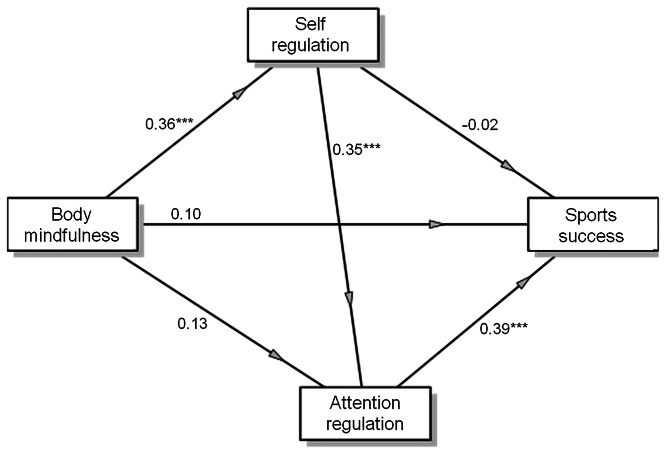
Results: Our findings indicate some small-to-moderate differences in particular dimensions of psychological traits related to sports success, mindfulness, and interoceptive awareness between athletes of different genders, groups, and competitive levels. A chain mediation model showed that the relationship between body mindfulness and psychological variables determining sports success is fully explained by two dimensions of interoception: self-regulation and attention regulation.
Conclusions: Cultivating the mindfulness state of the body can improve self-regulation and attention regulation, which in turn may increase the mental skills required for successful sports participation. Therefore, mental training should focus primarily on body mindfulness, attention regulation, and self-regulation to improve the mental skills responsible for athletes' sports achievements. In addition, individual differences in athletes' gender, sports discipline, and level of sports competition should be considered during mental training.
Keywords: Elite athletes; Interoceptive awareness; Speed skating; Sports success; State mindfulness for physical activity.
© 2024. The Author(s).
Conflict of interest statement
The authors declare no competing interests.
Figures
References
-
- Morrison J. An evolutionary perspective on sport and performance enhancement. Perform Enhanc Health. 2023;:100263.
-
- Foo KS, Kueh YC, Leong KJ, Teoh JY, Mok HA, Kim Y et al. Kawa model on mental health, sports and physical performance: a mini review. Asian J Sport Exerc Psychol. 2023.
-
- Yeadon MR, Pain MTG. Fifty years of performance-related sports biomechanics research. J Biomech. 2023;155. - PubMed
-
- Stephen SA, Coffee P, Habeeb CM, Morris R, Tod D. Social identity in sport: a scoping review of the performance hypothesis. Psychol Sport Exerc. 2023;67. - PubMed
-
- Mousavi A, Vaezmousavi M. Introducing the Sport Success Scale (SSS) Int J Sport Stud. 2015;5:1218–26.
LinkOut - more resources
Full Text Sources
