


Perennial biomass cropping and use: Shaping the policy ecosystem in European countries
- PMID: 38505831
- PMCID: PMC10946487
- DOI: 10.1111/gcbb.13038
Perennial biomass cropping and use: Shaping the policy ecosystem in European countries
Abstract
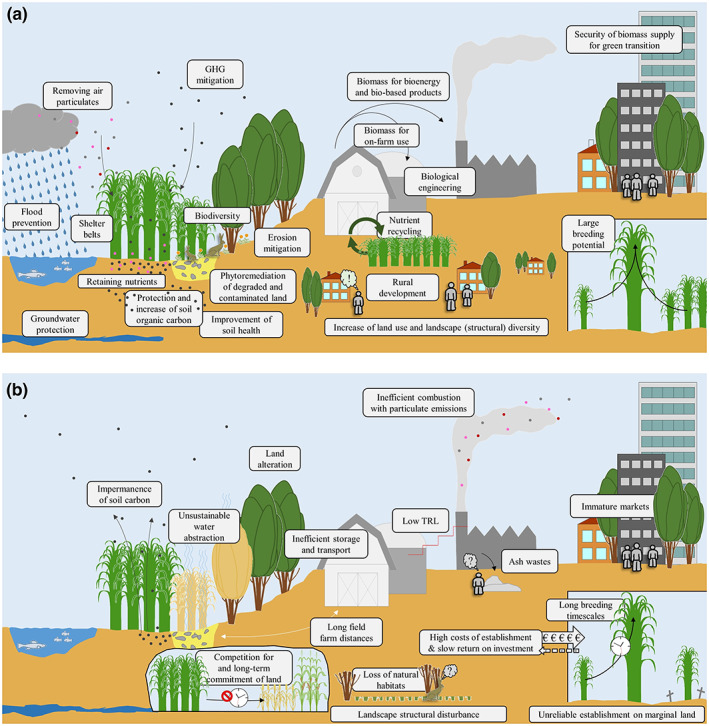
Demand for sustainably produced biomass is expected to increase with the need to provide renewable commodities, improve resource security and reduce greenhouse gas emissions in line with COP26 commitments. Studies have demonstrated additional environmental benefits of using perennial biomass crops (PBCs), when produced appropriately, as a feedstock for the growing bioeconomy, including utilisation for bioenergy (with or without carbon capture and storage). PBCs can potentially contribute to Common Agricultural Policy (CAP) (2023-27) objectives provided they are carefully integrated into farming systems and landscapes. Despite significant research and development (R&D) investment over decades in herbaceous and coppiced woody PBCs, deployment has largely stagnated due to social, economic and policy uncertainties. This paper identifies the challenges in creating policies that are acceptable to all actors. Development will need to be informed by measurement, reporting and verification (MRV) of greenhouse gas emissions reductions and other environmental, economic and social metrics. It discusses interlinked issues that must be considered in the expansion of PBC production: (i) available land; (ii) yield potential; (iii) integration into farming systems; (iv) R&D requirements; (v) utilisation options; and (vi) market systems and the socio-economic environment. It makes policy recommendations that would enable greater PBC deployment: (1) incentivise farmers and land managers through specific policy measures, including carbon pricing, to allocate their less productive and less profitable land for uses which deliver demonstrable greenhouse gas reductions; (2) enable greenhouse gas mitigation markets to develop and offer secure contracts for commercial developers of verifiable low-carbon bioenergy and bioproducts; (3) support innovation in biomass utilisation value chains; and (4) continue long-term, strategic R&D and education for positive environmental, economic and social sustainability impacts.
Keywords: BECCS; bioeconomy value chains; biomass utilisation; circular economy; energy security; farm subsidies; food security; integration into farm business; land availability; policy recommendation.
© 2023 The Authors. GCB Bioenergy Published by John Wiley & Sons Ltd.
Conflict of interest statement
The authors declare that progress reported in this paper, which includes input from industrial partners, is not biased by their business interests.
Figures


References
-
- Abreu, M. , Silva, L. , Ribeiro, B. , Ferreira, A. , Alves, L. , Paixão, S. M. , Gouveia, L. , Moura, P. , Carvalheiro, F. , Duarte, L. C. , Fernando, A. L. , Reis, A. , & Gírio, F. (2022). Low indirect land use change (ILUC) energy crops to bioenergy and biofuels—A review. Energies, 15, 4348. 10.3390/en15124348 - DOI
-
- Adams, P. , & Lindegaard, K. (2016). A critical appraisal of the effectiveness of UK perennial energy crops policy since 1990. Renewable and Sustainable Energy Reviews, 55, 188–202. 10.1016/j.rser.2015.10.126 - DOI
-
- Albanito, F. , Hastings, A. , Fitton, N. , Richards, M. , Martin, M. , Mac Dowell, N. , Bell, D. , Taylor, S. C. , Butnar, I. , Li, P.‐H. , Slade, R. , & Smith, P. (2019). Mitigation potential and environmental impact of centralized versus distributed BECCS with domestic biomass production in Great Britain. GCB Bioenergy, 11, 1234–1252. 10.1111/gcbb.12630 - DOI
-
- Anand, M. , Miao, R. , & Khanna, M. (2019). Adopting bioenergy crops: Does farmers' attitude toward loss matter? Agricultural Economics, 50(4), 435–450. 10.1111/agec.12501 - DOI
-
- Ashman, C. , Awty‐Carroll, D. , Mos, M. , Kam, J. , Guerrini, S. , Calder, S. , & Clifton‐Brown, J. (2023). Developing miscanthus seed plug establishment protocols with mulch film for commercial upscaling. GCB Bioenergy (in press).
Publication types
Associated data
LinkOut - more resources
Full Text Sources
Miscellaneous