


Estimating actual SARS-CoV-2 infections from secondary data
- PMID: 38509181
- PMCID: PMC10954653
- DOI: 10.1038/s41598-024-57238-0
Estimating actual SARS-CoV-2 infections from secondary data
Abstract
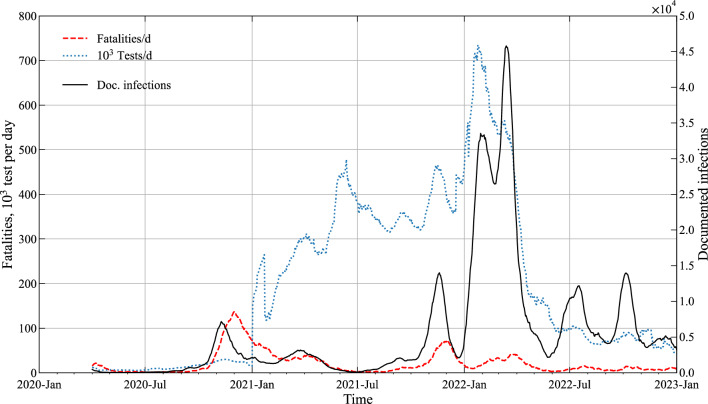
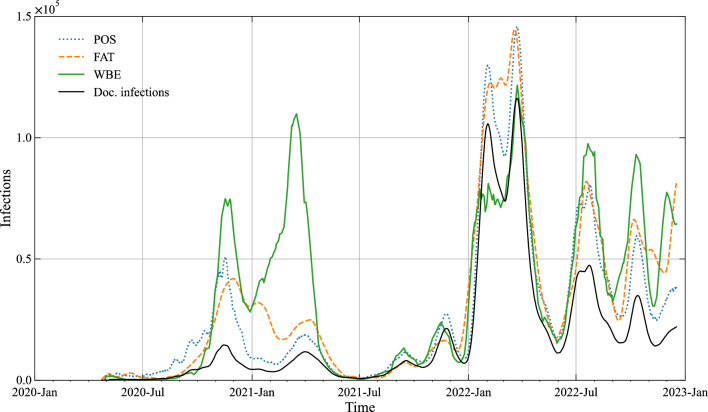
Eminent in pandemic management is accurate information on infection dynamics to plan for timely installation of control measures and vaccination campaigns. Despite huge efforts in diagnostic testing of individuals, the underestimation of the actual number of SARS-CoV-2 infections remains significant due to the large number of undocumented cases. In this paper we demonstrate and compare three methods to estimate the dynamics of true infections based on secondary data i.e., (a) test positivity, (b) infection fatality and (c) wastewater monitoring. The concept is tested with Austrian data on a national basis for the period of April 2020 to December 2022. Further, we use the results of prevalence studies from the same period to generate (upper and lower bounds of) credible intervals for true infections for four data points. Model parameters are subsequently estimated by applying Approximate Bayesian Computation-rejection sampling and Genetic Algorithms. The method is then validated for the case study Vienna. We find that all three methods yield fairly similar results for estimating the true number of infections, which supports the idea that all three datasets contain similar baseline information. None of them is considered superior, as their advantages and shortcomings depend on the specific case study at hand.
© 2024. The Author(s).
Conflict of interest statement
The authors declare no competing interests.
Figures



References
-
- Mathieu E. et al. Coronavirus Pandemic (COVID-19). https://ourworldindata.org/coronavirus.
-
- Giattino, C. How Epidemiological Models of COVID-19 Help us Estimate the True Number of Infections. https://ourworldindata.org/covid-models. Accessed 23 Sept 2023.
MeSH terms
LinkOut - more resources
Full Text Sources
Medical
Miscellaneous
