. 2024 Mar 21;12(3):e008482.
doi: 10.1136/jitc-2023-008482.

Inhibition of IL-25/IL-17RA improves immune-related adverse events of checkpoint inhibitors and reveals antitumor activity

Affiliations

Inhibition of IL-25/IL-17RA improves immune-related adverse events of checkpoint inhibitors and reveals antitumor activity

Xizi Hu et al. J Immunother Cancer. .

Abstract

Background: Immune checkpoint inhibitors (ICIs) have improved outcomes and extended patient survival in several tumor types. However, ICIs often induce immune-related adverse events (irAEs) that warrant therapy cessation, thereby limiting the overall effectiveness of this class of therapeutic agents. Currently, available therapies used to treat irAEs might also blunt the antitumor activity of the ICI themselves. Therefore, there is an urgent need to identify treatments that have the potential to be administered alongside ICI to optimize their use.

Methods: Using a translationally relevant murine model of anti-PD-1 and anti-CTLA-4 antibodies-induced irAEs, we compared the safety and efficacy of prednisolone, anti-IL-6, anti-TNFɑ, anti-IL-25 (IL-17E), and anti-IL-17RA (the receptor for IL-25) administration to prevent irAEs and to reduce tumor size.

Results: While all interventions were adequate to inhibit the onset of irAEs pneumonitis and hepatitis, treatment with anti-IL-25 or anti-IL-17RA antibodies also exerted additional antitumor activity. Mechanistically, IL-25/IL-17RA blockade reduced the number of organ-infiltrating lymphocytes.

Conclusion: These findings suggest that IL-25/IL-17RA may serve as an additional target when treating ICI-responsive tumors, allowing for better tumor control while suppressing immune-related toxicities.

Keywords: Immune Checkpoint Inhibitors; Immunotherapy; Ipilimumab; Nivolumab; T-Lymphocytes.


Conflict of interest statement

Competing interests: AM and XH invented a patent from this study but held no financial interests.

Figures

Figure 1
Figure 1
Anti-PD-1 and anti-CTLA-4 antibodies therapy induces irAEs in multiple organs. (A) A mouse model for immune checkpoint blockade-induced immune-related adverse events. Anti-PD-1 (200 µg) and anti-CTLA-4 (200 µg) were given biweekly through intraperitoneal injections starting on day 1 for 6 weeks or until euthanasia. (Bi) Each curve represents a treatment group. Green represents tumor growth of aPD-1+aCTLA-4 treated mice. Gray represents untreated mice. (Bii) Average tumor volumes on day 18. (C) Immune infiltration gradings of H&E-stained liver, lung, heart, colon, and pancreas harvested on mouse euthanasia. (D) Spectral flow analysis reveals multiple CD45+ T cell clusters composing liver and tumor. (E) Differences exist between liver and tumor CD45+ T cell population. Purple and green clusters are enriched in the liver, and the red cluster is unique to the tumor. irAEs, immune-related adverse events.
Figure 2
Figure 2
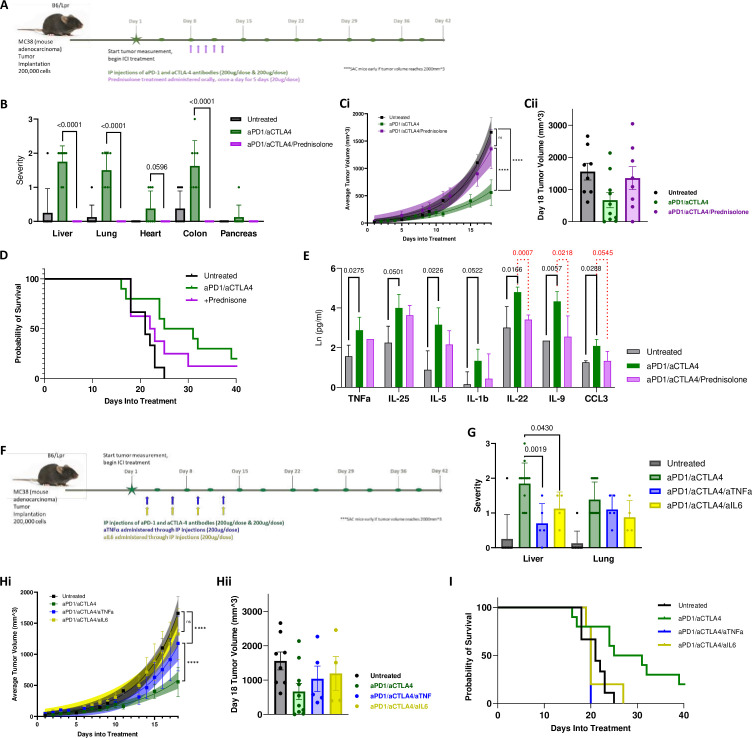
Treatments for irAEs counteract ICI’s antitumor effect. (A) Experiment design for examining the effect of prednisolone on tumor and immune-related adverse event development. Prednisolone was given daily via oral gavage from day 8 to day 12 (5 doses total) at 20 µg/dose in addition to regular aPD-1 and aCTLA-4 administration. (B) Immune infiltration gradings of H&E-stained organs harvested on mouse euthanasia reveal levels of organ-specific immune infiltration. (Ci) Each curve represents a treatment group illustrating tumor growth. (Cii) Average tumor volume on day 18. (D) Kaplan-Meier (KM) plot shows survival estimate of untreated mice and mice receiving aPD-1+aCTLA-4 with and without prednisolone. (E) Luminex detects levels of cytokines in peripheral blood serum collected at in vivo endpoints. (F) Experiment design for examining the effect of anti-IL-6 and anti-TNFα antibodies on tumor and immune-related adverse event development. Either aIL-6 or aTNFα was given biweekly starting day two at 200 µg per dose through intraperitoneal injections for 2 weeks on top of the regular dosage of aPD-1 and aCTLA-4. (G) Immune infiltration gradings of H&E-stained liver and lung harvested at the in vivo endpoint. (Hi) Tumor growth curves of different treatment groups. (Hii) Average tumor volumes on day 18. (I) KM plot of estimated survival probabilities of aPD-1+aCTLA-4 treated mice, aPD-1+aCTLA-4+aIL-6 treated mice, and aPD-1+aCTLA-4+aTNFα treated mice within the 40 days treatment period. ICI, immune checkpoint inhibitor; irAEs, immune-related adverse events.
Figure 3
Figure 3
Neutralizing IL-25 prevents irAEs while promoting tumor regression. (A) Schematic representation of the experimental design for administering single dose anti-IL-25 antibody in combination with aPD-1+aCTLA-4. High dose (400 µg), LD=low dose (200 µg). (B) Severity of immune cells infiltrating liver, lung, heart, colon, and pancreas. (Ci) Tumor growth curves. (Cii) Average tumor volumes on day 18. Each dot represents a mouse. (D) Survival probabilities of mice within different treatment groups over 40 days. (E) Schematic representation of the experimental design for dosing anti-IL-25 antibody weekly in combination with aPD-1+aCTLA-4. (Fi) Tumor growth curves of untreated, aPD-1+aCTLA-4 treated, and aPD-1+aCTLA-4+aIL-25 weekly LD treated mice. (Fii) Average tumor volume comparison on day 18. Each dot represents a mouse. (G) Immune infiltration levels in the liver, lung, heart, and pancreas at 25 days. (Hi) Markups of CD3+ T cells that infiltrated into the lung following aPD-1+aCTLA-4 and aPD-1+aCTLA-4+aIL-25 treatments. (Hii) Lung CD3+ T cell quantification by Halo software. irAEs, immune-related adverse events.
Figure 4
Figure 4
IL-17RA is an alternative and better target than IL-25. (A) IL-17 ligand and receptor family. IL-17A, IL-17A/F, IL-17F, IL-17E (IL-25), IL-17B, IL-17C, and IL-17D are either homodimers or heterodimers. (B) Schematic representation of the experimental design for administering anti-IL-17RA antibody (100 ug) twice in combination with aPD-1+aCTLA-4. (Ci) Tumor growth curve of aIL-17RA treated mice compared with those without anti-IL-17RA treatment. (Cii) Average tumor volumes on day 18. (D) Gradings of immune infiltration on day 25. (E) Flow cytometry plot of percent IL-17RA+ in CD4+ T cell and CD8+ T cell from Lpr mice splenocytes (T cells—CD3+ gate). (F) Flow cytometry analysis of CD69 activation marker expression in IL-17RA+ and IL-17RA CD4+ T cells. Flow cytometry analysis of IL-17RA in central and effector CD4 T cells. (Gi) Exhausted (PD1+ CD69-) CD4+ T cells presented in mice of previous in vivo experiments. (Gii) Sample exhausted cells gating of representative mice from aPD-1/aCTLA-4 and aPD-1/aCTLA-4/aIL-17RA treatment groups.
Figure 5
Figure 5
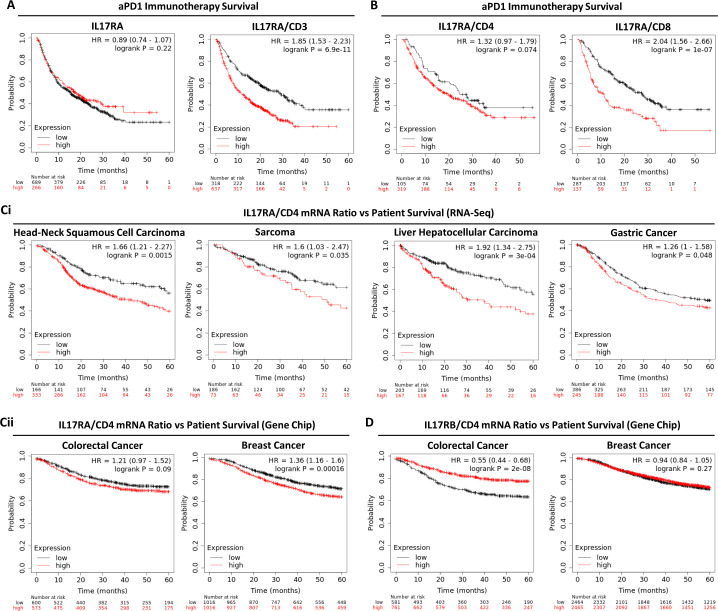
T cell IL-17RA gene expression correlates with worse patient outcomes. (A) Survival probability of patients receiving aPD-1 immunotherapy predicted by IL-17RA expression and IL-17RA/CD3 gene expression ratio. (B) aPD-1 immunotherapy patient survival predicted by IL-17RA/CD4 and IL-17RA/CD8 gene expression ratio. (Ci, Cii) Probability of survival predicted by IL-17RA/CD4 mRNA expression ratio in multiple malignancies. (D) Colorectal and breast cancer patient survival predicted by the IL-17RB/CD4 mRNA expression ratio.

References

    1. Topalian SL, Hodi FS, Brahmer JR, et al. . Safety, activity, and immune correlates of anti-PD-1 antibody in cancer. N Engl J Med 2012;366:2443–54. 10.1056/NEJMoa1200690 - DOI - PMC - PubMed
    1. Powles T, Eder JP, Fine GD, et al. . MPDL3280A (anti-PD-L1) treatment leads to clinical activity in metastatic bladder cancer. Nature 2014;515:558–62. 10.1038/nature13904 - DOI - PubMed
    1. Váraljai R, Zimmer L, Al-Matary Y, et al. . Interleukin 17 signaling supports clinical benefit of dual CTLA-4 and PD-1 checkpoint inhibition in Melanoma. Nat Cancer 2023;4:1292–308. 10.1038/s43018-023-00610-2 - DOI - PMC - PubMed
    1. Duan J, Cui L, Zhao X, et al. . Use of immunotherapy with programmed cell death 1 vs programmed cell death ligand 1 inhibitors in patients with cancer: a systematic review and meta-analysis. JAMA Oncol 2020;6:375–84. 10.1001/jamaoncol.2019.5367 - DOI - PMC - PubMed
    1. Kuol N, Stojanovska L, Nurgali K, et al. . The mechanisms tumor cells utilize to evade the host’s immune system. Maturitas 2017;105:8–15. 10.1016/j.maturitas.2017.04.014 - DOI - PubMed

Publication types