


The role of strigolactone in alleviating salinity stress in chili pepper
- PMID: 38519997
- PMCID: PMC10960418
- DOI: 10.1186/s12870-024-04900-4
The role of strigolactone in alleviating salinity stress in chili pepper
Abstract
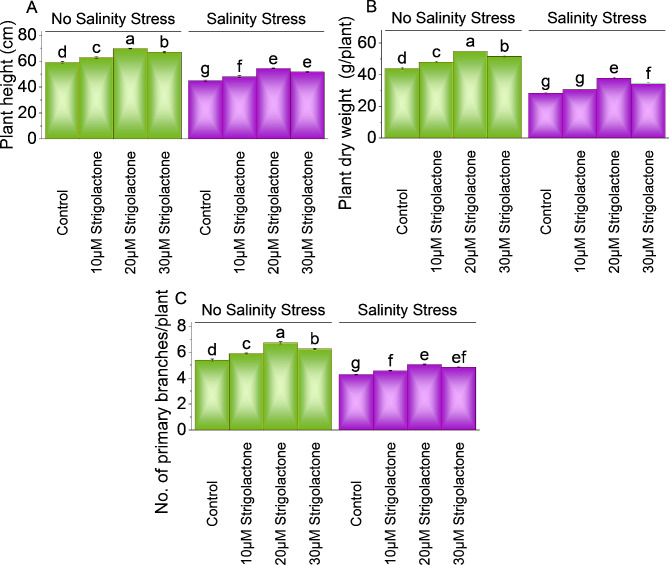
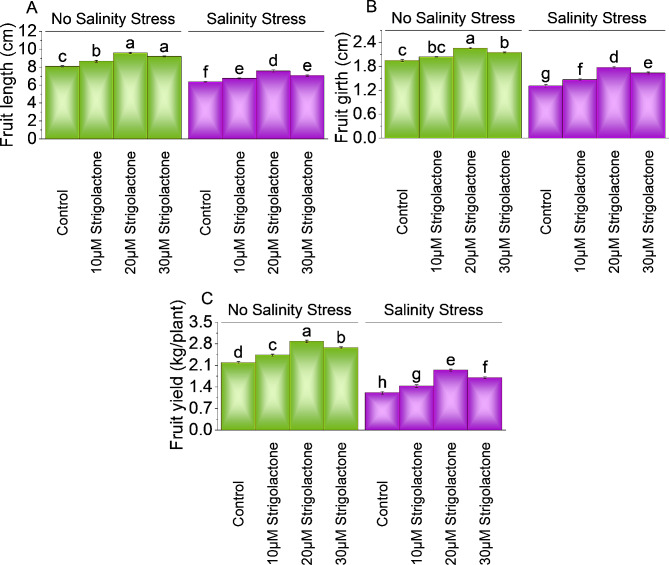
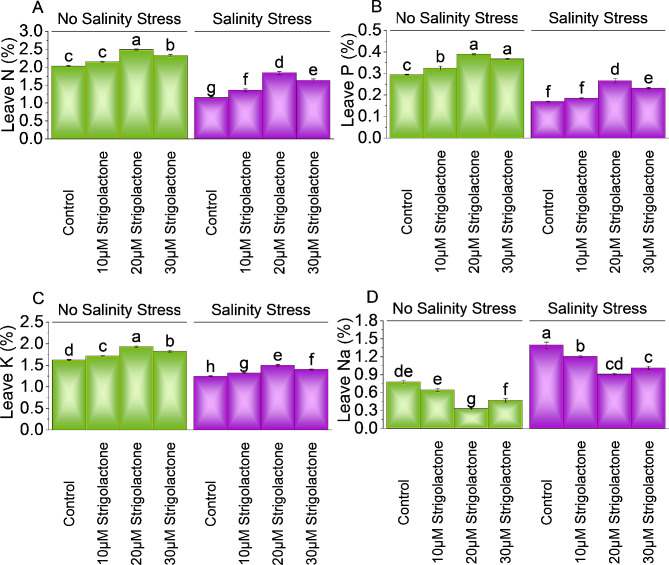
Salinity stress can significantly delay plant growth. It can disrupt water and nutrient uptake, reducing crop yields and poor plant health. The use of strigolactone can be an effective technique to overcome this issue. Strigolactone enhances plant growth by promoting root development and improvement in physiological attributes. The current pot study used strigolactone to amend chili under no salinity and salinity stress environments. There were four treatments, i.e., 0, 10µM strigolactone, 20µM strigolactone and 30µM strigolactone. All treatments were applied in four replications following a completely randomized design (CRD). Results showed that 20µM strigolactone caused a significant increase in chili plant height (21.07%), dry weight (33.60%), fruit length (19.24%), fruit girth (35.37%), and fruit yield (60.74%) compared to control under salinity stress. Significant enhancement in chili chlorophyll a (18.65%), chlorophyll b (43.52%), and total chlorophyll (25.09%) under salinity stress validated the effectiveness of 20µM strigolactone application as treatment over control. Furthermore, improvement in nitrogen, phosphorus, and potassium concentration in leaves confirmed the efficient functioning of 20µM strigolactone compared to other concentrations under salinity stress. The study concluded that 20µM strigolactone is recommended for mitigating salinity stress in chili plants. Growers are advised to apply 20µM strigolactone to enhance their chili production under salinity stress.
Keywords: Antioxidant; Chili chlorophyll content; Salinity stress; Strigolactone.
© 2024. The Author(s).
Conflict of interest statement
The authors declare no competing interests.
Figures
References
-
- Anwar T, Qureshi H, Fatimah H, Siddiqi EH, Anwaar S, Moussa IM, et al. Elucidating effect of ZnO-Nanoparticles and melatonin on physiological adjustments and growth of Solanum melongena under salinity stress. Sci Hortic (Amsterdam) 2023;322:112455. doi: 10.1016/j.scienta.2023.112455. - DOI
-
- Ma Y, Huang P, Huang S, Younis U, Hussain GS, Fahad S, et al. γ-Aminobutyric acid (GABA) and ectoine (ECT) impacts with and without AMF on antioxidants, gas exchange attributes and nutrients of cotton cultivated in salt affected soil. BMC Plant Biol. 2023;23:476. doi: 10.1186/s12870-023-04486-3. - DOI - PMC - PubMed
-
- Zafar-ul-Hye M, Yaseen R, Abid M, Abbas M, Ahmad M, Rahi AA, et al. Rhizobacteria having ACC-deaminase and biogas slurry can mitigate salinity adverse effects in wheat. Pakistan J Bot. 2022;54:297–303.
Publication types
MeSH terms
Substances
LinkOut - more resources
Full Text Sources
