


Unmasking bias in artificial intelligence: a systematic review of bias detection and mitigation strategies in electronic health record-based models
- PMID: 38520723
- PMCID: PMC11031231
- DOI: 10.1093/jamia/ocae060
Unmasking bias in artificial intelligence: a systematic review of bias detection and mitigation strategies in electronic health record-based models
Abstract
Objectives: Leveraging artificial intelligence (AI) in conjunction with electronic health records (EHRs) holds transformative potential to improve healthcare. However, addressing bias in AI, which risks worsening healthcare disparities, cannot be overlooked. This study reviews methods to handle various biases in AI models developed using EHR data.
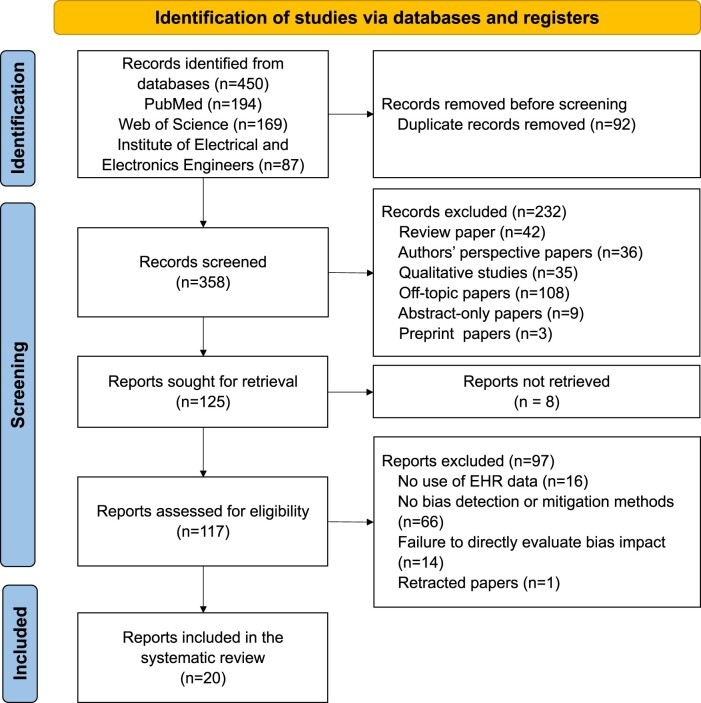
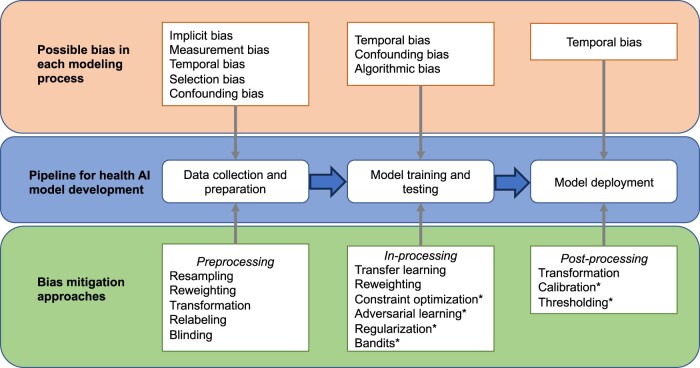
Materials and methods: We conducted a systematic review following the Preferred Reporting Items for Systematic Reviews and Meta-analyses guidelines, analyzing articles from PubMed, Web of Science, and IEEE published between January 01, 2010 and December 17, 2023. The review identified key biases, outlined strategies for detecting and mitigating bias throughout the AI model development, and analyzed metrics for bias assessment.
Results: Of the 450 articles retrieved, 20 met our criteria, revealing 6 major bias types: algorithmic, confounding, implicit, measurement, selection, and temporal. The AI models were primarily developed for predictive tasks, yet none have been deployed in real-world healthcare settings. Five studies concentrated on the detection of implicit and algorithmic biases employing fairness metrics like statistical parity, equal opportunity, and predictive equity. Fifteen studies proposed strategies for mitigating biases, especially targeting implicit and selection biases. These strategies, evaluated through both performance and fairness metrics, predominantly involved data collection and preprocessing techniques like resampling and reweighting.
Discussion: This review highlights evolving strategies to mitigate bias in EHR-based AI models, emphasizing the urgent need for both standardized and detailed reporting of the methodologies and systematic real-world testing and evaluation. Such measures are essential for gauging models' practical impact and fostering ethical AI that ensures fairness and equity in healthcare.
Keywords: artificial intelligence; bias; deep learning; electronic health record; scoping review.
© The Author(s) 2024. Published by Oxford University Press on behalf of the American Medical Informatics Association. All rights reserved. For permissions, please email: journals.permissions@oup.com.
Conflict of interest statement
None declared.
Figures
Update of
-
Unmasking bias in artificial intelligence: a systematic review of bias detection and mitigation strategies in electronic health record-based models.ArXiv [Preprint]. 2024 Jul 1:arXiv:2310.19917v3. ArXiv. 2024. Update in: J Am Med Inform Assoc. 2024 Apr 19;31(5):1172-1183. doi: 10.1093/jamia/ocae060. PMID: 39010875 Free PMC article. Updated. Preprint.
References
-
- Adler-Milstein J, Jha AK.. HITECH act drove large gains in hospital electronic health record adoption. Health Aff (Millwood). 2017;36(8):1416-1422. - PubMed
-
- Topol EJ. High-performance medicine: the convergence of human and artificial intelligence. Nat Med. 2019;25(1):44-56. - PubMed
-
- Hee K. Is data quality enough for a clinical decision?: apply machine learning and avoid bias. In: 2017 IEEE International Conference on Big Data (Big Data). IEEE; 2017:2612-2619.
Publication types
MeSH terms
Grants and funding
LinkOut - more resources
Full Text Sources
Miscellaneous
