Review
. 2023 Sep 20;11(4):101122.
doi: 10.1016/j.gendis.2023.101122. eCollection 2024 Jul.

The role of lipid metabolism in osteoporosis: Clinical implication and cellular mechanism

Affiliations
Review

The role of lipid metabolism in osteoporosis: Clinical implication and cellular mechanism

Jing Zhang et al. Genes Dis. .

Abstract

In recent years, researchers have become focused on the relationship between lipids and bone metabolism balance. Moreover, many diseases related to lipid metabolism disorders, such as nonalcoholic fatty liver disease, atherosclerosis, obesity, and menopause, are associated with osteoporotic phenotypes. It has been clinically observed in humans that these lipid metabolism disorders promote changes in osteoporosis-related indicators bone mineral density and bone mass. Furthermore, similar osteoporotic phenotype changes were observed in high-fat and high-cholesterol-induced animal models. Abnormal lipid metabolism (such as increased oxidized lipids and elevated plasma cholesterol) affects bone microenvironment homeostasis via cross-organ communication, promoting differentiation of mesenchymal stem cells to adipocytes, and inhibiting commitment towards osteoblasts. Moreover, disturbances in lipid metabolism affect the bone metabolism balance by promoting the secretion of cytokines such as receptor activator of nuclear factor-kappa B ligand by osteoblasts and stimulating the differentiation of osteoclasts. Conclusively, this review addresses the possible link between lipid metabolism disorders and osteoporosis and elucidates the potential modulatory mechanisms and signaling pathways by which lipid metabolism affects bone metabolism balance. We also summarize the possible approaches and prospects of intervening lipid metabolism for osteoporosis treatment.

Keywords: Bone homeostasis; Cross-organ communication; Lipid metabolism; Osteoclast; Osteoporosis.


Figures

Figure 1
Figure 1
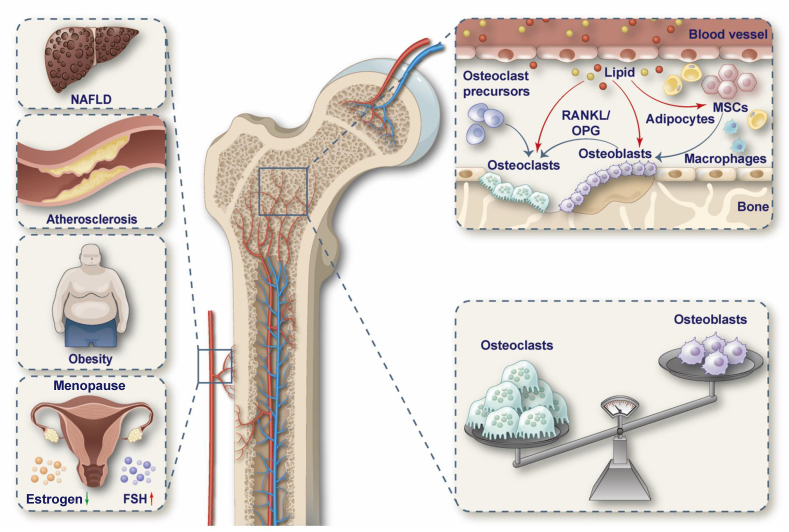
The effect of lipid metabolic diseases on osteoporosis. Many diseases, such as NAFLD, atherosclerosis, obesity, and postmenopause can cause lipid metabolism disorders in the body. Lipid metabolism will affect bone metabolism through blood circulation, mainly including lipid promotion of lipogenic differentiation of MSCs and inhibition of osteoblast differentiation. This makes bone resorption greater than bone formation, leading to osteoporosis. NAFLD, nonalcoholic fatty liver disease; MSCs, mesenchymal stem cells; FSH, follicle-stimulating hormone; RANKL, receptor activator of nuclear factor-kappa B ligand; OPG, osteoprotegerin.
Figure 2
Figure 2
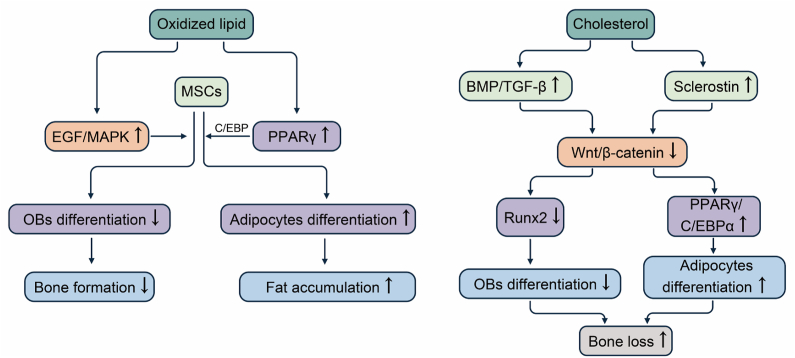
Oxidized lipids and cholesterol affect MSC differentiation. Oxidized lipids bind to and activate the PPARγ/C/EBP signaling pathway, promoting adipocyte differentiation, leading to fat accumulation. It also activates the EGF/MAPK pathway in MSCs and inhibits osteoblast differentiation. Cholesterol activates the BMP/TGF-β pathway and increases serum sclerostin levels, which leads to down-regulation of the Wnt/β-catenin pathway. Low activity of the Wnt pathway down-regulates Runx2 expression, thereby inhibiting osteogenic differentiation. The low-activity Wnt pathway also up-regulates PPARγ and C/EBPα to enhance adipocyte differentiation. MSCs, mesenchymal stem cells; PPARγ, peroxisome proliferator-activated receptor gamma; C/EBP, CCAAT/enhancer binding protein; EGF, epidermal-like growth factors; MAPK, mitogen-activated protein kinase; BMP, bone morphogenetic protein; TGF-β, transforming growth factor β; Runx2, runt-related transcription factor 2.
Figure 3
Figure 3
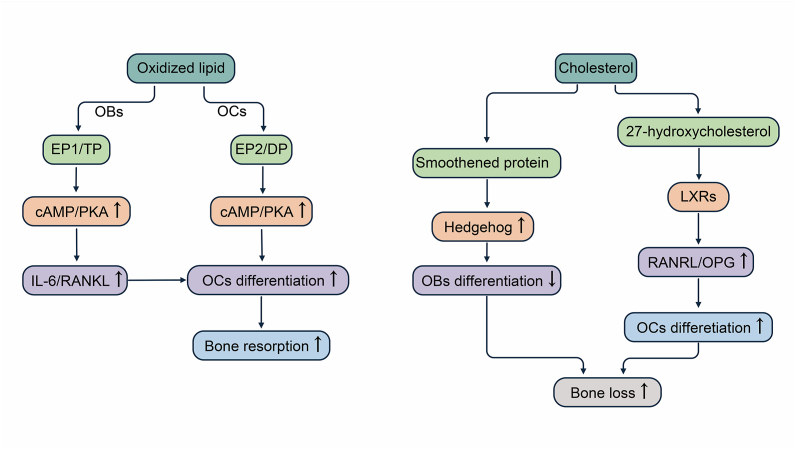
Oxidized lipids and cholesterol break the bone homeostasis between osteogenesis and osteolysis. Oxidized lipids act on the receptor EP1/TP on osteoblasts to induce the cAMP/PKA pathway in osteoblasts, leading to the release of cytokines. Oxidized lipids also act directly on EP2/DP receptors on osteoclasts to promote osteoclast differentiation via the cAMP/PKA pathway. Cholesterol binds to Smoothened protein and activates the Hedgehog signaling pathway, thereby inhibiting osteoblast differentiation. The intermediate metabolite of cholesterol, 27-hydroxycholesterol, acts on liver X receptors (LXRs) and increases the RANKL/OPG ratio, leading to the inhibition of osteoclast differentiation. PKA, cAMP-dependent protein kinase; RANKL, receptor activator of nuclear factor-kappa B ligand; OPG, osteoprotegerin.

References

    1. Zhang Y., Kishi H., Kobayashi S. Add-on therapy with traditional Chinese medicine: an efficacious approach for lipid metabolism disorders. Pharmacol Res. 2018;134:200–211. - PubMed
    1. Chao H.W., Chao S.W., Lin H., Ku H.C., Cheng C.F. Homeostasis of glucose and lipid in non-alcoholic fatty liver disease. Int J Mol Sci. 2019;20(2):298. - PMC - PubMed
    1. Xu X., Liu S., Liu H., et al. Piezo channels: awesome mechanosensitive structures in cellular mechanotransduction and their role in bone. Int J Mol Sci. 2021;22(12):6429. - PMC - PubMed
    1. Vachliotis I.D., Anastasilakis A.D., Goulas A., Goulis D.G., Polyzos S.A. Nonalcoholic fatty liver disease and osteoporosis: a potential association with therapeutic implications. Diabetes Obes Metab. 2022;24(9):1702–1720. - PubMed
    1. Tian L., Yu X. Lipid metabolism disorders and bone dysfunction: interrelated and mutually regulated (review) Mol Med Rep. 2015;12(1):783–794. - PMC - PubMed

LinkOut - more resources