


Bayesian evaluation of sensitivity and specificity of blood culture media and hypoglycemia in sepsis-suspected calves
- PMID: 38526076
- PMCID: PMC11099746
- DOI: 10.1111/jvim.17040
Bayesian evaluation of sensitivity and specificity of blood culture media and hypoglycemia in sepsis-suspected calves
Abstract
Background: Sepsis is a life-threatening condition for which critically important antimicrobials are often indicated. The value of blood culture for sepsis is indisputable, but appropriate guidelines on sampling and interpretation are currently lacking in cattle.
Objective: Compare the diagnostic accuracy of 2 blood culture media (pediatric plus [PP] and plus aerobic [PA]) and hypoglycemia for bacteremia detection. Estimate the contamination risk of blood cultures in critically ill calves.
Animals: One hundred twenty-six critically ill calves, 0 to 114 days.
Methods: Retrospective cross-sectional study in which the performance of PP, PA and hypoglycemia to diagnose sepsis was assessed using a Bayesian latent class model. A Cox proportional hazards model was used to compare time to positivity (TTP). Potential contamination was descriptively analyzed. Isolates were considered relevant when they were; member of the Enterobacterales, isolated from both blood cultures vials, or well-known, significant bovine pathogens.
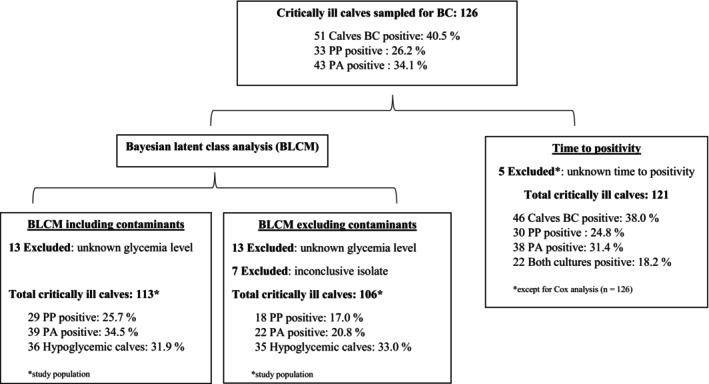
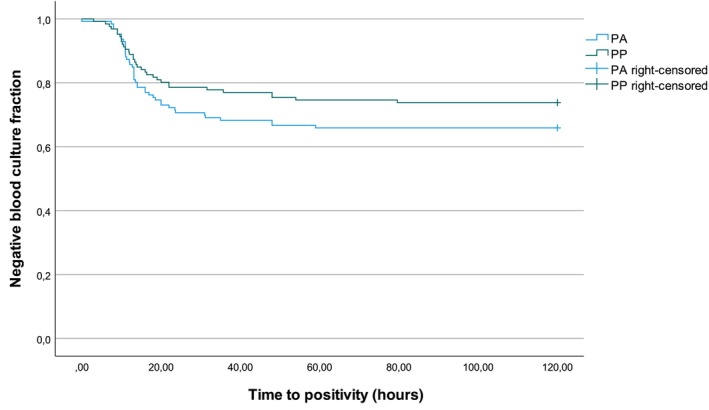
Results: The sensitivities for PP, PA, and hypoglycemia were higher when excluding assumed contaminants; 68.7% (95% credibility interval = 30.5%-93.7%), 87.5% (47.0%-99.5%), and 61.3% (49.7%-72.4%), respectively. Specificity was estimated at 95.1% (82.2%-99.7%), 94.2% (80.7%-99.7%), and 72.4% (64.6%-79.6%), respectively. Out of 121 interpretable samples, 14.9% grew a presumed contaminant in PA, PP, or both. There was no significant difference in the TTP between PA and PP.
Conclusions and clinical importance: PA and PP appear to outperform hypoglycemia as diagnostic tests for sepsis. PA seems most sensitive, but a larger sample size is required to verify this. Accuracy increased greatly after excluding assumed contaminants. The type of culture did not influence TTP or the contamination rate.
Keywords: contamination; hemoculture; rational antimicrobial use; sepsis; volume.
© 2024 The Authors. Journal of Veterinary Internal Medicine published by Wiley Periodicals LLC on behalf of American College of Veterinary Internal Medicine.
Conflict of interest statement
Authors declare no conflict of interest.
Figures
References
-
- Kumar A, Ellis P, Arabi Y, et al. Initiation of inappropriate antimicrobial therapy results in a fivefold reduction of survival in human septic shock. Chest. 2009;136:1237‐1248. - PubMed
-
- Pardon B, Deprez P. Rational antimicrobial therapy for sepsis in cattle in face of the new legislation on critically important antimicrobials. Vlaams Diergenskund Tijds. 2018;87:37‐46.
-
- Roy MF. Sepsis in adults and foals. Vet Clin North Am Equine Pract. 2004;20:41‐61. - PubMed
MeSH terms
Grants and funding
LinkOut - more resources
Full Text Sources
Medical
Miscellaneous
