


Health Hazard Among Shrimp Cultivators in India: A Quantitative Burden of Disease Study
- PMID: 38529100
- PMCID: PMC10962463
- DOI: 10.2147/IJGM.S449364
Health Hazard Among Shrimp Cultivators in India: A Quantitative Burden of Disease Study
Abstract
Background: The lack of focus on the health status of shrimp cultivators by previous studies while the production of shrimp has been rising over the years after the introduction of the blue revolution in India. The present study estimated the burden of diseases among shrimp cultivators in India.
Methods: Primary data were collected by using simple random sampling. The sample size was 357. The classification of diseases were made by using the international classification of diseases, tenth revision (ICD-10), version 2019. Disability-adjusted life years (DALY) were used to measure the health status of shrimp cultivators. DALY is the summation of the burden of disease from mortality and morbidity. Sensitive and uncertainty analysis was used by changing the value of the parameter and method, respectively.
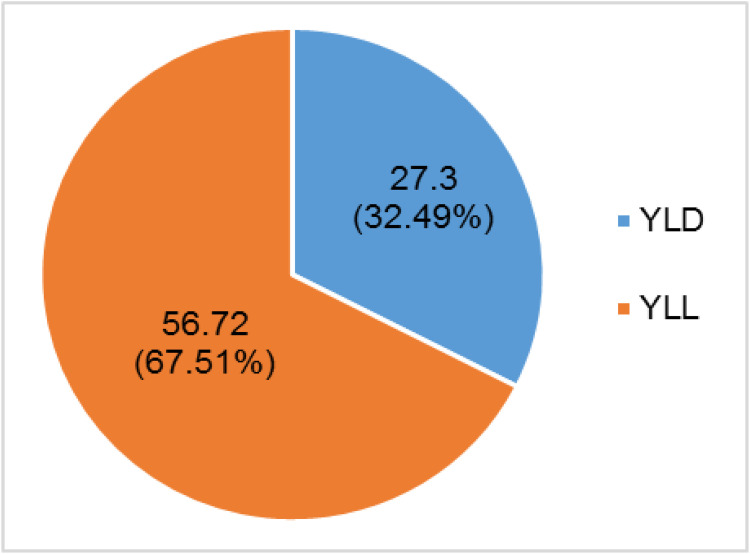
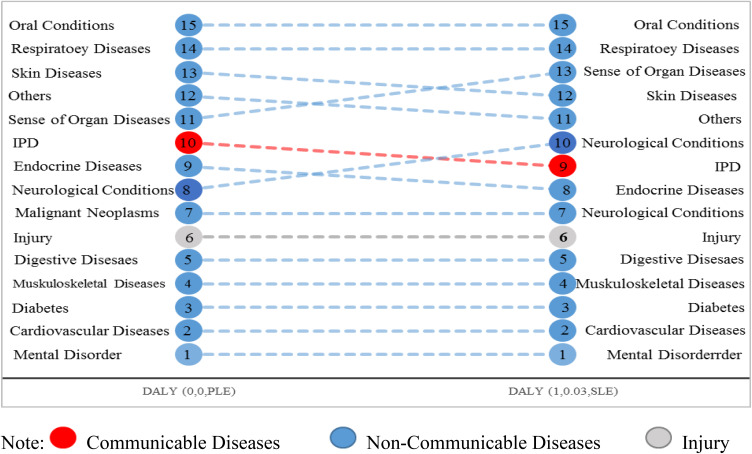
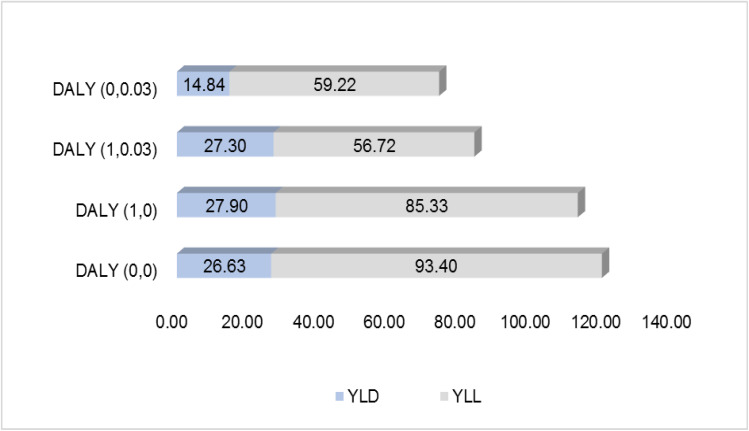
Results: The burden of disease among shrimp cultivators in 2020 ranges from 101.03 DALY based on equal age weightage, without discount rate, and potential life expectancy (DALY0,0,PLE) to 84.02 DALY based on unequal age weightage, discount rate, and standardized life expectancy (DALY1,0.03,SLE). The burden of disease per 100,000 shrimp cultivators was 28,477.74 DALY and 23,600.84 DALY when calculated by using DALY0,0,PLE and DALY1,0.03,SLE method, respectively. The higher burden of diseases from non-communicable diseases was followed by injury and communicable diseases for both methods. The disease burden from mortality was more than two-thirds of the total burden of disease and the rest from morbidity. The burden of disease among shrimp cultivators was sensitive to parameter changes because it changes between 92.10 DALY and 63.03 DALY with the change in the parameter. Uncertainty in the burden of disease among them was due to method variation, which ranges from 120.03 DALY to 74.06 DALY.
Conclusion: The higher burden of non-communicable diseases, and the lower burden of communicable, and injuries per 100,000 shrimp cultivators compared to the national level in India.
Keywords: DALY; India; epidemiology; occupational hazard; shrimp cultivators.
© 2024 Swain et al.
Conflict of interest statement
The authors declare that they have no competing interests in this work.
Figures




References
-
- Saha A. A study of environmental awareness and knowledge of occupational hazard of fishermen in a remote district of India. Ann Pharma Res. 2014;2(2):61–65.
-
- Watterson A, Little D, Young JA, Boyd K, Azim E, Murray F. Towards integration of environmental and health impact assessments for wild capture fishing and farmed fish with particular reference to public health and occupational health dimensions. Int J Environ Res Public Health. 2008;5(4):258–277. doi: 10.3390/ijerph5040258 - DOI - PMC - PubMed
-
- Wu RS. The environmental impact of marine fish culture: towards a sustainable future. Marine Pollution Bulletin. 1995;31(4–12):159–166. doi: 10.1016/0025-326X(95)00100-2 - DOI
LinkOut - more resources
Full Text Sources
