. 2024 Mar 25;10(2):00891-2023.
doi: 10.1183/23120541.00891-2023. eCollection 2024 Mar.

ERS International Congress 2023: highlights from the Airway Diseases Assembly

Affiliations

ERS International Congress 2023: highlights from the Airway Diseases Assembly

Laura Bergantini et al. ERJ Open Res. .

Abstract

In this review, early career and senior members of Assembly 5 (Airway Diseases, Asthma, COPD and Chronic Cough) present key recent findings pertinent to airway diseases that were presented during the European Respiratory Society International Congress 2023 in Milan, Italy, with a particular focus on asthma, COPD, chronic cough and bronchiectasis. During the congress, an increased number of symposia, workshops and abstract presentations were organised. In total, 739 abstracts were submitted for Assembly 5 and the majority of these were presented by early career members. These data highlight the increased interest in this group of respiratory diseases.


Conflict of interest statement

Conflict of interest: A. Bossios reports grants from the Swedish Heart–Lung Foundation and lecture honoraria to his institution, not related to this manuscript. Conflict of interest: G-J. Braunstahl reports honoraria for lectures and consultancy from GlaxoSmithKline, AstraZeneca, Novartis and Sanofi Genzyme, as well as research grants from Sanofi Genzyme, GlaxoSmithKline and AstraZeneca, not related to this manuscript. Conflict of interest: L.H. Conemans reports honoraria from GlaxoSmithKline, Sanofi, AstraZeneca and Vertex, as well as travel support from TEVA and Novartis. Conflict of interest: A.G. Mathioudakis reports lecture fees from GlaxoSmithKline. Conflict of interest: P. Pobeha reports consulting fees from Pfizer; consulting fees and honoraria from Chiesi, Angeliny and Boehringer Ingelheim; and honoraria from Berlin-Chemie. Conflict of interest: F.L.M. Ricciardolo reports grants from Chiesi, Sanofi and GlaxoSmithKline; consulting fees and honoraria from Sanofi Novartis and GlaxoSmithKline; and personal fees from AstraZeneca, Sanofi, GlaxoSmithKline and Novartis. Conflict of interest: F. Schleich reports grants, consulting fees and honoraria from Chiesi, AstraZeneca, GlaxoSmithKline and Novartis, as well as grants and consulting fees from TEVA. Conflict of interest: R.J. Snelgrove reports grants from The Wellcome Trust, Rosetrees Trust and The Stoneygate Trust. Conflict of interest: F. Trinkmann reports grants from AstraZeneca, Bayer Boehringer Ingelheim, Chiesi, Novartis, Roche, BMBF, DZL, Markedsmodningsfonden and E+H Knorr Stiftung; consulting fees and honoraria from AstraZeneca, Berlin-Chemie, Boehringer Ingelheim, Bristol-Myers Squibb, Chiesi, Fisher and Paykel, GlaxoSmithKline, Janssen-Cilag, Merck Healthcare, Novartis, Omron, OM-Pharma, Roche, Sanofi, Aventis and Thorasys; and travel support from AstraZeneca, Actelion, Bayer, Berlin-Chemie, Boehringer Ingelheim, Chiesi, Mundipharma, Novartis, Pfizer and TEVA. Conflict of interest: L. Uller reports lecture fees from AstraZeneca. Conflict of interest: L. Bergantini, J. Baker, F. Lombardi, L.P. Prada Romero and A. Beech have no conflicts of interest.

Figures
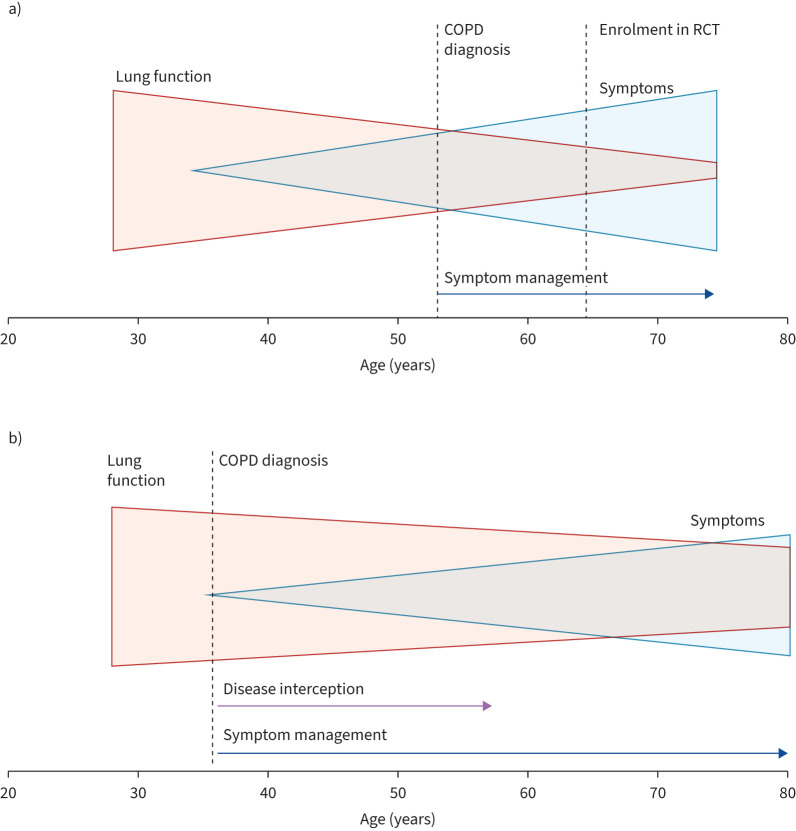
FIGURE 1
FIGURE 1
The importance of early diagnosis in COPD. a) Currently, COPD is diagnosed at a stage when pathological changes are irreversible. This late diagnosis is due to a combination of factors, including the lack of predictive biomarkers, under-recognised clinical symptoms, a long period of disease activity associated with no or minimal symptoms, and reliance on spirometry, an insensitive diagnostic tool. b) Implementation of a more inclusive diagnosis of COPD allows for the detection of early disease before irreversible pathological changes have occurred and could lead to disease interception. RCT: randomised controlled trial. Reproduced from [4] with permission.
FIGURE 2
FIGURE 2
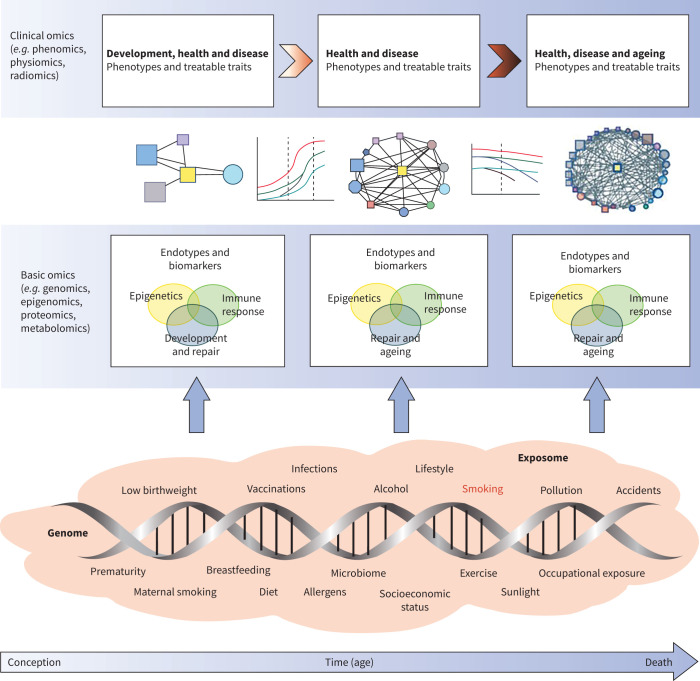
A GETomics approach to understanding COPD and other chronic human diseases. The biological effects and clinical outcomes of different gene–environment interactions depend not only on their specific characteristics, but also on a time dimension, i.e. the age of the individual at which the interaction occurs and the cumulative history of the individual's previously encountered gene–environment interactions. We propose that future research should take a holistic approach that considers the range of interactions between genes (G) and the environment (E) that occur over an individual's lifespan (time, T) in the context of integrated omics approaches (i.e. GETomics) to better understand the pathogenesis of COPD (and probably other chronic human diseases). Examples of environmental factors (the exposome [–59]), from conception to death, are represented by orange shading. The positions of different exposures included in the shaded area are not necessarily related to the time axis (arrow) and might occur several times during the lifespan. At different timepoints, these environmental factors interact with the genomic background of the individual through epigenetic and other mechanisms that might be identified through various basic omics approaches. These interactions induce biological responses (endotypes [60]), such as innate or acquired immune responses, that modulate organ structure (development, maintenance and repair, ageing) and function. Biomarkers for these endotypes are needed to be able to objectively characterise the pathogenic mechanisms linked to altered lung structure and function. Modulation of organ structure and function, represented here by different lung function trajectories associated with development and ageing, determines long-term phenotypes associated with health and disease, which can be explored through clinical omics approaches. Reproduced from [61] with permission.

References

    1. Schleich F, Bikov A, Mathioudakis AG, et al. . Research highlights from the 2018 European Respiratory Society International Congress: airway disease. ERJ Open Res 2019; 5: 00225-2018. doi:10.1183/23120541.00225-2018 - DOI - PMC - PubMed
    1. Lahousse L, Bahmer T, Cuevas-Ocaña S, et al. ERS International Congress, Madrid, 2019: highlights from the Airway Diseases, Asthma and COPD Assembly. ERJ Open Res 2020; 6: 00341-2019. doi:10.1183/23120541.00341-2019 - DOI - PMC - PubMed
    1. Beech A, Portacci A, Herrero-Cortina B, et al. . ERS International Congress 2022: highlights from the Airway Diseases Assembly. ERJ Open Res 2023; 9: 00034-2023. doi:10.1183/23120541.00034-2023 - DOI - PMC - PubMed
    1. Stolz D, Mkorombindo T, Schumann DM, et al. . Towards the elimination of chronic obstructive pulmonary disease: a Lancet Commission. Lancet 2022; 400: 921–972. doi:10.1016/S0140-6736(22)01273-9 - DOI - PMC - PubMed
    1. Trinkmann F, Watz H, Herth FJF. Why do we still cling to spirometry for assessing small airway function? Eur Respir J 2020; 56: 2001071. doi:10.1183/13993003.01071-2020 - DOI - PubMed