


Capi-score: a quantitative algorithm for identifying disease patterns in nailfold videocapillaroscopy
- PMID: 38530791
- PMCID: PMC11637479
- DOI: 10.1093/rheumatology/keae197
Capi-score: a quantitative algorithm for identifying disease patterns in nailfold videocapillaroscopy
Abstract
Objectives: EULAR supports the use of nailfold videocapillaroscopy (NVC) for identifying disease patterns (DPs) associated with SSc and RP. Recently, EULAR proposed an easy-to-manage procedure, a so-called Fast Track algorithm, for differentiating SSc patterns from non-SSc patterns in NVC specimens. However, subjectivity among capillaroscopists remains a limitation. Our aim was to perform a software-based analysis of NVC peculiarities in a cohort of samples from SSc and RP patients and, subsequently, build a Fast Track-inspired algorithm for identifying DPs without the constraint of interobserver variability.
Methods: NVCs were examined by 9 capillaroscopists. Those NVCs whose DPs were consensually agreed upon (by ≥2 out of 3 interobservers) were subsequently analysed using in-house-developed software. The results for each variable were grouped according to the consensually agreed-upon DPs in order to identify useful hallmarks for categorizing them.
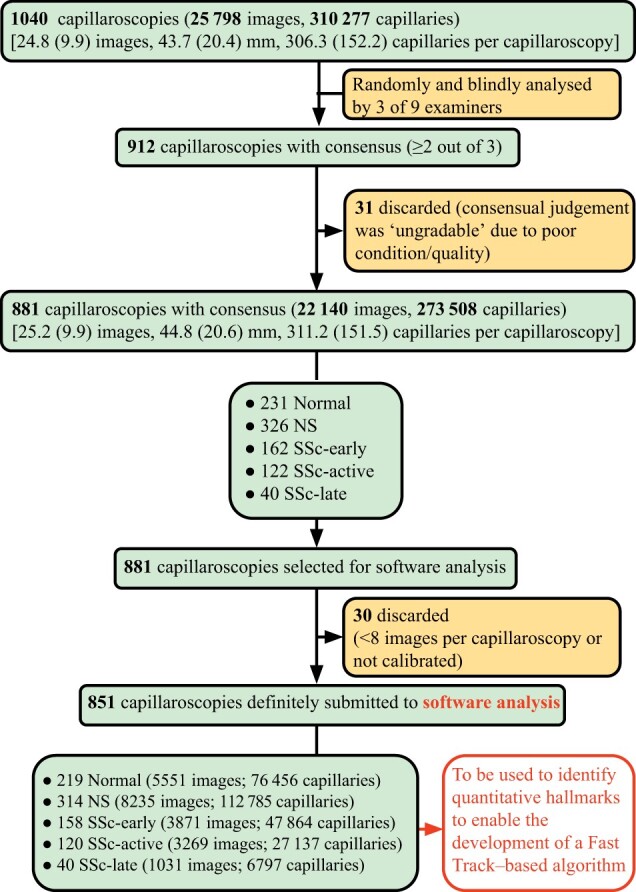
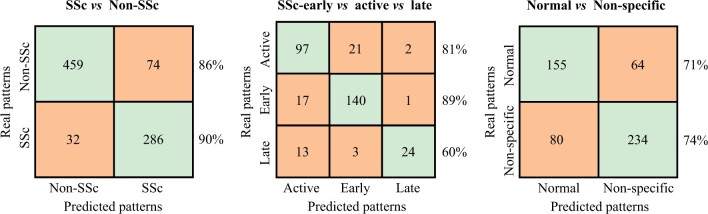
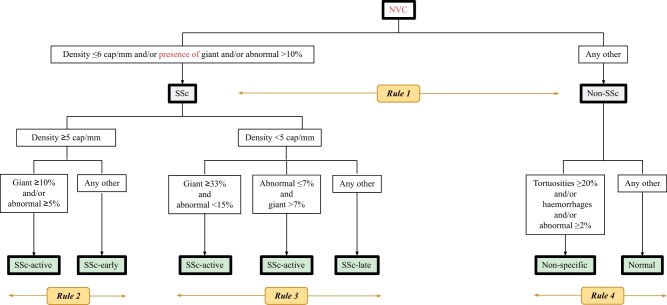
Results: A total of 851 NVCs (21 957 images) whose DPs had been consensually agreed upon were software-analysed. Appropriate cut-offs set for capillary density and percentage of abnormal and giant capillaries, tortuosities and haemorrhages allowed DP categorization and the development of the CAPI-score algorithm. This consisted of four rules: Rule 1, SSc vs non-SSc, accuracy 0.88; Rules 2 and 3, SSc-early vs SSc-active vs SSc-late, accuracy 0.82; Rule 4, non-SSc normal vs non-SSc non-specific, accuracy 0.73. Accuracy improved when the analysis was limited to NVCs whose DPs had achieved full consensus between the interobservers.
Conclusion: The CAPI-score algorithm may become a tool that is useful in assigning DPs by overcoming the limitations of subjectivity.
Keywords: Fast Track algorithm; Raynaud’s phenomenon; nailfold videocapillaroscopy; quantitative; software-based algorithm; systemic sclerosis.
© The Author(s) 2024. Published by Oxford University Press on behalf of the British Society for Rheumatology.
Figures
References
-
- Arvanitaki A, Giannakoulas G, Triantafyllidou E et al. Nailfold videocapillaroscopy: a novel possible surrogate marker for the evaluation of peripheral microangiopathy in pulmonary arterial hypertension. Scand J Rheumatol 2021;50:85–94. - PubMed
-
- Sáez-Comet L, Fanlo-Mateo P, Gracia-Tello B; en representación del GREC (Grupo Español de Capilaroscopias); Otros miembros del Grupo Español de Capilaroscopias. Nailfold capillaroscopy in the Spanish Group of Systemic Autoimmune Diseases (GEAS). Results of an electronic survey. Capilaroscopia periungueal en el Grupo Español de Enfermedades Autoinmunes Sistémicas (GEAS). Resultados de una encuesta electrónica. Med Clin (Barc) 2020;155:509–10. - PubMed
MeSH terms
Grants and funding
LinkOut - more resources
Full Text Sources
Medical
