


Acute Effect in Mechanical Efficiency by Pressure-Volume Loop Analysis after Transcatheter Aortic Valve Implantation
- PMID: 38532811
- PMCID: PMC10961641
- DOI: 10.6515/ACS.202403_40(2).20231230A
Acute Effect in Mechanical Efficiency by Pressure-Volume Loop Analysis after Transcatheter Aortic Valve Implantation
Abstract
Background: This study aimed to evaluate the immediate effect of transcatheter aortic valve implantation (TAVI) on mechanical efficiency.
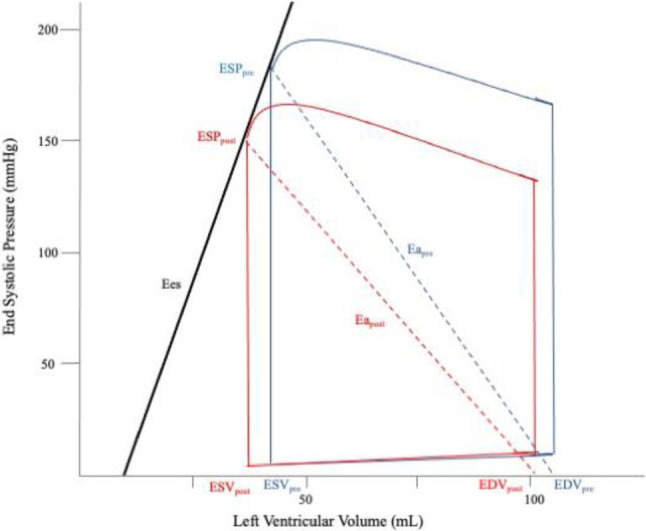
Methods: A total of 46 patients (25 females) with an average age of 83 ± 6.4 years underwent TAVI using the CoreValve system. During the same hospitalization, we conducted a comprehensive comparison of the patients before and after TAVI without inotropic support using echocardiography. The parameters encompassed left ventricular (LV) geometry, valvular load, global LV afterload and ventricular hemodynamics. The analysis using pressure-volume loops enabled the determination of load-independent contractility (Ees) and afterload, in addition to assessing potential energy, stroke work, and mechanical efficiency.
Results: The immediate effect was an augmented aortic valve area accompanied by a reduction in the transvalvular pressure gradient. We observed reductions in left ventricular end-systolic volume and end-diastolic volume, and also reductions in global afterload and end-systolic meridional wall stress. The Ea index decreased, while the Ees index remained relatively stable. We noted increases in stroke volume and systemic arterial compliance, indicating more efficient blood transfer from the ventricle to aorta. These changes contributed to the normalization of ventricular-arterial coupling. In terms of mechanical work of the chamber, we observed significant decreases in potential energy, stroke work, and pressure-volume area. There was an increase in the mechanical efficiency of the chamber.
Conclusions: The TAVI procedure immediately reduced global afterload and improved diastolic compliance of the chamber, resulting in enhanced ventricular function and mechanical efficiency.
Keywords: Mechanical efficiency; Pressure-volume loop; Ventricular-arerial coupling.
Conflict of interest statement
All the authors declare no conflict of interest.
Figures


References
-
- Pibarot P, Dumesnil JG. Hemodynamic and clinical impact of prosthesis-patient mismatch in the aortic valve position and its prevention. J Am Coll Cardiol. 2000;36:1131–1141. - PubMed
-
- Kawaguchi M, Hay I, Kass DA, et al. Combined ventricular systolic and arterial stiffening in patients with heart failure and preserved ejection fraction: implications for systolic and diastolic reserve limitations. Circulation. 2003;107:714–720. - PubMed
-
- Laine H, Katoh C, Luotolahti M, et al. Myocardial oxygen consumption is unchanged but efficiency is reduced in patients with essential hypertension and left ventricular hypertrophy. Circulation. 1999;100:2425–2430. - PubMed
-
- Tasca G, Brunelli F, Cirillo M, et al. Impact of the improvement of valve area achieved with aortic valve replacement on the regression of left ventricular hypertrophy in patients with pure aortic stenosis. Ann Thorac Surg. 2005;79:1291–1296. - PubMed
LinkOut - more resources
Full Text Sources