


PROTAC-Mediated Dual Degradation of BCL-xL and BCL-2 Is a Highly Effective Therapeutic Strategy in Small-Cell Lung Cancer
- PMID: 38534371
- PMCID: PMC10968744
- DOI: 10.3390/cells13060528
PROTAC-Mediated Dual Degradation of BCL-xL and BCL-2 Is a Highly Effective Therapeutic Strategy in Small-Cell Lung Cancer
Abstract
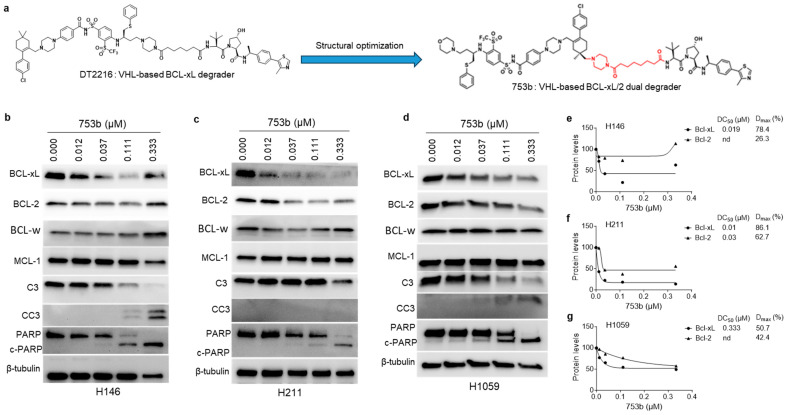
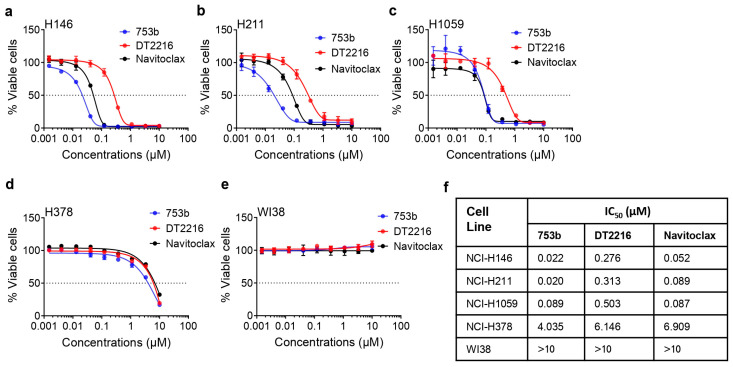
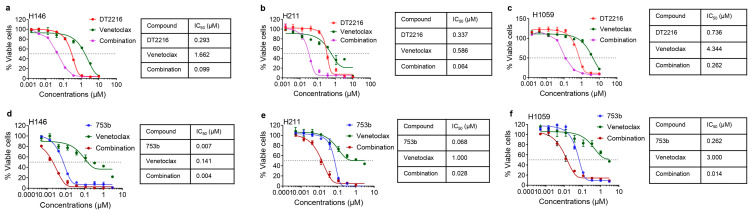
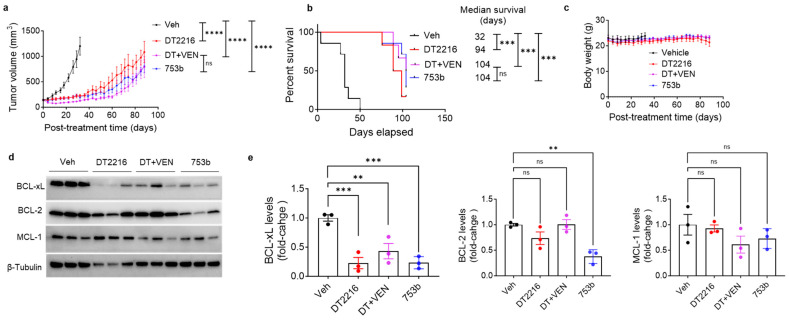
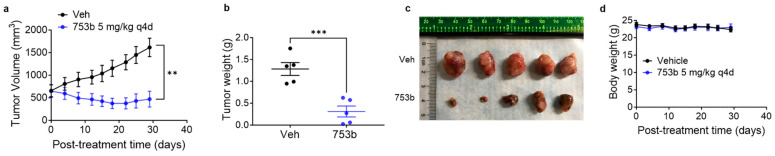
BCL-xL and BCL-2 are validated therapeutic targets in small-cell lung cancer (SCLC). Targeting these proteins with navitoclax (formerly ABT263, a dual BCL-xL/2 inhibitor) induces dose-limiting thrombocytopenia through on-target BCL-xL inhibition in platelets. Therefore, platelet toxicity poses a barrier in advancing the clinical translation of navitoclax. We have developed a strategy to selectively target BCL-xL in tumors, while sparing platelets, by utilizing proteolysis-targeting chimeras (PROTACs) that hijack the cellular ubiquitin proteasome system for target ubiquitination and subsequent degradation. In our previous study, the first-in-class BCL-xL PROTAC, called DT2216, was shown to have synergistic antitumor activities when combined with venetoclax (formerly ABT199, BCL-2-selective inhibitor) in a BCL-xL/2 co-dependent SCLC cell line, NCI-H146 (hereafter referred to as H146), in vitro and in a xenograft model. Guided by these findings, we evaluated our newly developed BCL-xL/2 dual degrader, called 753b, in three BCL-xL/2 co-dependent SCLC cell lines and the H146 xenograft models. 753b was found to degrade both BCL-xL and BCL-2 in these cell lines. Importantly, it was considerably more potent than DT2216, navitoclax, or DT2216 + venetoclax in reducing the viability of BCL-xL/2 co-dependent SCLC cell lines in cell culture. In vivo, 5 mg/kg weekly dosing of 753b was found to lead to significant tumor growth delay, similar to the DT2216 + venetoclax combination in H146 xenografts, by degrading both BCL-xL and BCL-2. Additionally, 753b administration at 5 mg/kg every four days induced tumor regressions. At this dosage, 753b was well tolerated in mice, without observable induction of severe thrombocytopenia as seen with navitoclax, and no evidence of significant changes in mouse body weights. These results suggest that the BCL-xL/2 dual degrader could be an effective and safe therapeutic for a subset of SCLC patients, warranting clinical trials in future.
Keywords: BCL-2; BCL-xL; PROTAC; apoptosis; small-cell lung cancer.
Conflict of interest statement
S.K., P.Z., G.Z. and D.Z. are inventors of several patent applications for use of BCL-xL/2 PROTACs as senolytic and antitumor agents. G.Z. and D.Z. are co-founders of, and have equity in, Dialectic Therapeutics, which develops BCL-xL/2 PROTACs to treat cancer.
Figures
Update of
-
PROTAC-mediated dual degradation of BCL-xL and BCL-2 is a highly effective therapeutic strategy in small-cell lung cancer.bioRxiv [Preprint]. 2024 Mar 1:2024.02.27.582353. doi: 10.1101/2024.02.27.582353. bioRxiv. 2024. Update in: Cells. 2024 Mar 17;13(6):528. doi: 10.3390/cells13060528. PMID: 38464204 Free PMC article. Updated. Preprint.
References
-
- Megyesfalvi Z., Gay C.M., Popper H., Pirker R., Ostoros G., Heeke S., Lang C., Hoetzenecker K., Schwendenwein A., Boettiger K., et al. Clinical insights into small cell lung cancer: Tumor heterogeneity, diagnosis, therapy, and future directions. CA Cancer J. Clin. 2023;73:620–652. doi: 10.3322/caac.21785. - DOI - PubMed
-
- Mathieu L., Shah S., Pai-Scherf L., Larkins E., Vallejo J., Li X., Rodriguez L., Mishra-Kalyani P., Goldberg K.B., Kluetz P.G., et al. FDA Approval Summary: Atezolizumab and Durvalumab in Combination with Platinum-Based Chemotherapy in Extensive Stage Small Cell Lung Cancer. Oncologist. 2021;26:433–438. doi: 10.1002/onco.13752. - DOI - PMC - PubMed
MeSH terms
Substances
Grants and funding
LinkOut - more resources
Full Text Sources
Medical
Research Materials
