Review
. 2024 Mar 11;13(3):251.
doi: 10.3390/antibiotics13030251.

Antimicrobial Properties of Colostrum and Milk

Affiliations
Review

Antimicrobial Properties of Colostrum and Milk

Furkan Eker et al. Antibiotics (Basel). .

Abstract

The growing number of antibiotic resistance genes is putting a strain on the ecosystem and harming human health. In addition, consumers have developed a cautious attitude towards chemical preservatives. Colostrum and milk are excellent sources of antibacterial components that help to strengthen the immunity of the offspring and accelerate the maturation of the immune system. It is possible to study these important defenses of milk and colostrum, such as lactoferrin, lysozyme, immunoglobulins, oligosaccharides, etc., as biotherapeutic agents for the prevention and treatment of numerous infections caused by microbes. Each of these components has different mechanisms and interactions in various places. The compound's mechanisms of action determine where the antibacterial activity appears. The activation of the antibacterial activity of milk and colostrum compounds can start in the infant's mouth during lactation and continue in the gastrointestinal regions. These antibacterial properties possess potential for therapeutic uses. In order to discover new perspectives and methods for the treatment of bacterial infections, additional investigations of the mechanisms of action and potential complexes are required.

Keywords: antibacterial activity; bioactive components; colostrum; immunity; milk.


Conflict of interest statement

The authors declare no conflicts of interest.

Figures
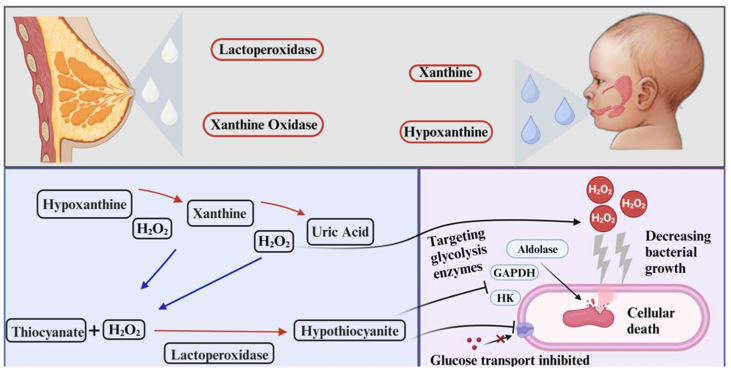
Figure 3
Figure 3
Scheme of XO-LPO systems with their combined antibacterial activity. Breast milk XO can use the substrates found in the neonatal saliva during lactation to initiate the uric acid pathway that creates H2O2 in the process. Excess H2O2 can be involve in the LPOS if the system has the required components. Alternatively, produced H2O2 can directly show antibacterial activity as disrupting bacterial growth. Thereafter, milk LPO creates the antibacterial molecule hypothiocyanite to inhibit bacterial enzymes and transport proteins that cause cellular death of the bacteria [100].
Figure 1
Figure 1
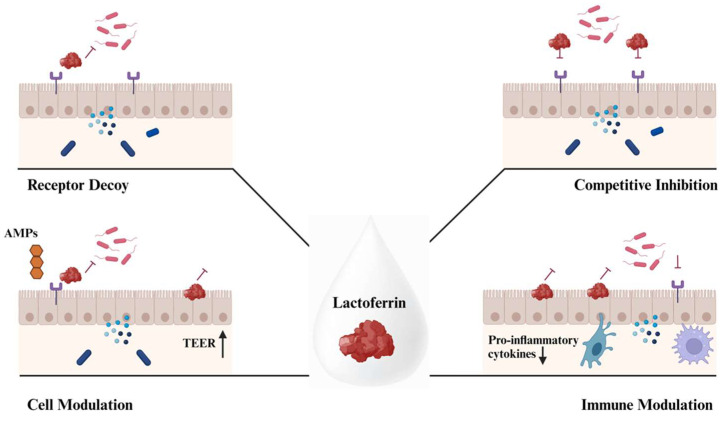
A schematic diagram describing the different modes of action of Lf to combat bacterial infections. Competitive inhibition occurs when Lf binds directly to the cell surface receptors, preventing the pathogen from attaching and blocking the first phase necessary for further colonization. Intestinal barrier modification occurs when Lf alters the surface of epithelial cells, triggering the release of antimicrobial peptides, modifying the carbohydrate components of membrane proteins, increasing the expression of tight junction proteins such as occludin, and strengthening the intestinal barrier. In terms of immunomodulation, Lf controls immunological responses by reducing uncontrolled pro-inflammatory responses that occur during infection, thereby averting damage to epithelial cells. In addition, Lf can bind to and activate phagocytic cells to induce phagocytosis of bacterial particles [33].
Figure 2
Figure 2
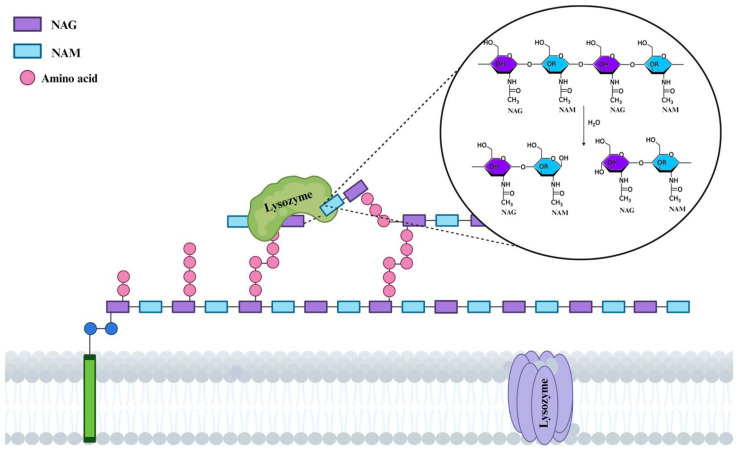
Demonstration of LZ showing enzymatic activity against bacterial cell wall. By cleaving the links between N-acetyl-D-glucosamine and ß-1,4-N-acetylmuramic acid in the peptidoglycan structure of bacterial cell walls, LZ demonstrates enzymatic activity [76].
Figure 4
Figure 4
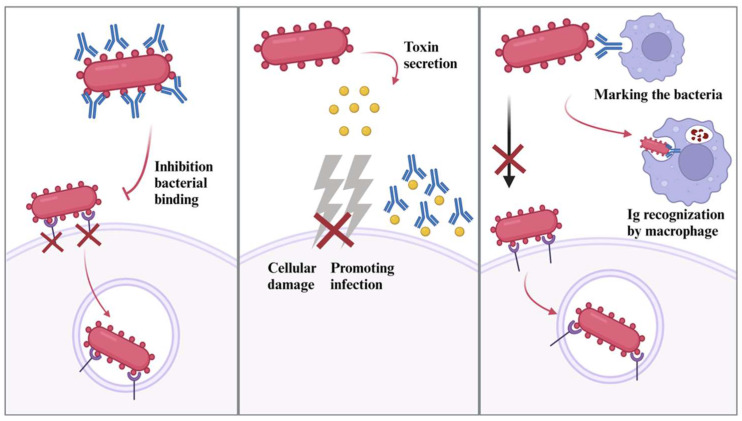
Antibacterial mechanisms of immunoglobulins. Igs can show three main mechanisms during bacterial infection. First, Igs can directly bind to the bacteria and inhibit host cell binding. Secondly, secreted toxins by the bacteria during the infection can be blocked by Igs to prevent cellular damage and host cells’ tendency to infection. Lastly, Igs can bind into bacteria and initiate macrophage recognition by regulating antibody receptor interaction with bacteria and macrophage. The interaction leads to phagocytosis of the bacteria, thus preventing their cellular interaction for infection [117].
Figure 5
Figure 5
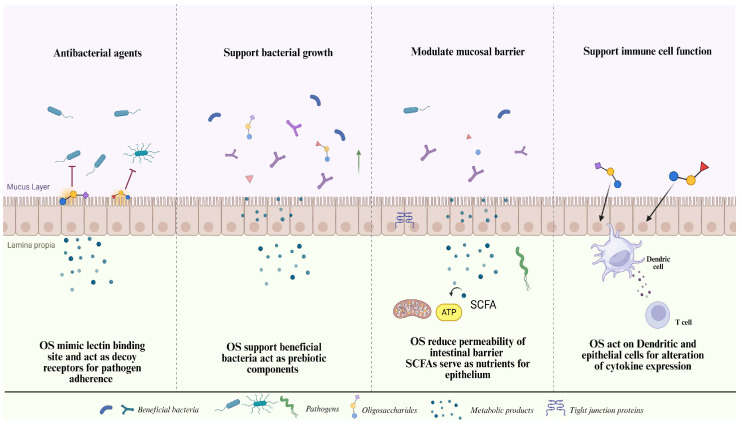
A schematic overview describing the different mechanisms of actions of milk OS to overcome bacterial infections. OS acts as an antimicrobial agent by attaching to toxins and pathogens and by directly interacting with epithelial receptors to stop invasive pathogen adherence and infection. OS serve as prebiotics, favorably promoting bifidobacteria and other intestinal flora. Additionally, protecting against infectious diseases is this selective advantage that bifidobacterial species have over pathogens. The metabolites generated during OS fermentation play a role in the physiology of neonatal development. The primary metabolites of OS fermentation, short-chain fatty acids, affect how intestinal epithelial cells mature. By controlling the production of tight junction proteins and lowering intestinal permeability, OS improves barrier function. OS also changes how proteins are expressed in the mucus and glycocalyx layers. OS contributes to the preservation of immunological homeostasis by interacting with immune cells (DCs, T cells, and B cells) and influencing the expression of pro- and anti-inflammatory cytokines [103,138].

References

    1. Crowley S.V., Kelly A.L., Lucey J.A., O’Mahony J.A. Potential Applications of Non-Bovine Mammalian Milk in Infant Nutrition. In: Park Y.W., Haenlein G.F.W., Wendorff W.L., editors. Handbook of Milk of Non-Bovine Mammals. Wiley; Hoboken, NJ, USA: 2017. pp. 625–654.
    1. Fox P.F., Uniacke-Lowe T., McSweeney P.L.H., O’Mahony J.A. Dairy Chemistry and Biochemistry. Springer; Cham, Switzerland: 2015. Biologically Active Compounds in Milk; pp. 415–497.
    1. Beermann C., Hartung J. Physiological Properties of Milk Ingredients Released by Fermentation. Food Funct. 2013;4:185–199. doi: 10.1039/C2FO30153A. - DOI - PubMed
    1. Thum C., Ozturk G., McNabb W.C., Roy N.C., Leite Nobrega De Moura Bell J.M. Effects of Microwave Processing Conditions on Microbial Safety and Antimicrobial Proteins in Bovine Milk. J. Food Process. Preserv. 2020;44:14348. doi: 10.1111/jfpp.14348. - DOI
    1. Kaplan M., Arslan A., Duman H., Karyelioğlu M., Baydemir B., Günar B.B., Alkan M., Bayraktar A., Tosun H.İ., Ertürk M., et al. Production of Bovine Colostrum for Human Consumption to Improve Health. Front. Pharmacol. 2021;12:796824. doi: 10.3389/fphar.2021.796824. - DOI - PMC - PubMed

LinkOut - more resources