


Wolbachia Infection through Hybridization to Enhance an Incompatible Insect Technique-Based Suppression of Aedes albopictus in Eastern Spain
- PMID: 38535401
- PMCID: PMC10971076
- DOI: 10.3390/insects15030206
Wolbachia Infection through Hybridization to Enhance an Incompatible Insect Technique-Based Suppression of Aedes albopictus in Eastern Spain
Abstract
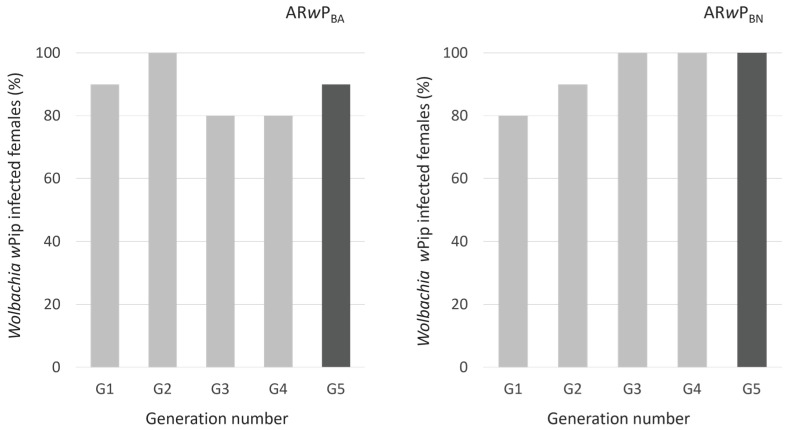
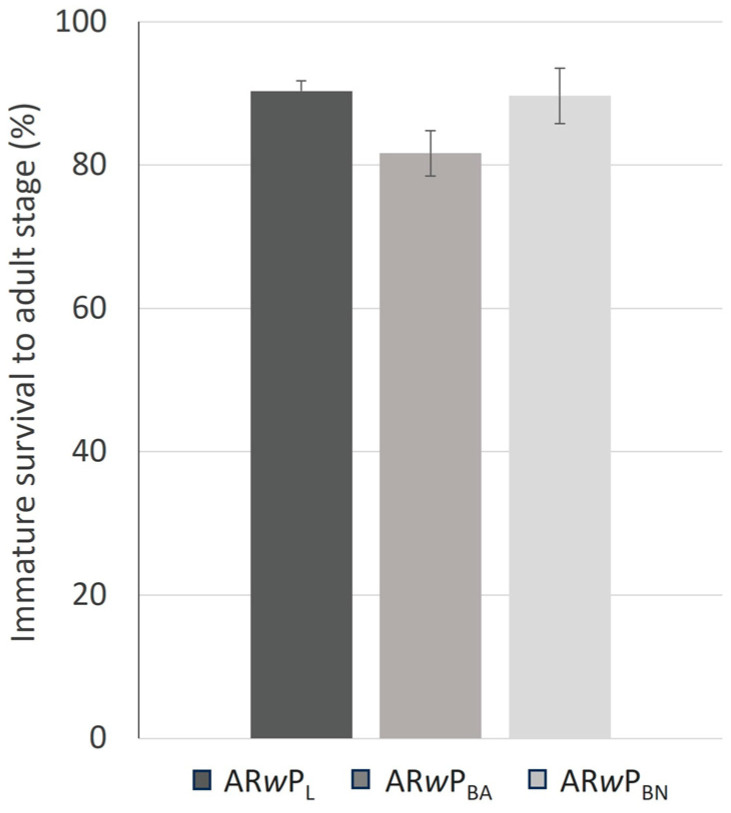
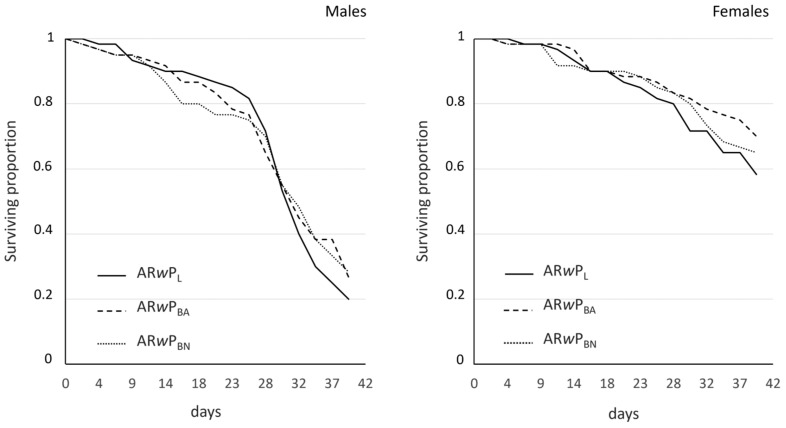
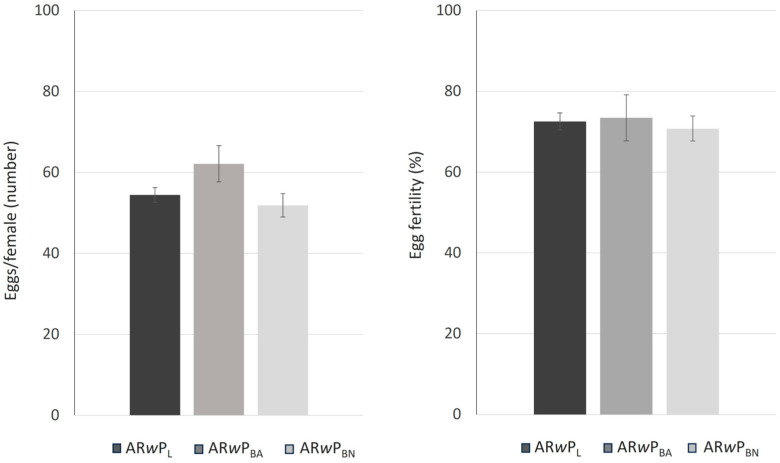
The emergence of insecticide resistance in arbovirus vectors is putting the focus on the development of new strategies for control. In this regard, the exploitation of Wolbachia endosymbionts is receiving increasing attention due to its demonstrated effectiveness in reducing the vectorial capacity of Aedes mosquitoes. Here, we describe the establishment of a naïve Wolbachia infection in a wild Aedes albopictus population of eastern Spain through a hybridization approach to obtain males capable of sterilizing wild females. The obtained lines were compared with the Wolbachia donor, Ae. albopictus ARwP, previously artificially infected with Wolbachia wPip, regarding immature and adult survival, female fecundity, egg fertility, and level of induced sterility. Our results did not show significant differences between lines in any of the biological parameters analyzed, indicating the full suitability of the hybrids to be used as a control tool against Ae. albopictus. In particular, hybrid males induced 99.9% sterility in the eggs of wild females without the need for any preliminary treatment. Being harmless to non-target organisms and the environment, the use of this bacterium for the control of Ae. albopictus deserves further exploration. This is especially relevant in areas such as eastern Spain, where this mosquito species has recently spread and may represent a serious threat due to its competence as a vector for dengue, chikungunya, and Zika viruses.
Keywords: Asian tiger mosquito; Wolbachia; arboviruses; cytoplasmic incompatibility; genetic control; genotyping; hybridization; population suppression.
Conflict of interest statement
The authors declare no conflicts of interest.
Figures
References
-
- WHO (World Health Organization) Global Vector Control Response 2017–2030. World Health Organization; Geneva, Switzerland: 2017. [(accessed on 1 March 2024)]. Licence: CC BY-NC-SA 3.0 IGO. Available online: http://www.jstor.org/stable/resrep35629.
-
- Tozan Y., Branch O.L.H., Rocklöv J. Vector-borne diseases in a changing climate and world. In: Pinkerton K.E., Rom W.N., editors. Climate Change and Global Public Health. Humana; Cham, Switzerland: Totowa, NJ, USA: 2021. pp. 253–271. Respiratory Medicine.
-
- Roiz D., Wilson A.L., Scott T.W., Fonseca D.M., Jourdain F., Müller P., Velayudhan R., Corbel V. Integrated Aedes management for the control of Aedes-borne diseases. PLoS Negl. Trop. Dis. 2018;12:e0006845. doi: 10.1371/journal.pntd.0010310. Erratum in PLoS Negl. Trop. Dis. 2022, 16, e0010310. - DOI - PMC - PubMed
-
- WHO (World Health Organization) Global Vector Control Response: Progress in Planning and Implementation. World Health Organization; Geneva, Switzerland: 2020. [(accessed on 1 March 2024)]. Licence: CC BY-NC-SA 3.0 IGO. Available online: https://www.who.int/publications/i/item/9789240007987.
LinkOut - more resources
Full Text Sources
