


Better off with you: Exploring congruity between caregivers' and Veterans' experience of efforts to cope with suicide
- PMID: 38536260
- PMCID: PMC10013249
- DOI: 10.1080/08995605.2021.1959222
Better off with you: Exploring congruity between caregivers' and Veterans' experience of efforts to cope with suicide
Abstract
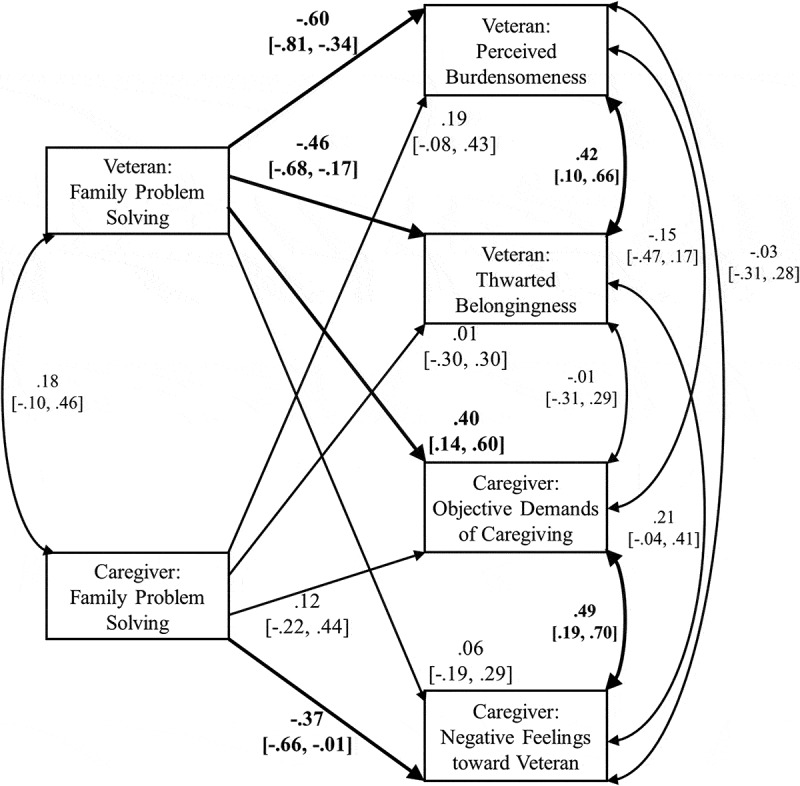
The interpersonal theory of suicide posits people are more likely to consider suicide when they perceive themselves as alone and as a burden. However, there is limited research on whether these self-perceptions reflect caregiver experiences. As part of a larger study of collaborative safety planning, 43 Veteran/caregiver dyads (N = 86 individuals) completed measures of belongingness and burdensomeness, caregiver burden, family problem solving, and suicide-related coping. We conducted dyad-level actor interdependence models allowing two types of social coping (i.e., general problem solving and suicide-specific coping) to predict Veteran's self-views and caregiver interpersonal perceptions. Results suggested that Veteran social coping predicted lower Veteran thwarted belonginess and burdensomeness and caregiver involvement in problem solving was similarly associated with their own lower caregiver emotional burden. But examination of cross-partner effects demonstrated that greater Veteran coping was associated with greater time burden for caregivers. Findings suggest that social coping is associated with positive perceptions at the individual level (i.e., Veterans and caregivers to themselves) but does not indicate positive effects at the partner level. Clinicians working with Veterans may wish to involve supports in care to encourage effective collaboration that meets both caregiver/recipient needs.
Keywords: Veteran; caregiver burden; coping; interpersonal theory of suicide; perceived burdensomeness.
This work was authored as part of the Contributor’s official duties as an Employee of the United States Government and is therefore a work of the United States Government. In accordance with 17 USC. 105, no copyright protection is available for such works under US Law.
Conflict of interest statement
No potential conflict of interest was reported by the author(s).
Figures
References
-
- Bryan, C. J., Mintz, J., Clemans, T. A., Leeson, B., Burch, T. S., Williams, S. R., … Rudd, M. D. (2017). Effect of crisis response planning vs. contracts for safety on suicide risk in US army soldiers: A randomized clinical trial. Journal of Affective Disorders, 212, 64–72. doi: 10.1016/j.jad.2017.01.028 - DOI - PubMed
-
- Centers for Disease Control and Prevention . (2019). Web-based Injury Statistics Query and Reporting System (WISQARS). Retrieved from www.cdc.gov/injury/wisqars/index.html
-
- Christensen, A., Doss, B. D., & Jacobson, N. S. (2020). Integrative behavioral couple therapy: A therapist’s guide to creating acceptance and change. New York, NY: WW Norton & Company.
Grants and funding
LinkOut - more resources
Full Text Sources
Research Materials
