


The role of coast guard courage in the relationship between personality and organizational commitment
- PMID: 38536265
- PMCID: PMC10013258
- DOI: 10.1080/08995605.2022.2057788
The role of coast guard courage in the relationship between personality and organizational commitment
Abstract
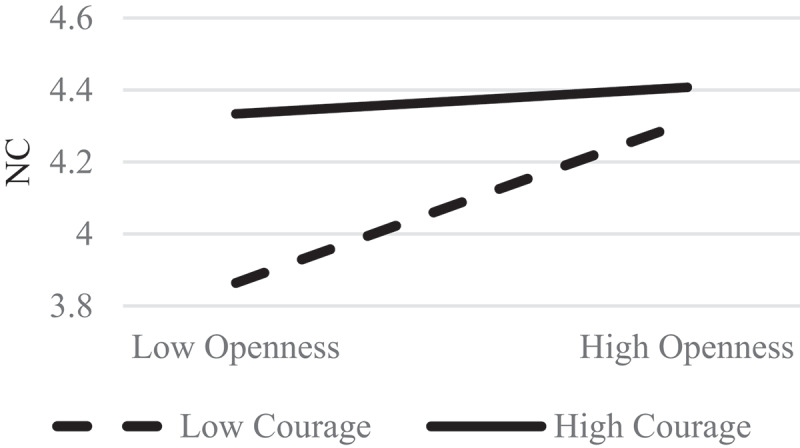
Courageous behaviors are risky and devoted actions performed primarily for the benefit of others, and they closely relate to many beneficial organizational (e.g., commitment) outcomes. Even courage plays a crucial role in many professions' results; investigating it in military content is a primary issue. This paper examined the relationship between the Big Five personality traits and organizational commitment and the moderator role of courage in this relationship by focusing on coast guards. Cross-sectional survey data (n = 512) were obtained from employees and analyzed using the least square method regression analysis. The results showed that the Conscientiousness trait is a strong antecedent for organizational commitment, and courage emerges as a moderator for the relationship between personality traits and organizational commitment. High courage strengthened the effect of Conscientiousness-Emotional Stability on normative commitment, Extraversion-Agreeableness on affective commitment, Openness on continuance, and normative commitment. Practitioners might recruit high conscientious, agreeable, emotionally stable, and courageous candidates considering correlational and moderating effects.
Keywords: Big-Five; Courage; coast guards; commitment; military; non-western culture.
© 2022 Division 19 (Society for Military Psychology) of the American Psychological Association.
Conflict of interest statement
No potential conflict of interest was reported by the author(s).
Figures


References
-
- Allen, N. J. (2003). Organizational commitment in the military: A discussion of theory and practice. Military Psychology, 15(3), 237–253. 10.1207/S15327876MP1503_06 - DOI
-
- Barrick, M. R., & Mount, M. K. (1991). The big five personality dimensions and job performance: A meta-analysis. Personnel Psychology, 44(1), 1–26. 10.1111/j.1744-6570.1991.tb00688.x - DOI
-
- Barrick, M. R., Mount, M. K., & Strauss, J. P. (1993). Conscientiousness and performance of sales representatives: Test of the mediating effects of goal setting. Journal of Applied Psychology, 78(5), 715–722. 10.1037/0021-9010.78.5.715 - DOI
-
- Becker, H. S. (1960). Notes on the concept of commitment. American Journal of Sociology, 66(1), 32–40. 10.1086/222820 - DOI
LinkOut - more resources
Full Text Sources
