


Effects of psychological stress on the emission of volatile organic compounds from the skin
- PMID: 38538690
- PMCID: PMC10973438
- DOI: 10.1038/s41598-024-57967-2
Effects of psychological stress on the emission of volatile organic compounds from the skin
Abstract
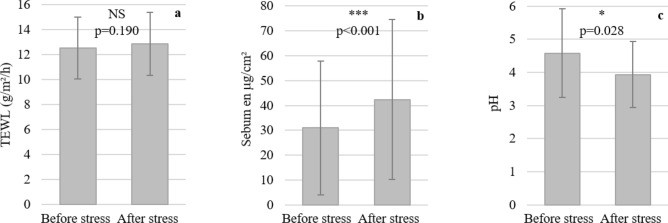
Thirty-five women were included in a clinical study to characterize the volatile organic compounds (VOCs) emitted by the skin during exposure to psychological stress. An original silicon-based polymeric phase was used for VOC sampling on the forehead before and after stress induction. Cognitive stress was induced using specialized software that included a chronometer for semantic and arithmetic tasks. Assessment of stress was monitored using a State-trait anxiety inventory questionnaire, analysis of participants' verbal expressions and clinical measurements. Identification and relative quantification of VOCs were performed by gas chromatography-mass spectrometry. Stress induction was validated by a significant increase in state-anxiety as indicated by the questionnaire, modifications in electrodermal activity measurements and the expression of stress verbatims. In parallel, a sebum production increase and a skin pH decrease were observed. A total of 198 VOCs with different potential sources were identified. They were categorized in 5 groups: probable cosmetic composition, VOCs produced by the body or its microbiota, environmental origin, and dietary intake. In our qualitative statistical approach, three VOCs were found to be correlated with stress induction and 14 compounds showed significance in the paired Wilcoxon test. Fatty-acyls derived from lipids were predominantly identified as well as ethylbenzenes.
© 2024. The Author(s).
Conflict of interest statement
The authors declare no competing interests.
Figures


References
-
- Raquel C. Volatilome metabolomics and databases, recent advances and needs. Curr. Metabolom. 2017;5:79–89.
MeSH terms
Substances
LinkOut - more resources
Full Text Sources
