. 2024 Mar 9;13(6):840.
doi: 10.3390/foods13060840.

Ethanol Extracts from Torreya grandis Seed Have Potential to Reduce Hyperuricemia in Mouse Models by Influencing Purine Metabolism

Affiliations

Ethanol Extracts from Torreya grandis Seed Have Potential to Reduce Hyperuricemia in Mouse Models by Influencing Purine Metabolism

Jianghui Yao et al. Foods. .

Abstract

The purpose of this study was to evaluate the efficacy of ethanol extracts from Torreya grandis seed (EST) as a functional food in hyperuricemia mice. We investigated EST by analyzing its chemical composition. Using a mouse model of hyperuricemia induced by potassium oxonate (PO), we evaluated the effects of EST on uric acid (UA) production, inflammation-related cytokines, and gut microbiota diversity. The primary constituents of EST consist of various flavonoids and phenolic compounds known for their antioxidant and anti-inflammatory properties in vitro. Notably, our findings demonstrate that EST significantly reduced UA levels in hyperuricemia mice by 71.9%, which is comparable to the effects observed with xanthine treatment. Moreover, EST exhibited an inhibitory effect on xanthine oxidase activity in mouse liver, with an IC50 value of 20.90 μg/mL (36%). EST also provided protective effects to the mouse kidneys by modulating oxidative stress and inflammation in damaged tissues, while also enhancing UA excretion. Finally, EST influenced the composition of the intestinal microbiota, increasing the relative abundance of beneficial bacteria such as Akkermansia muciniphila, Corynebacterium parvum, Enterorhabdus, Muribaculaceae, Marvinbryantia, and Blautia. In summary, our research unveils additional functions of Torreya grandis and offers new insights into the future of managing hyperuricemia.

Keywords: ROS; Torreya grandis; functional food ingredients; gut microbiota; uric acid.


Conflict of interest statement

The authors declare that the research was conducted in the absence of any commercial or financial relationships that could be construed as potential conflicts of interest.

Figures
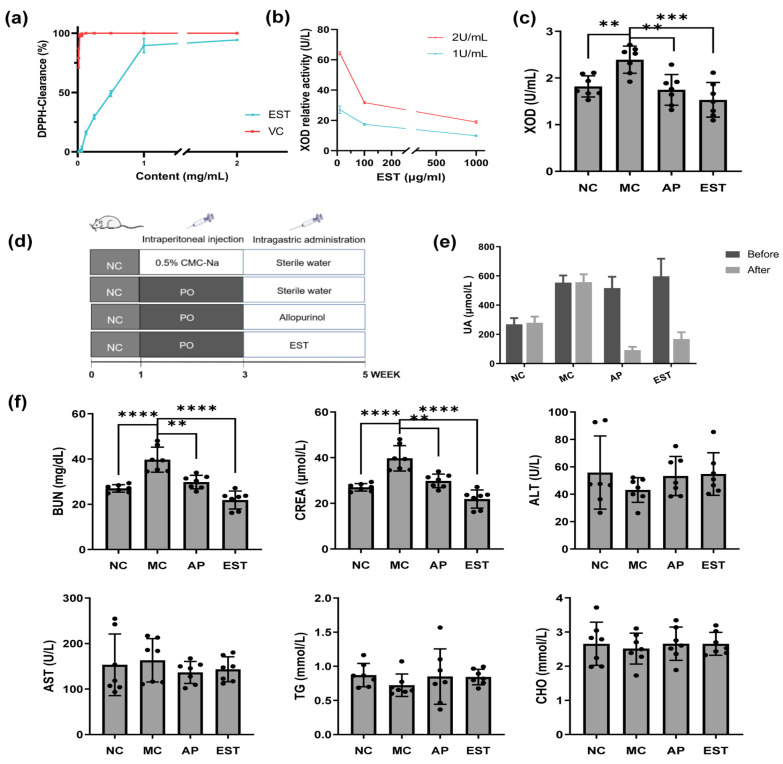
Figure 1
Figure 1
Effects of EST in vivo and in vitro. Antioxidant activities of the ethanol extract from Torreya grandis seeds. (a) DPPH radical scavenging activity; (b) xanthine oxidase activity inhibition ability of EST in vitro; (c) xanthine oxidase activity inhibition ability of EST in liver; (d) graphical presentation of the experimental design; (e) uric acid level of the ethanol extract from the seeds of Torreya grandis in PO-induced hyperuricemia mice, with the results presented as the mean ± SEM of eight mice; and (f) EST and allopurinol impact on BUN, CREA, ALT, AST, CHO, and TG levels. The * marked by different letters represents significantly different results at the level of ** p < 0.01, and *** p < 0.001, **** p < 0.0001, which represents the MC group vs. other groups according to one-way ANOVA followed by the Bonferroni multiple comparison test.
Figure 2
Figure 2
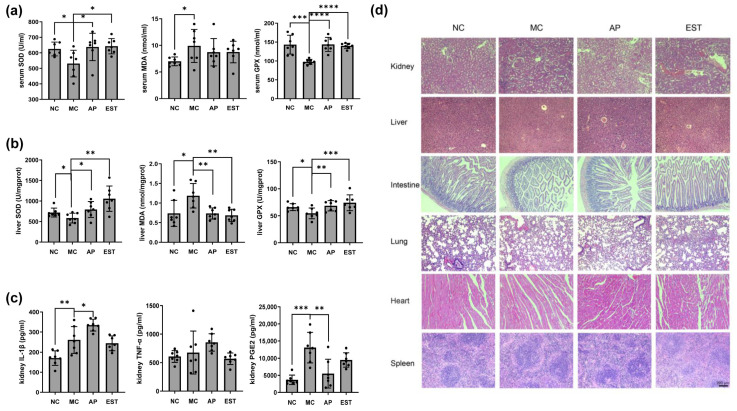
Effects of EST on the physiological status of mice with hyperuricemia. (a) EST and allopurinol effects on SOD, MDA, and GSH-Px levels in serum; (b) EST and allopurinol effects on SOD, MDA, and GSH-Px levels in liver; (c) EST and allopurinol effects on kidney IL-1β, TNF-α, and PGE2 level; and (d) hematoxylin and eosin-stained section of mouse organ compared with four groups (using optical microscope (Leica Microsystems CMS GmbH, Wetzlar, Germany) original magnification ×100). The * marked by different letters represents significantly different results at the level of * p < 0.05, ** p < 0.01, and *** p < 0.001, **** p < 0.0001, which represents the MC group vs. the other groups according to the one-way ANOVA followed by the Bonferroni multiple comparison test.
Figure 3
Figure 3
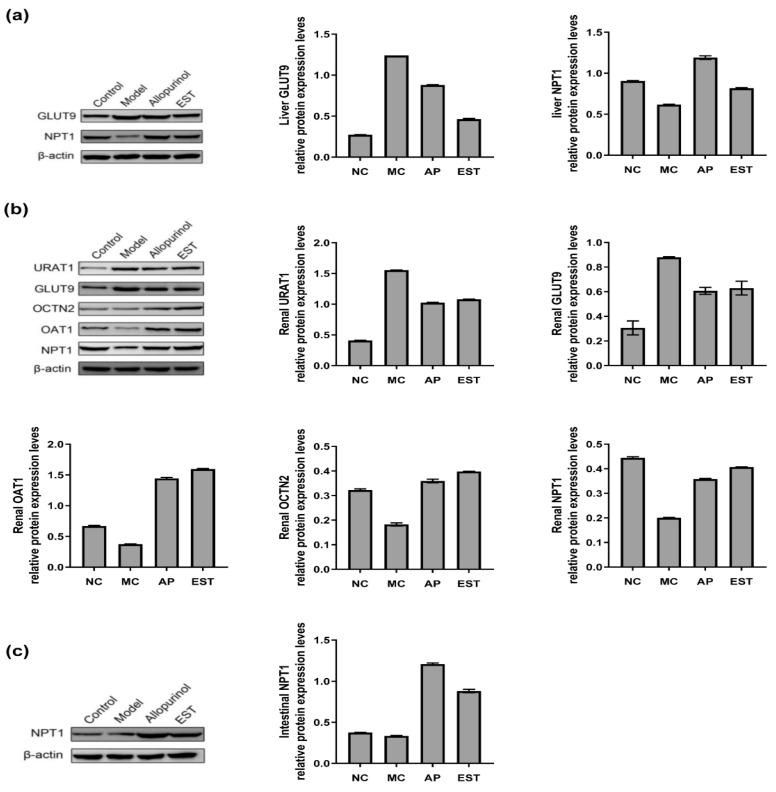
EST affects transport protein expression in PO-induced hyperuricemia. (a) EST treatment effects on protein expression of mouse GLUT9 and NPT1 in isolated liver tissues; (b) EST treatment effects on protein expression of mouse URAT1, GLUT9, OCTN2, OAT1, and NPT1 in isolated renal tissues; and (c) EST treatment effects on protein expression of mouse NPT1 in isolated intestine tissues. Data are presented as mean ± SEM (n = 3).
Figure 4
Figure 4
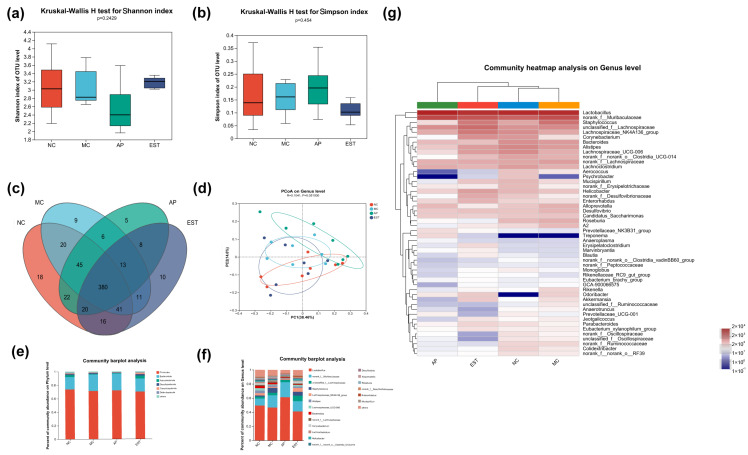
Analysis of intestinal flora composition in mice. (a) Shannon index of four groups; (b) Simpson index of four groups; (c) Venn diagram of four groups; (d) PCA plot based on genus level; (e) relative community abundance of flora at the phylum level; (f) relative community abundance of flora at the genus level; and (g) community heatmap at the genus level.
Figure 5
Figure 5
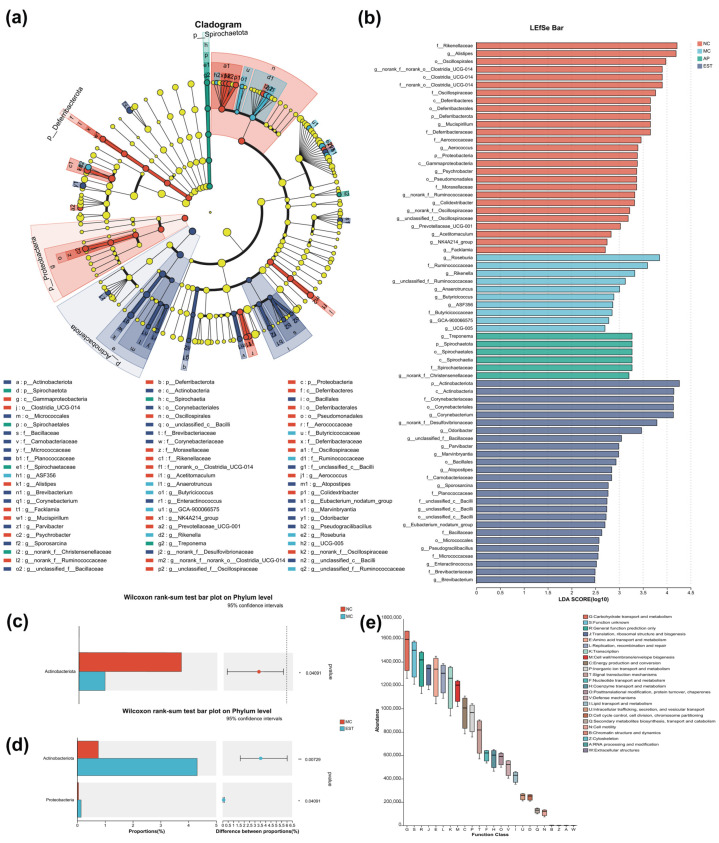
Analysis of the variability in intestinal flora in mice. (a) Evolutionary branching diagram for LEfSe analysis; (b) histogram of LDA distribution for LEfSe analysis; (c) comparison of bacterial microbiota between NC and MC at the genus level; and (d) comparison of bacterial microbiota between MC and EST at the genus level (* p < 0.05, ** p < 0.01). (e) The COG function of OTUs was determined as follows: G: transport and metabolism of carbohydrates; E: transport and metabolism of amino acids; P: transport and metabolism of inorganic ions; J: translation, ribosome structure and biogenesis; L: replication, recombination and repair; K: transcription; M: biogenesis of cell wall and membrane; C: energy production and conversion; and T: signal transduction mechanism.

References

    1. Feng S., Wu S., Xie F., Yang C.S., Shao P. Natural compounds lower uric acid levels and hyperuricemia: Molecular mechanisms and prospective. Trends Food Sci. Technol. 2022;123:87–102. doi: 10.1016/j.tifs.2022.03.002. - DOI
    1. Bardin T., Richette P. Definition of hyperuricemia and gouty conditions. Curr. Opin. Rheumatol. 2014;26:186–191. doi: 10.1097/BOR.0000000000000028. - DOI - PubMed
    1. Lin Z., Chen H., Lan Q., Chen Y., Liao W., Guo X. Composite Dietary Antioxidant Index Is Negatively Associated with Hyperuricemia in US Adults: An Analysis of NHANES 2007–2018. Int. J. Endocrinol. 2023;2023:6680229. doi: 10.1155/2023/6680229. - DOI - PMC - PubMed
    1. Almuqrin A., Alshuweishi Y.A., Alfaifi M., Daghistani H., Al-Sheikh Y.A., Alfhili M.A. Prevalence and association of hyperuricemia with liver function in Saudi Arabia: A large cross-sectional study. Ann. Saudi Med. 2024;44:18–25. doi: 10.5144/0256-4947.2024.18. - DOI - PMC - PubMed
    1. Otaki Y., Konta T., Ichikawa K., Fujimoto S., Iseki K., Moriyama T., Yamagata K., Tsuruya K., Narita I., Kondo M., et al. Possible burden of hyperuricaemia on mortality in a community-based population: A large-scale cohort study. Sci. Rep. 2021;11:8999. doi: 10.1038/s41598-021-88631-8. - DOI - PMC - PubMed