


Identification of Characteristic Bioactive Compounds in Silkie Chickens, Their Effects on Meat Quality, and Their Gene Regulatory Network
- PMID: 38540959
- PMCID: PMC10970468
- DOI: 10.3390/foods13060969
Identification of Characteristic Bioactive Compounds in Silkie Chickens, Their Effects on Meat Quality, and Their Gene Regulatory Network
Abstract
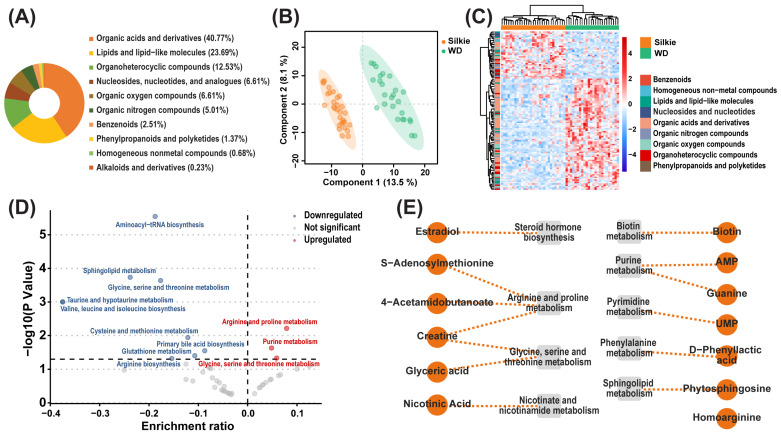
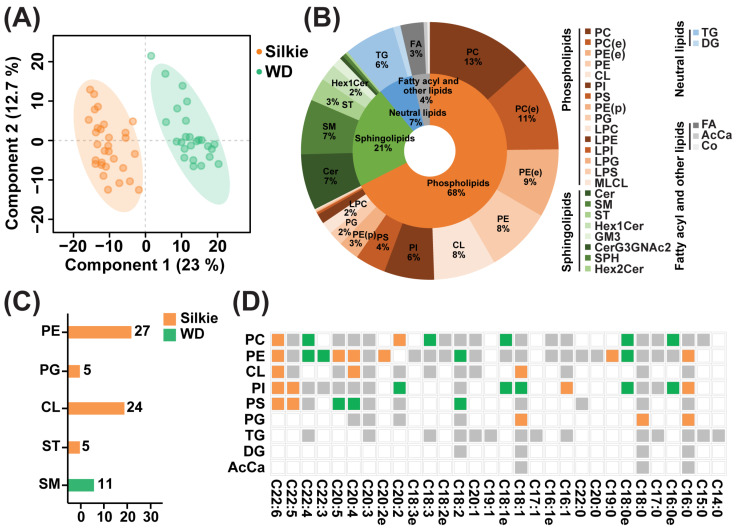
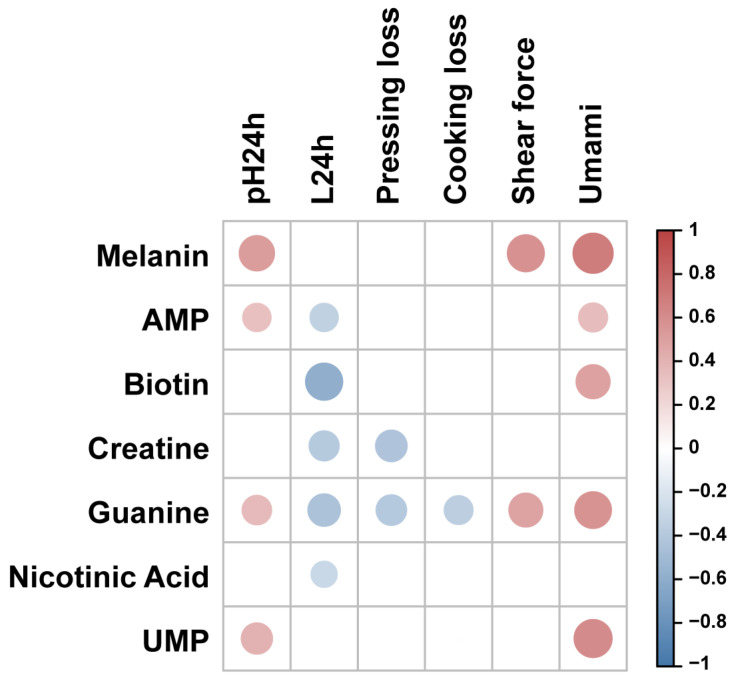
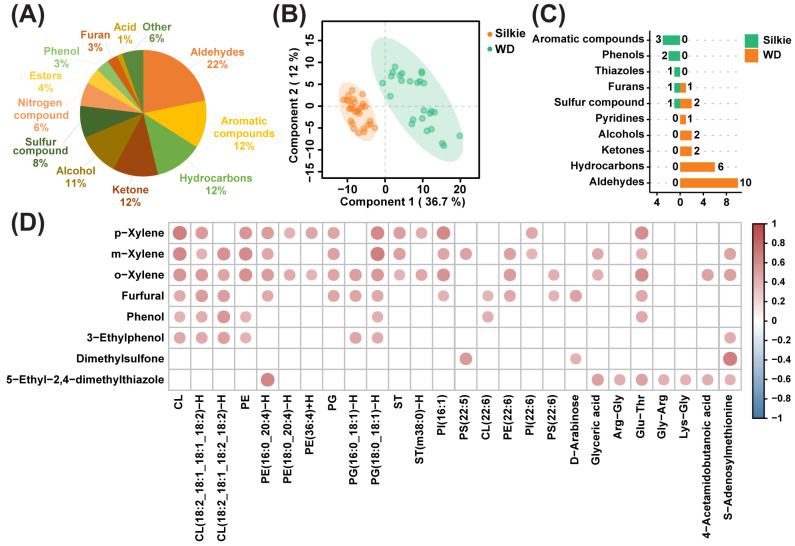
Silkie chicken, an important chicken breed with high medicinal and nutritional value, has a long history of being used as a dietary supplement in China. However, the compounds with health-promoting effects in Silkie chickens remain unclear. In the present study, we conducted a comprehensive analysis of metabolic and lipidomic profiles to identify the characteristic bioactive compounds in Silkie chickens, using a common chicken breed as control. The results showed that the levels of 13 metabolites including estradiol, four lipid subclasses including cardiolipin (CL), eight lipid molecules, and three fatty acids including docosahexaenoic acid (C22:6) were significantly increased in Silkie chickens, which have physiological activities such as resisting chronic diseases and improving cognition. These characteristic bioactive compounds have effects on meat quality characteristics, including improving its water-holding capacity and umami taste and increasing the content of aromatic compounds and phenols. The differentially expressed genes (DEGs) between the two chicken breeds revealed the regulatory network for these characteristic bioactive compounds. Fifteen DEGs, including HSD17B1, are involved in the synthesis of characteristic metabolites. Eleven DEGs, including ELOVL2, were involved in the synthesis and transport of characteristic lipids and fatty acids. In summary, we identified characteristic bioactive compounds in Silkie chickens, and analyzed their effects on meat quality characteristics. This study provided important insight into Silkie chicken meat as a functional food.
Keywords: characteristic lipid; characteristic metabolite; gene regulatory network; meat quality; silkie chicken; volatile flavor compound.
Conflict of interest statement
The authors declare no conflicts of interest.
Figures
References
-
- Liu J.-H., Tian Y.-G., Wang Y., Nie S.-P., Xie M.-Y., Zhu S., Wang C.-Y., Zhang P. Characterization and in vitro antioxidation of papain hydrolysate from black-bone silky fowl (Gallus gallus domesticus Brisson) muscle and its fractions. Food Res. Int. 2011;44:133–138. doi: 10.1016/j.foodres.2010.10.050. - DOI
-
- Qiu Y., Ying J., Yan F., Yu H., Zhao Y., Li H., Xia S., Chen J., Zhu J. Novel antiosteoporotic peptides purified from protein hydrolysates of taihe black-boned silky fowl: By larval zebrafish model and molecular docking. Food Res. Int. 2023;169:112850. doi: 10.1016/j.foodres.2023.112850. - DOI - PubMed
-
- Tu Y.-G., Sun Y.-Z., Tian Y.-G., Xie M.-Y., Chen J. Physicochemical characterisation and antioxidant activity of melanin from the muscles of Taihe Black-bone silky fowl (Gallus gallus domesticus Brisson) Food Chem. 2009;114:1345–1350. doi: 10.1016/j.foodchem.2008.11.015. - DOI
-
- Yang X., Tang C., Zhao Q., Jia Y., Qin Y., Zhang J. Melanin: A promising source of functional food ingredient. J. Funct. Foods. 2023;105:105574. doi: 10.1016/j.jff.2023.105574. - DOI
-
- Tian Y., Xie M., Wang W., Wu H., Fu Z., Lin L. Determination of carnosine in Black-Bone Silky Fowl (Gallus gallus domesticus Brisson) and common chicken by HPLC. Eur. Food Res. Technol. 2007;226:311. doi: 10.1007/s00217-006-0528-1. - DOI
Grants and funding
LinkOut - more resources
Full Text Sources
