


Delivery of Probiotics with Cellulose-Based Films and Their Food Applications
- PMID: 38543398
- PMCID: PMC10976014
- DOI: 10.3390/polym16060794
Delivery of Probiotics with Cellulose-Based Films and Their Food Applications
Abstract
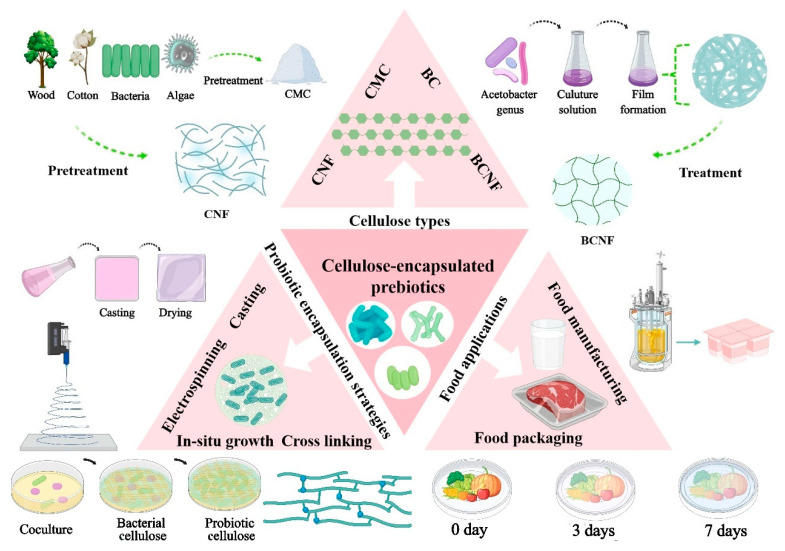
Probiotics have attracted great interest from many researchers due to their beneficial effects. Encapsulation of probiotics into biopolymer matrices has led to the development of active food packaging materials as an alternative to traditional ones for controlling food-borne microorganisms, extending food shelf life, improving food safety, and achieving health-promoting effects. The challenges of low survival rates during processing, storage, and delivery to the gut and low intestinal colonization, storage stability, and controllability have greatly limited the use of probiotics in practical food-preservation applications. The encapsulation of probiotics with a protective matrix can increase their resistance to a harsh environment and improve their survival rates, making probiotics appropriate in the food packaging field. Cellulose has attracted extensive attention in food packaging due to its excellent biocompatibility, biodegradability, environmental friendliness, renewability, and excellent mechanical strength. In this review, we provide a brief overview of the main types of cellulose used for probiotic encapsulation, as well as the current advances in different probiotic encapsulating strategies with cellulose, grafted cellulose, and cellulose-derived materials, including electrospinning, cross-linking, in-situ growth, casting strategies, and their combinations. The effect of cellulose encapsulation on the survival rate of probiotics and the patented encapsulated probiotics are also introduced. In addition, applications of cellulose-encapsulated probiotics in the food industry are also briefly discussed. Finally, the future trends toward developing encapsulated probiotics with improved health benefits and advanced features with cellulose-based materials are discussed.
Keywords: cellulose; encapsulation; food application; probiotic.
Conflict of interest statement
The authors declare no conflict of interest.
Figures
References
-
- FAO/WHO . Health and Nutritional Properties of Probiotics in Food including Powder Milk with Live Lactic Acid Bacteria; Report of the Joint Food and Agriculture (FAO) of the United Nations/World Health Organization (WHO) Expert Consultation on Evaluation of Health and Nutritional Properties of Probiotics in Food including Powder Milk with Live Lactic Acid Bacteria. FAO; Rome, Italy: WHO; Geneva, Switzerland: 2001. Report of a joint FAO/WHO expert Consultation.
Publication types
Grants and funding
LinkOut - more resources
Full Text Sources
