


Prognostic Value of D-dimer to Lymphocyte Ratio (DLR) in Hospitalized Coronavirus Disease 2019 (COVID-19) Patients: A Validation Study in a National Cohort
- PMID: 38543700
- PMCID: PMC10976262
- DOI: 10.3390/v16030335
Prognostic Value of D-dimer to Lymphocyte Ratio (DLR) in Hospitalized Coronavirus Disease 2019 (COVID-19) Patients: A Validation Study in a National Cohort
Abstract
Background: This study aimed to validate the role of the D-dimer to lymphocyte ratio (DLR) for mortality prediction in a large national cohort of hospitalized coronavirus disease 2019 (COVID-19) patients.
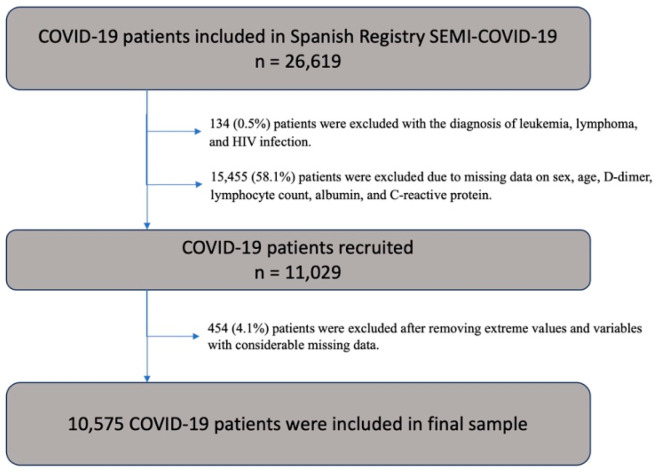
Methods: A retrospective, multicenter, observational study that included hospitalized patients due to SARS-CoV-2 infection in Spain was conducted from March 2020 to March 2022. All biomarkers and laboratory indices analyzed were measured once at admission.
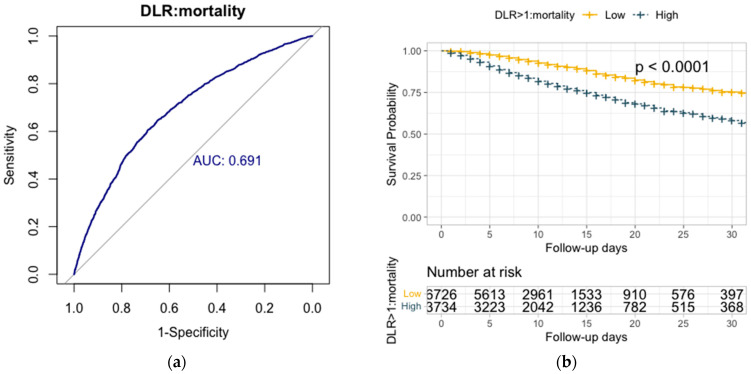
Results: A total of 10,575 COVID-19 patients were included in this study. The mean age of participants was 66.9 (±16) years, and 58.6% (6202 patients) of them were male. The overall mortality rate was 16.3% (n = 1726 patients). Intensive care unit admission was needed in 10.5% (n = 1106 patients), non-invasive mechanical ventilation was required in 8.8% (n = 923 patients), and orotracheal intubation was required in 7.5% (789 patients). DLR presented a c-statistic of 0.69 (95% CI, 0.68-0.71) for in-hospital mortality with an optimal cut-off above 1. Multivariate analysis showed an independent association for in-hospital mortality for DLR > 1 (adjusted OR 2.09, 95% CI 1.09-4.04; p = 0.03); in the same way, survival analysis showed a higher mortality risk for DLR > 1 (HR 2.24; 95% CI 2.03-2.47; p < 0.01). Further, no other laboratory indices showed an independent association for mortality in multivariate analysis.
Conclusions: This study confirmed the usefulness of DLR as a prognostic biomarker for mortality associated with SARS-CoV-2 infection, being an accessible, cost-effective, and easy-to-use biomarker in daily clinical practice.
Keywords: COVID-19; D-dimer to lymphocyte ratio; SARS-CoV-2; biomarkers; mortality; ratios.
Conflict of interest statement
The authors declare no conflicts of interest.
Figures
References
-
- Coronavirus COVID-19 Global Cases by the Center for Systems Science and Engineering (CSSE) at Johns Hopkins University. [(accessed on 21 June 2023)]. Available online: https://coronavirus.jhu.edu.
Publication types
MeSH terms
Substances
LinkOut - more resources
Full Text Sources
Medical
Miscellaneous
