. 2024 Feb 19:69:102475.
doi: 10.1016/j.eclinm.2024.102475. eCollection 2024 Mar.

Healthy weight loss maintenance with exercise, GLP-1 receptor agonist, or both combined followed by one year without treatment: a post-treatment analysis of a randomised placebo-controlled trial

Affiliations

Healthy weight loss maintenance with exercise, GLP-1 receptor agonist, or both combined followed by one year without treatment: a post-treatment analysis of a randomised placebo-controlled trial

Simon Birk Kjær Jensen et al. EClinicalMedicine. .

Abstract

Background: New obesity medications result in large weight losses. However, long-term adherence in a real-world setting is challenging, and termination of obesity medication results in weight regain towards pre-treatment body weight. Therefore, we investigated whether weight loss and improved body composition are sustained better at 1 year after termination of active treatment with glucagon-like peptide-1 (GLP-1) receptor agonist, supervised exercise program, or both combined for 1 year.

Methods: We conducted a post-treatment study in extension of a randomised, controlled trial in Copenhagen. Adults with obesity (aged 18-65 years and initial body mass index 32-43 kg/m2) completed an eight-week low-calorie diet-induced weight loss of 13.1 kg (week -8 to 0) and were randomly allocated (1:1:1:1) to one-year weight loss maintenance (week 0-52) with either supervised exercise, the GLP-1 receptor agonist once-daily subcutaneous liraglutide 3.0 mg, the combination of exercise and liraglutide, or placebo. 166 Participants completed the weight loss maintenance phase. All randomised participants were invited to participate in the post-treatment study with outcome assessments one year after treatment termination, at week 104. The primary outcome of the post-treatment assessment was change in body weight from after the initial weight loss (at randomisation, week 0) to one year after treatment termination (week 104) in the intention-to-treat population. The secondary outcome was change in body-fat percentage (week 0-104). The study is registered with EudraCT, 2015-005585-32, and with ClinicalTrials.gov, NCT04122716.

Findings: Between Dec 17, 2018, and Dec 17, 2020, 109 participants attended the post-treatment study. From randomisation to one year after termination of combined exercise and liraglutide treatment (week 0-104), participants had reduced body weight (-5.1 kg [95% CI -10.0; -0.2]; P = 0.040) and body-fat percentage (-2.3%-points [-4.3 to -0.3]; P = 0.026) compared with after termination of liraglutide alone. More participants who had previously received combination treatment maintained a weight loss of at least 10% of initial body weight one year after treatment termination (week -8 to 104) compared with participants who had previously received placebo (odds ratio [OR] 7.2 [2.4; 21.3]) and liraglutide (OR 4.2 [1.6; 10.8]). More participants who had previously received supervised exercise maintained a weight loss of at least 10% compared with placebo (OR 3.7 [1.2; 11.1]). During the year after termination of treatment (week 52-104), weight regain was 6.0 kg [2.1; 10.0] larger after termination of liraglutide compared with after termination of supervised exercise and 2.5 kg [-1.5 to 6.5] compared with after termination of combination treatment.

Interpretation: The addition of supervised exercise to obesity pharmacotherapy seems to improve healthy weight maintenance after treatment termination compared with treatment termination of obesity pharmacotherapy alone. Body weight and body composition were maintained one year after termination of supervised exercise, in contrast to weight regain after termination of treatment with obesity pharmacotherapy alone.

Funding: Helsefonden and the Novo Nordisk Foundation.

Keywords: Exercise; GLP-1 receptor agonist; Obesity; Physical activity; Weight loss maintenance.


Conflict of interest statement

RMS: family member owns Novo Nordisk stocks. S.M.: Advisory boards: AstraZeneca; Boehringer Ingelheim; Eli Lilly; Merck Sharp & Dohme; Novo Nordisk; Sanofi Aventis. Lecture fees: AstraZeneca; Boehringer Ingelheim; Merck Sharp & Dohme; Novo Nordisk; Sanofi Aventis. Research Grant Recipient: Novo Nordisk, Boehringer-Ingelheim. S.S.T.: Research Grant and Lecture Fee Recipient: Novo Nordisk. J.J.H.: Advisory board: Novo Nordisk. M.B.B.: Research Grant Novo Nordisk A/S, payment made to institution. B.M.S.: Board member of Steno Diabetes Center Copenhagen. Board member of the Centre for Childhood Health, appointed by the Novo Nordisk Foundation.

Figures
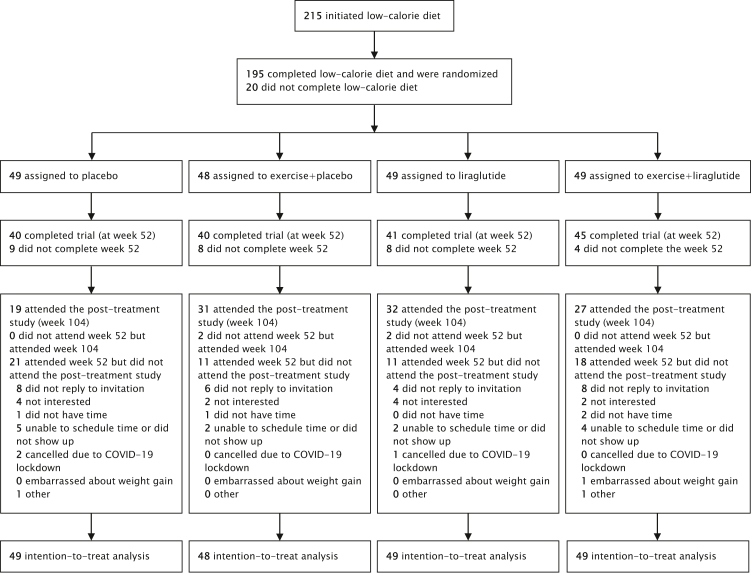
Fig. 1
Fig. 1
Study CONSORT diagram. Reasons for participants not attending the post-treatment study are shown. Reasons for participants not completing the low-calorie diet and 52-week intervention have been published previously.
Fig. 2
Fig. 2
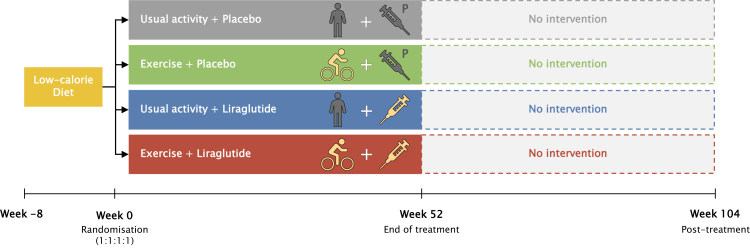
Study profile. Participants who obtained a weight loss of at least 5% during an 8-week low-calorie diet were randomly allocated (1:1:1:1) to exercise plus placebo, once-daily subcutaneous liraglutide 3.0 mg plus usual physical activity, combined exercise plus liraglutide, or placebo plus usual physical activity for 52 weeks. All randomised participants were invited for post-treatment outcome assessments one year after treatment was stopped. In the one-year post-treatment phase, there was no contact between study participants and study personnel.
Fig. 3
Fig. 3
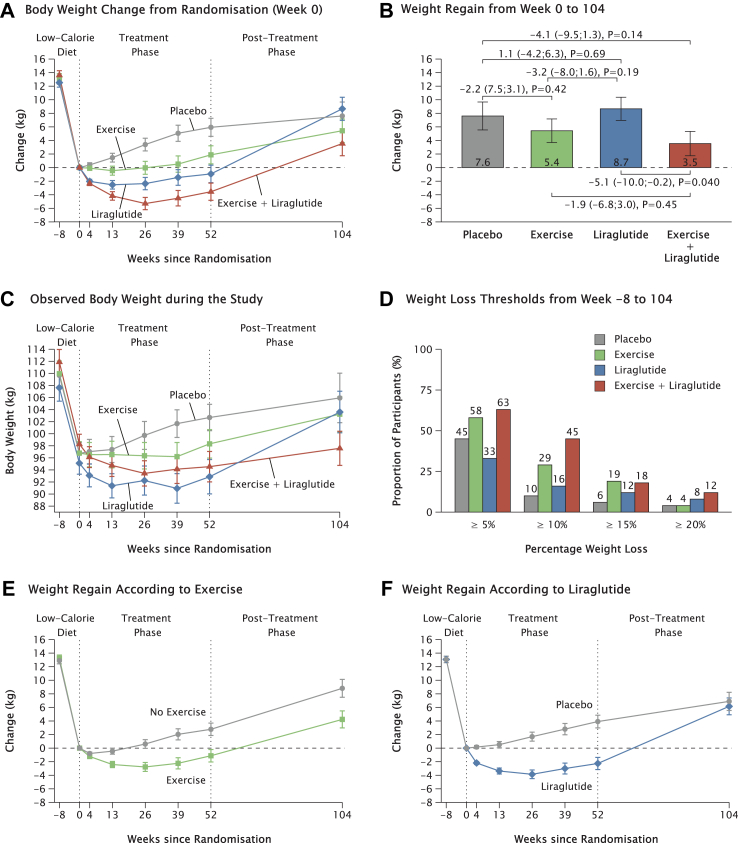
Changes in body weight during the study. Data are for the intention-to-treat population and reported as estimated mean ± SE changes derived from a linear mixed model with time, group, sex, age, and a time–group interaction as fixed effects unless otherwise stated. Panel A shows the estimated mean changes in body weight during a low-calorie diet (week −8 to 0), a weight maintenance intervention (week 0–52) with placebo, exercise plus placebo, liraglutide, or the combination of exercise and liraglutide, and a post-treatment phase (week 52–104). The randomisation value (week 0) is set to zero. Panel B shows the changes in body weight from randomisation (week 0) to week 104 with estimated mean differences and 95% confidence intervals between all four groups. Panel C shows the observed mean ± SE body weights in the study. Panel D shows a bar graph of the percentages of participants who had a weight loss at week 104 of at least 5%, 10%, 15%, and 20% of initial body weight (at week −8). Percentages were calculated using logistic regression. For missing data, categorisation was based on predicted values from the linear mixed model. Panel E shows the estimated mean changes in body weight from randomisation (week 0) for those who were randomised to exercise (exercise plus placebo and exercise plus liraglutide, n = 97) versus no exercise (placebo and liraglutide, n = 98) adjusted for the effect of liraglutide. Panel F shows the estimated mean changes in body weight from randomisation for those who were randomised to liraglutide (liraglutide and exercise plus liraglutide, n = 98) versus placebo (placebo and exercise plus placebo, n = 97) adjusted for the effect of exercise.
Fig. 4
Fig. 4
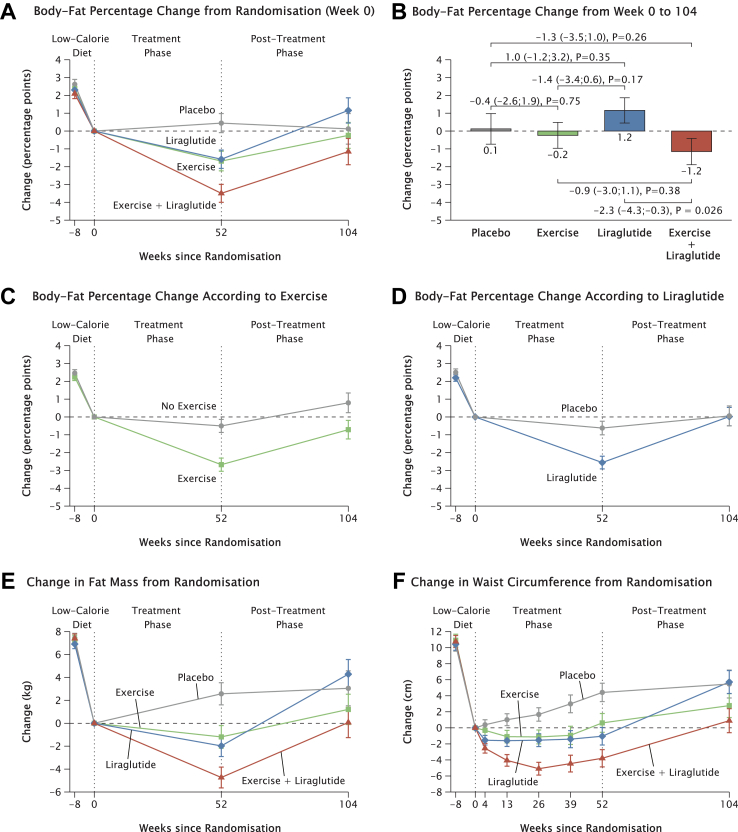
Changes in body composition during the study. Data are for the intention-to-treat population and reported as estimated mean ± SE changes derived from a linear mixed model with time, group, sex, age, and a time–group interaction as fixed effects unless otherwise stated. Panel A shows the estimated mean changes in body-fat percentage during a low-calorie diet (week −8 to 0), a weight maintenance intervention (week 0–52) with placebo, exercise plus placebo, liraglutide, or the combination of exercise and liraglutide, and a post-treatment phase (week 52–104). The randomisation value (week 0) is set to zero. Panel B shows the changes in body-fat percentage from randomisation (week 0) to week 104 with estimated mean differences and 95% confidence intervals between all four groups. Panel C shows the estimated mean changes in body-fat percentage from randomisation for those who were randomised to exercise (exercise plus placebo and exercise plus liraglutide, n = 97) versus no exercise (placebo and liraglutide, n = 98) adjusted for the effect of liraglutide. Panel D shows the estimated mean changes in body-fat percentage from randomisation for those who were randomised to liraglutide (liraglutide and exercise plus liraglutide, n = 98) versus placebo (placebo and exercise plus placebo, n = 97) adjusted for the effect of exercise. Panel E shows the estimated mean changes in fat mass from randomisation. Panel F shows the estimated mean changes in waist circumference from randomisation.
Fig. 5
Fig. 5
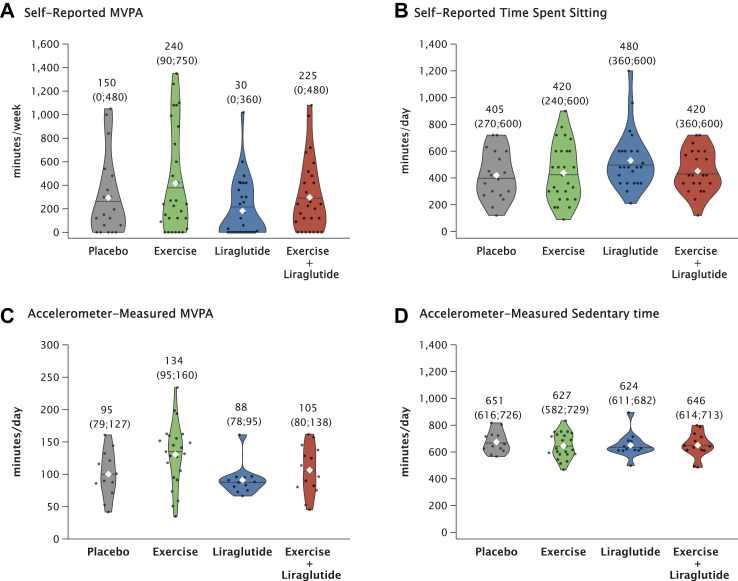
Physical activity and sedentary time. Violin plots of physical activity and sedentary time in the post-treatment study. Panel A shows the self-reported moderate-to-vigorous-intensity physical activity in the week leading up to post-treatment assessments (week 104). Panel B shows the self-reported daily sitting time in the week leading up to post-treatment assessments (week 104). Panel C shows the daily moderate-to-vigorous-intensity physical activity measured with accelerometers worn on the wrist in the week leading up to post-treatment assessments (week 104). Panel D shows the sedentary time measured from the accelerometers. The black lines indicate the medians, the white diamonds indicate the observed means, and the black dots indicate individual observations. Self-reported measures were calculated from the International Physical Activity Questionnaire. Accelerometer-derived measures were calculated with the R-package GGIR.MVPA, moderate-to-vigorous-intensity physical activity.

References

    1. Avila C., Holloway A.C., Hahn M.K., et al. An overview of links between obesity and mental health. Curr Obes Rep. 2015;4(3):303–310. - PubMed
    1. Kolotkin R.L., Andersen J.R. A systematic review of reviews: exploring the relationship between obesity, weight loss and health-related quality of life. Clin Obes. 2017;7(5):273–289. - PMC - PubMed
    1. Powell-Wiley T.M., Poirier P., Burke L.E., et al. Obesity and cardiovascular disease: a scientific statement from the American Heart Association. Circulation. 2021;143(21):E984–E1010. - PMC - PubMed
    1. Narayan K.M.V., Boyle J.P., Thompson T.J., Gregg E.W., Williamson D.F. Effect of BMI on lifetime risk for diabetes in the U.S. Diabetes Care. 2007;30(6):1562–1566. - PubMed
    1. Friedrichsen M., Breitschaft A., Tadayon S., Wizert A., Skovgaard D. The effect of semaglutide 2.4 mg once weekly on energy intake, appetite, control of eating, and gastric emptying in adults with obesity. Diabetes Obes Metab. 2021;23(3):754–762. - PMC - PubMed

Associated data