


. 2024 Mar 12:2024:10.17912/micropub.biology.001138.
doi: 10.17912/micropub.biology.001138.
eCollection 2024.
The tyrosine kinase inhibitor Gefitinib reduces C. elegans stress-induced sleep, but not likely via LET-23/EGFR inhibition
Affiliations
- PMID: 38545437
- PMCID: PMC10966387
- DOI: 10.17912/micropub.biology.001138
Item in Clipboard
The tyrosine kinase inhibitor Gefitinib reduces C. elegans stress-induced sleep, but not likely via LET-23/EGFR inhibition
MicroPubl Biol.
.
Abstract
The anticancer drug Gefitinib is a tyrosine kinase inhibitor with selectivity for the Epidermal Growth Factor Receptor (EGFR/ErbB1). As the C. elegans EGF receptor LET-23 shares notable structural homology over its kinase domain with human EGFR, we wished to examine whether Gefitinib treatment can interfere with LET-23-dependent processes. We show that Gefitinib disrupts C. elegans stress-induced sleep (SIS) but does not impact EGF overexpression-induced sleep nor vulva induction. These findings indicate that Gefitinib does not interfere with LET-23 signaling and impairs SIS through an off-target mechanism.
Copyright: © 2024 by the authors.
Conflict of interest statement
The authors declare that there are no conflicts of interest present.
Figures
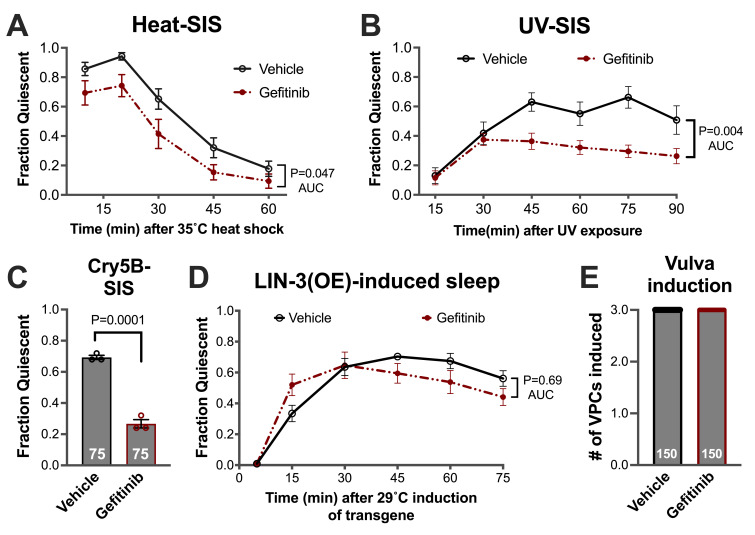
Wild type N2 animals were exposed from hatching to either 10 uM Gefitinib or an equivalent concentration of DMF vehicle and examined for defects in EGFR-dependent processes. (A–C) Young adult animals were assayed for stress-induced sleep (SIS) as described in methods. Gefitinib-treated animals show reduced quiescence relative to vehicle controls during (A) heat-induced sleep, (B) UV-induced sleep, and (C) Cry5B toxin-induced sleep. (D) Young adult animals were assayed for the sleep-like state triggered by ubiquitous overexpression (OE) of the EGF family ligand LIN-3. Gefitinib-treated animals show no defect in LIN-3(OE)-induced sleep. (E) Vulval induction was examined in Gefitinib and vehicle-treated animals at the L4 stage. All animals showed vulval patterning indicative of three VPCs having adopted a vulval fate. At least three trials of 25 animals were performed in A-D. In C and E, the number of animals examined is shown at the base of each bar. P values were determined by unpaired t tests, AUC = area under the curve.
References
-
- Barker AJ, Gibson KH, Grundy W, Godfrey AA, Barlow JJ, Healy MP, Woodburn JR, Ashton SE, Curry BJ, Scarlett L, Henthorn L, Richards L. Studies leading to the identification of ZD1839 (IRESSA): an orally active, selective epidermal growth factor receptor tyrosine kinase inhibitor targeted to the treatment of cancer. Bioorg Med Chem Lett. 2001 Jul 23;11(14):1911–1914. doi: 10.1016/s0960-894x(01)00344-4. - DOI - PubMed
LinkOut - more resources
Full Text Sources
Research Materials
Miscellaneous