


Use and acceptance of traditional, complementary and integrative medicine in Germany-an online representative cross-sectional study
- PMID: 38545512
- PMCID: PMC10965565
- DOI: 10.3389/fmed.2024.1372924
Use and acceptance of traditional, complementary and integrative medicine in Germany-an online representative cross-sectional study
Abstract
Background: Older representative surveys show that Traditional, Complementary and Integrative Medicine (TCIM) is used by about 60% of the German population. However, no data exists for the current nationwide situation. The main aim of this cross-sectional study is to investigate the current use and acceptance of TCIM in Germany.
Methods: This study is based on a representative sample of the German population aged 18-75 years. Participants were asked about the use and acceptance of TCIM. The survey was conducted online using Computer Assisted Web Interview (CAWI) in 2022 by three renowned German market research institutes on behalf of and in close coordination with the working group. The data set was analyzed descriptively and inferentially.
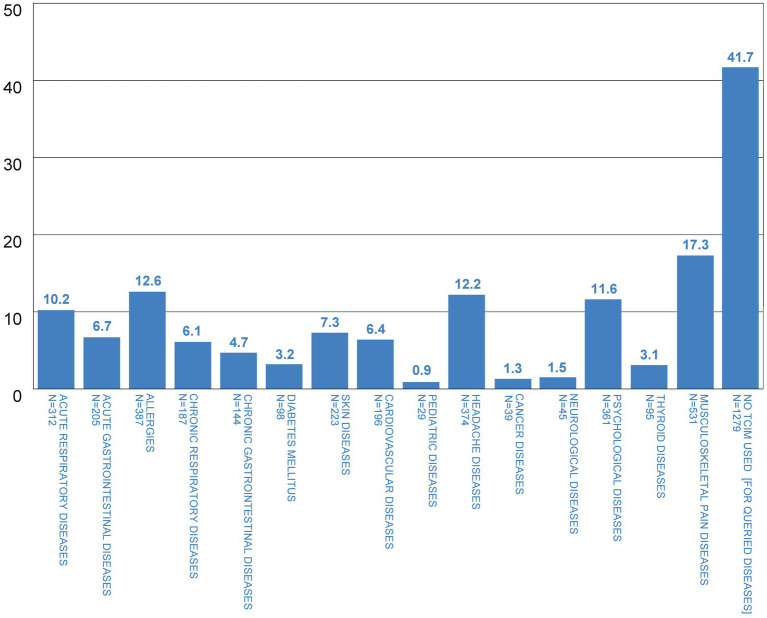
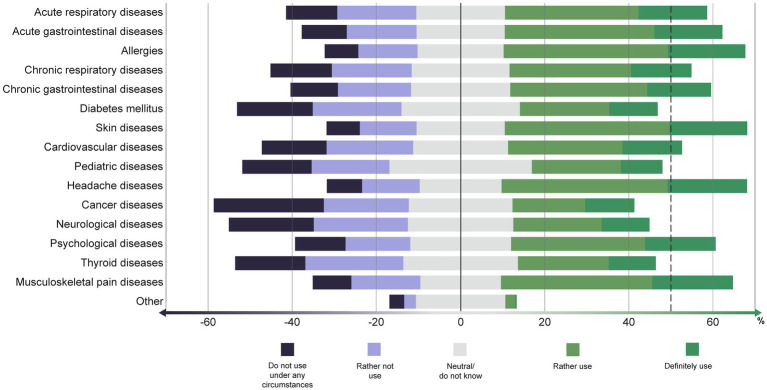
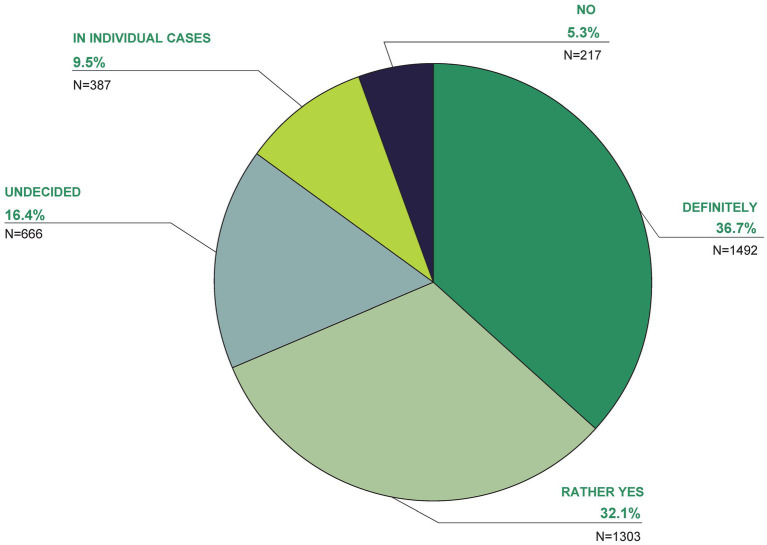
Results: In total, 4,065 participants (52% female, 48% male, 0.4% diverse) responded completely (response rate: 21.5%). Among participants, 70% stated that they had used TCIM at some point in their lives, with 32% doing so in the last 12 months and 18% currently. The most common reason given (17%) was musculoskeletal pain. For their own health, 39% stated that TCIM is important. Traditional European Medicine was rated as very/mainly effective by 27% of participants and as partly effective by 44% (conventional medicine: 69% very/mainly effective, 19% partly effective). As a complementary treatment strategy to conventional medicine, 35% considered TCIM to be optimal ("Complementary Medicine"), 33% in combination with conventional medicine ("Integrative Medicine") and 5% without conventional medicine ("Alternative Medicine"). The majority of the participants were in favor of more research on TCIM and stated that the costs of TCIM services should be covered by health insurance companies (71% and 69%, respectively).
Conclusion: These results from a representative online-population suggest that the use of TCIM in Germany remains at a high level. The nationwide relevance of TCIM should be given greater consideration in German health care policy making. TCIM should be systematically investigated using appropriate study designs and methods including high quality randomized clinical trials to investigate their effectiveness, efficacy, therapeutic safety and costs in the future.
Keywords: Naturheilkunde; alternative medicine; complementary medicine; cross-sectional study; integrative medicine; online-representative; traditional European medicine; traditional medicine.
Copyright © 2024 Jeitler, Ortiz, Brinkhaus, Sigl, Hoffmann, Trübner, Michalsen, Wischnewsky and Kessler.
Conflict of interest statement
MJ reports grants from the Karl and Veronica Carstens Foundation. MO is a board member of the Berlin Brandenburg Medical Doctors’ Association for Naturheilkunde (Physiotherapy; ÄN e.V.). AM reports grants from the Karl and Veronica Carstens Foundation and Stifterverband der Deutschen Wissenschaft. He receives honoraria for consulting from the Klosterfrau Foundation. BB and its working group were partly funded by the Kneipp-Bund e.V. MT reports grants from the Karl and Veronica Carstens Foundation. CK reports grants from the Karl and Veronica Carstens Foundation for conducting this study. He is a member of the scientific advisory board of the company Bruno Zimmer, board member of the German Medical Doctors’ Association for Ayurveda-Medicine (DÄGAM e.V.) and receives honoraria for lecturing Ayurveda at Sonne und Mond, Berlin. The remaining authors declare that the research was conducted in the absence of any commercial or financial relationships that could be construed as a potential conflict of interest.
Figures





References
-
- WHO . Traditional, complementary and integrative medicine (2023) [22.11.23]. Available from: https://www.who.int/health-topics/traditional-complementary-and-integrat....
-
- WHO . Who traditional medicine strategy 2014–2023. Geneva: World Health Organization; (2013).
LinkOut - more resources
Full Text Sources
Research Materials
