Review
. 2024 Mar;210(2):145-166.
doi: 10.1007/s00359-024-01697-3. Epub 2024 Mar 28.

"Resistance leads to self-destruction": how an (a)political strategy helped Karl von Frisch succeed during the Nazi era

Affiliations
Review

"Resistance leads to self-destruction": how an (a)political strategy helped Karl von Frisch succeed during the Nazi era

Günther K H Zupanc et al. J Comp Physiol A Neuroethol Sens Neural Behav Physiol. 2024 Mar.

Abstract

Karl von Frisch, one of the leading zoologists of the twentieth century and co-founder of the Journal of Comparative Physiology A, has been frequently portrayed as an opponent of the Nazi regime because he, as a 'quarter-Jew,' faced the threat of forced retirement from his position as a professor at the University of Munich during the Third Reich. However, doubts about an active opposition role have surfaced in recent years. A litmus test for assessing the validity of this notion is provided by our discovery that four of the six core members of the anti-Nazi resistance group 'White Rose'-Sophie Scholl, Hans Scholl, Christoph Probst, and Alexander Schmorell-were his students. When they were arrested, sentenced to death, and executed, he seemed to ignore this historic event, both during and after World War II-in line with his belief that resistance leads to self-destruction, and research can flourish only by ignoring what happens around oneself. On the other hand, this seemingly apolitical attitude did not prevent him from making use of politics when it served his interests. Such actions included his (pseudo-)scientific justification of forced sterilization of people suffering from hereditary disorders during the Third Reich and his praise of the Nazi government's efforts to "keep races pure." As unsettling as these and some other political views and actions of Karl von Frisch are, they enabled him to carry out several critical pieces of his research agenda during the Third Reich, which three decades later earned him a Nobel Prize.

Keywords: Karl von Frisch; Konrad Lorenz; Niko Tinbergen; Sophie Scholl; Werner Jacobs; White Rose.


Conflict of interest statement

GKHZ is Editor-in-Chief of the Journal of Comparative Physiology A.

Figures

Fig. 1
Fig. 1
Karl von Frisch performing an odor experiment in the garden of the Alte Akademie (Old Academy) in Munich, around 1930. In this experiment, bees were trained to enter the inside of cardboard boxes through the round hole in front, where they learned to associate the presence of sugar water with a specific floral scent, such as jasmine oil. Courtesy: Bayerische Staatsbibliothek München/Bildarchiv
Fig. 2
Fig. 2
Members of the White Rose who took courses with Karl von Frisch at the University of Munich. a Sophie Scholl. b Hans Scholl. c Christoph Probst. d Alexander Schmorell. The photographs were taken after their arrests by the Gestapo in Munich. Courtesy: Stadtarchiv München a: reference number DE-1992-FS-PER-S-0008-01; b: reference number DE-1992-FS-PER-S-0007-01; c: reference number DE-1992-FS-PER-P-0003-01; Wikimedia Commons (d). Photographer(s) unknown
Fig. 3
Fig. 3
Lichthof (atrium) of the main building of the University of Munich. On February 18, 1943, after Hans and Sophie Scholl had distributed most of their copies of the sixth leaflet, Sophie flung the remaining copies from the top floor of the gallery down into the atrium. This was observed by a member of the maintenance staff, ultimately leading to the arrest of the Scholl siblings by the Gestapo. Photograph by Günther K.H. Zupanc
Fig. 4
Fig. 4
Belegblatt (course registration card) of Sophie Scholl for the summer semester 1942. She entered by hand the information on this form, such as the names of the faculty (column 2) of the respective course she took (column 3), the number of course units (Wochenstundenzahl, ‘number of hours per week spent in class;’ column 4), and the tuition fee paid (column 5). The first course listed is von Frisch’s Allgemeine Zoologie (General Zoology), bearing 3 credit hours. She paid a tuition fee of 9 Reichsmark for this course. Courtesy: UAM
Fig. 5
Fig. 5
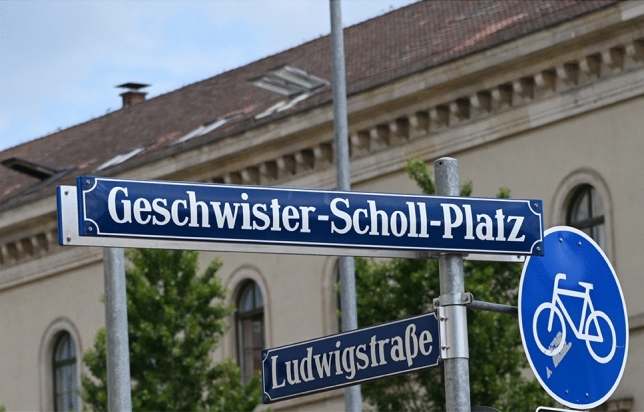
Geschwister-Scholl-Platz (Scholl Sibling Square), named after Hans and Sophie Scholl and located in front of the main building of the University of Munich. Photograph by Günther K.H. Zupanc
Fig. 6
Fig. 6
Bronze relief commemorating the seven executed members of the White Rose—Hans Scholl, Sophie Scholl, Willi Graf, Hans Leipelt, Christoph Probst, Alexander Schmorell, and Kurt Huber. It is mounted on the western side in the atrium of the main building in which Hans and Sophie Scholl were arrested. Created by the German sculptor Lothar Dietz, this piece of artwork was unveiled in 1958. Photograph by Günther K.H. Zupanc
Fig. 7
Fig. 7
Pavement memorial to the White Rose. Embedded in the cobblestone pavement in front of the main entrance of the university building, the ceramic tablets by artist Robert Schmidt-Matt depict photographs and biosketches of Hans Scholl, Sophie Scholl, and Christoph Probst, as well as leaflets of the White Rose. Photograph by Günther K.H. Zupanc
Fig. 8
Fig. 8
Karl von Frisch receiving an honorary doctorate from J. Hampden Robb, University Marshal, during the 312th commencement of Harvard University in 1963. The honoree applauding in front of von Frisch is Willy Brandt, then Mayor of West Berlin. Brand served as the chancellor of West Germany from 1969 to 1974. He was awarded the Nobel Peace Prize in 1971, two years before von Frisch received a Nobel Prize for Physiology or Medicine. Courtesy: BSB Ana-540, E.I.14
Fig. 9
Fig. 9
Grave sites of a Hans Scholl, Sophie Scholl, and Christoph Probst; b Alexander Schmorell; and c Karl von Frisch in the Perlacher Forst Cemetery. Photographs by Günther K.H. Zupanc

References

    1. Beuys B. Sophie Scholl: Biografie. Berlin: Insel Verlag; 2021.
    1. Böhm H. Von der Selbstverwaltung zum Führerprinzip: Die Universität München in den ersten Jahren des Dritten Reiches (1933–1936) Berlin: Duncker & Humblot; 1995.
    1. Föger B, Taschwer K. Die andere Seite des Spiegels: Konrad Lorenz und der Nationalsozialismus. Vienna: Czernin Verlag; 2001.
    1. Greilinger G. Das Studium der Medizin an der Ludwig-Maximilians-Universität München in den Jahren 1946 bis 1954. München: Institut für Geschichte der Medizin der Universität München; 2006.
    1. Grüttner M. Biographisches Lexikon zur nationalsolzialistischen Wissenschaftspolitik. Heidelberg: Synchron Wissenschaftsverlag der Autoren; 2004.