Prevalence and natural course of incidental gastric subepithelial tumors
- PMID: 38549244
- PMCID: PMC11294851
- DOI: 10.5946/ce.2023.124
Prevalence and natural course of incidental gastric subepithelial tumors
Abstract
Background/aims: Gastric subepithelial tumors (SETs) are often encountered during the upper gastrointestinal endoscopic screening. We assessed the prevalence of gastric SETs and the risk factors for their progression.
Methods: We reviewed the electronic medical records of 30,754 patients who underwent upper gastrointestinal endoscopic screening at our medical center between January 2013 and December 2016.
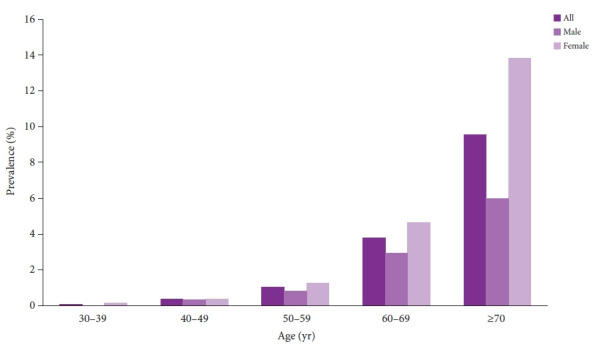
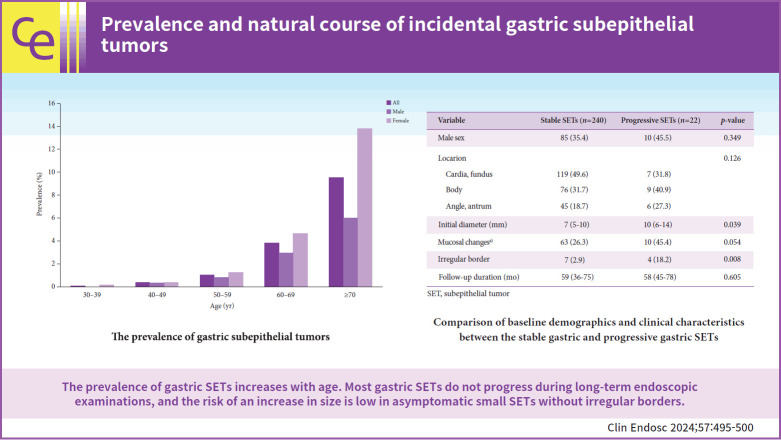
Results: Among the 30,754 patients examined, 599 (1.94%) had gastric SETs. The prevalence increased with age and was 9.56% in patients aged ≥70 years. In total, 262 patients underwent serial endoscopy for more than 6 months. The median age was 68 years (interquartile range [IQR], 61-74), and the number of females was 167 (63.7%). During a median follow-up of 58 months (IQR, 38-75), 22 patients (8.4%) showed significant changes in tumor size. An irregular border (odds ratio, 4.623; 95% confidence interval, 1.093-19.558; p=0.037) was a significant risk factor for progression. Seven patients underwent surgical or endoscopic resections. The pathologies of gastric SETs included leiomyomas (n=3), gastrointestinal stromal tumors (n=2), and lipomas (n=2).
Conclusions: The prevalence of gastric SETs increases with age. Most gastric SETs do not progress during long-term endoscopic examinations, and the risk of an increase in size is low in asymptomatic small SETs without irregular borders.
Keywords: Gastrointestinal endoscopy; Irregular border; Risk factors; Stomach; Subepithelial tumor.
Conflict of interest statement
The authors have no potential conflicts of interest.
Figures
References
-
- Lee JH, Lee HL, Ahn YW, et al. Prevalence of gastric subepithelial tumors in Korea: a single center experience. Korean J Gastroenterol. 2015;66:274–276. - PubMed
Grants and funding
LinkOut - more resources
Full Text Sources