


doi: 10.1016/j.jaccas.2024.102241.
eCollection 2024 Mar 20.
Severe Acute Cor Pulmonale With Impending Shock: An Insidious Incidental
Affiliations
- PMID: 38549852
- PMCID: PMC10966360
- DOI: 10.1016/j.jaccas.2024.102241
Item in Clipboard
Severe Acute Cor Pulmonale With Impending Shock: An Insidious Incidental
JACC Case Rep.
.
Abstract
The S1Q3T3 sign associated with cor pulmonale was first described by Sylvester McGinn and Paul White in 1935. It has since become an overlooked and relatively nonspecific finding associated with pulmonary embolism. We present this case to elucidate the importance for clinicians to promptly identify this electrocardiographic triad.
Keywords: McConnell’s sign; cor pulmonale; electrocardiography; pulmonary embolism; right heart strain.
© 2024 The Authors.
Conflict of interest statement
The authors have reported that they have no relationships relevant to the contents of this paper to disclose.
Figures

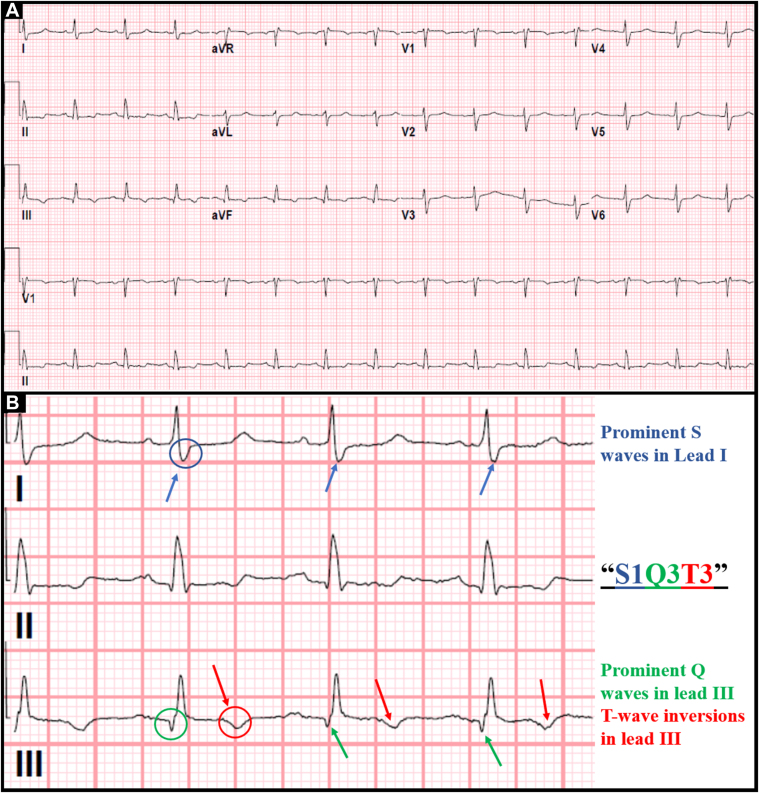
The McGinn-White Sign (A) The electrocardiogram (ECG) on arrival at the emergency department (ED) revealing the notable S1Q3T3 sign, a nonspecific, but characteristic, finding of acute pulmonary embolism with subsequent cor pulmonale. (B) Detailed labeling of the triad of morphological ECG changes that correspond to the clinical disease process.
References
-
- McGinn S., White P.D. Acute cor pulmonale resulting from pulmonary embolism. JAMA. 1935;104:1473–1480.
-
- McConnell M.V., Solomon S.D., Rayan M.E., Come P.C., Goldhaber S.Z., Lee R.T. Regional right ventricular dysfunction detected by echocardiography in acute pulmonary embolism. Am J Cardiol. 1996;78:469–473. - PubMed
-
- Nazeyrollas P., Metz D., Jolly D., et al. Use of transthoracic Doppler echocardiography combined with clinical and electrocardiographic data to predict acute pulmonary embolism. Eur Heart J. 1996;17:779–786. - PubMed
LinkOut - more resources
Full Text Sources
