


Modeling the neurocognitive dynamics of language across the lifespan
- PMID: 38553863
- PMCID: PMC10980845
- DOI: 10.1002/hbm.26650
Modeling the neurocognitive dynamics of language across the lifespan
Abstract
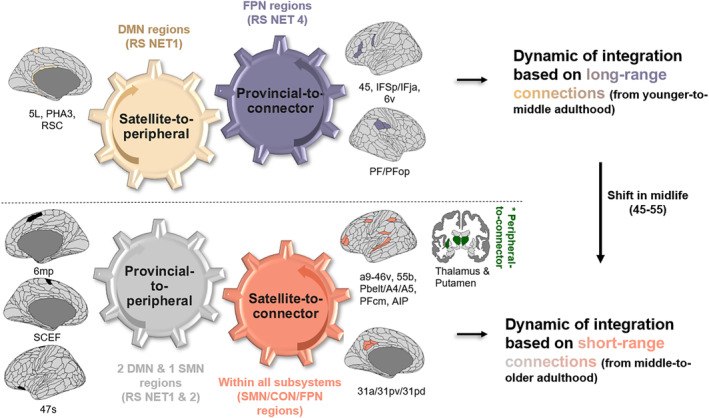
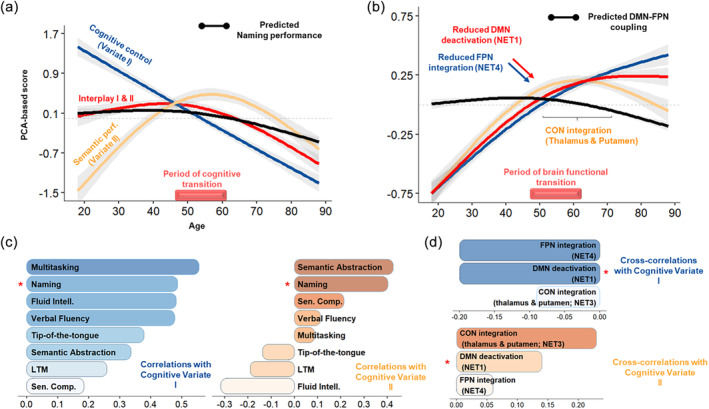
Healthy aging is associated with a heterogeneous decline across cognitive functions, typically observed between language comprehension and language production (LP). Examining resting-state fMRI and neuropsychological data from 628 healthy adults (age 18-88) from the CamCAN cohort, we performed state-of-the-art graph theoretical analysis to uncover the neural mechanisms underlying this variability. At the cognitive level, our findings suggest that LP is not an isolated function but is modulated throughout the lifespan by the extent of inter-cognitive synergy between semantic and domain-general processes. At the cerebral level, we show that default mode network (DMN) suppression coupled with fronto-parietal network (FPN) integration is the way for the brain to compensate for the effects of dedifferentiation at a minimal cost, efficiently mitigating the age-related decline in LP. Relatedly, reduced DMN suppression in midlife could compromise the ability to manage the cost of FPN integration. This may prompt older adults to adopt a more cost-efficient compensatory strategy that maintains global homeostasis at the expense of LP performances. Taken together, we propose that midlife represents a critical neurocognitive juncture that signifies the onset of LP decline, as older adults gradually lose control over semantic representations. We summarize our findings in a novel synergistic, economical, nonlinear, emergent, cognitive aging model, integrating connectomic and cognitive dimensions within a complex system perspective.
Keywords: SENECA; aging; cognition; connectomics; graph theory; language; reorganization.
© 2024 The Authors. Human Brain Mapping published by Wiley Periodicals LLC.
Conflict of interest statement
The authors declare no conflicts of interest.
Figures


References
-
- Alves, P. N. , Foulon, C. , Karolis, V. , Bzdok, D. , Margulies, D. S. , Volle, E. , & Thiebaut de Schotten, M. (2019). An improved neuroanatomical model of the default‐mode network reconciles previous neuroimaging and neuropathological findings. Communications Biology, 2(1), 370. 10.1038/s42003-019-0611-3 - DOI - PMC - PubMed
MeSH terms
Grants and funding
LinkOut - more resources
Full Text Sources
