Review
. 2024 May:100:39-48.
doi: 10.1016/j.semcancer.2024.03.003. Epub 2024 Mar 29.

Hypoxia-targeting bacteria in cancer therapy

Affiliations
Review

Hypoxia-targeting bacteria in cancer therapy

Verena Staedtke et al. Semin Cancer Biol. 2024 May.

Abstract

Tumor hypoxia plays a crucial role in driving cancer progression and fostering resistance to therapies by contributing significantly to chemoresistance, radioresistance, angiogenesis, invasiveness, metastasis, altered cell metabolism, and genomic instability. Despite the challenges encountered in therapeutically addressing tumor hypoxia with conventional drugs, a noteworthy alternative has emerged through the utilization of anaerobic oncolytic bacteria. These bacteria exhibit a preference for accumulating and proliferating within the hypoxic regions of tumors, where they can initiate robust antitumor effects and immune responses. Through simple genetic manipulation or sophisticated synthetic bioengineering, these bacteria can be further optimized to improve safety and antitumor activities, or they can be combined synergistically with chemotherapies, radiation, or other immunotherapies. In this review, we explore the potential benefits and challenges associated with this innovative anticancer approach, addressing issues related to clinical translation, particularly as several strains have progressed to clinical evaluation.

Keywords: Clostridium; anaerobic bacteria; cancer; hypoxia.


Conflict of interest statement

Declaration of Competing Interest All sources of funding should also be acknowledged and you should declare any involvement of study sponsors in the study design; collection, analysis and interpretation of data; the writing of the manuscript; the decision to submit the manuscript for publication. If the study sponsors had no such involvement, this should be stated.

Figures
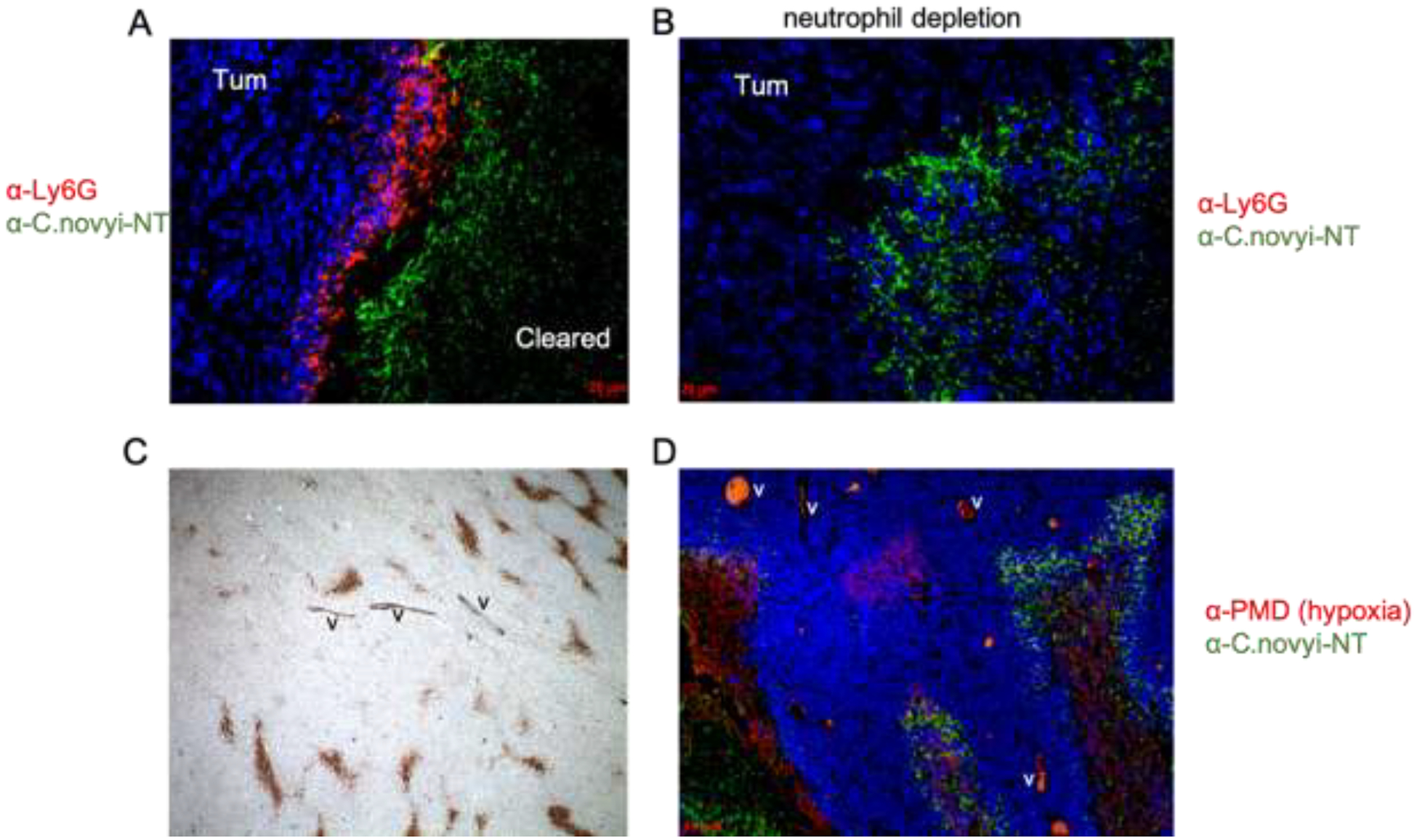
Figure 1.
Figure 1.
Neutrophil-depletion was able to facilitate the complete tumor clearance in the subcutaneous GL261 mouse tumor model. A. Accumulation of neutrophils blocked the expansion of germinated C. novyi-NT in the tumor. GL261 tumor was injected with C. novyi-NT spores and was harvested after 24 hours. Neutrophils were stained by 1A8 anti-Ly6G antibody (red), C. novyi-NT was stained in green, and nuclei were stained in blue by DAPI. B. Depletion of neutrophils enabled the expansion of C. novyi-NT in the tumor. GL261-bearing mice were pre-treated by neutrophil-depleting anti-Ly6G antibody 24 hours prior to the C. novyi-NT spore injection. Tumors were harvested and stained same as described in A. C. Presence of hypoxia pockets in non-necrotic tumor body. GL261 tumor was labeled by pimonidazole (PMD) via intraperitoneal (IP) injection in the mouse. Immunohistochemistry with anti-PMD Hypoxyprobe-1 antibody showed the hypoxic areas in the tumor (brown). Section was counterstained by hematoxylin (blue). Magnification: 5x. D. C. novyi-NT was able to spread through the hypoxic pockets in the tumor body after neutrophil depletion. GL261 tumor bearing mice were pre-treated with anti-Ly6G antibody 24 hours prior to C. novyi-NT spore injection. One hour before harvesting at 12 hours, tumor was labeled by PMD via IP injection and the immunofluorescence staining showed hypoxic area in red, C. novyi-NT in green and nuclei in blue.
Figure 2.
Figure 2.
C. novyi-NT germinated in an invasive tumor satellite and in a tumor blood vessel structure in the brain. A. In the F98 rat glioma model, C. novyi-NT spores were injected in the brain tumor. A gram staining of the brain section showed extensive germination (blue) in the brain tumor (yellow arrow heads), including germination in the tumor satellite (S, yellow arrow) that invaded in the brain tissue (Br). B. In the VX2 rabbit brain tumor model, C. novyi-NT spores were injected in the brain tumor. A gram staining of the brain section showed extensive germination (blue, yellow arrow heads) in the brain tumor (Tum) and germination in a blood vessel structure adjacent to the tumor (black arrow) that invaded in the brain tissue (Br).

References

    1. Vaupel P, Harrison L, Tumor hypoxia: causative factors, compensatory mechanisms, and cellular response, Oncologist 9 Suppl 5 (2004) 4–9. - PubMed
    1. Vaupel P, Mayer A, Hypoxia in cancer: significance and impact on clinical outcome, Cancer Metastasis Rev 26(2) (2007) 225–39. - PubMed
    1. Vaupel P, Kallinowski F, Okunieff P, Blood flow, oxygen and nutrient supply, and metabolic microenvironment of human tumors: a review, Cancer Res 49(23) (1989) 6449–65. - PubMed
    1. Thomlinson RH, Gray LH, The histological structure of some human lung cancers and the possible implications for radiotherapy, Br J Cancer 9(4) (1955) 539–49. - PMC - PubMed
    1. Staedtke V, Gray-Bethke T, Liu G, Liapi E, Riggins GJ, Bai RY, Neutrophil depletion enhanced the Clostridium novyi-NT therapy in mouse and rabbit tumor models, Neurooncol Adv 4(1) (2022) vdab184. - PMC - PubMed
