


This is a preprint.
Protein nanoparticle vaccines induce potent neutralizing antibody responses against MERS-CoV
- PMID: 38558973
- PMCID: PMC10979991
- DOI: 10.1101/2024.03.13.584735
Protein nanoparticle vaccines induce potent neutralizing antibody responses against MERS-CoV
Update in
-
Protein nanoparticle vaccines induce potent neutralizing antibody responses against MERS-CoV.Cell Rep. 2024 Dec 24;43(12):115036. doi: 10.1016/j.celrep.2024.115036. Epub 2024 Dec 6. Cell Rep. 2024. PMID: 39644492 Free PMC article.
Abstract
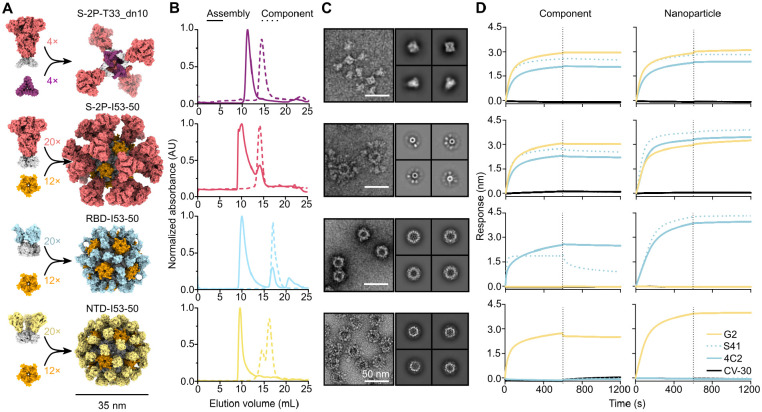
Middle East respiratory syndrome coronavirus (MERS-CoV) is a zoonotic betacoronavirus that causes severe and often lethal respiratory illness in humans. The MERS-CoV spike (S) protein is the viral fusogen and the target of neutralizing antibodies, and has therefore been the focus of vaccine design efforts. Currently there are no licensed vaccines against MERS-CoV and only a few candidates have advanced to Phase I clinical trials. Here we developed MERS-CoV vaccines utilizing a computationally designed protein nanoparticle platform that has generated safe and immunogenic vaccines against various enveloped viruses, including a licensed vaccine for SARS-CoV-2. Two-component protein nanoparticles displaying MERS-CoV S-derived antigens induced robust neutralizing antibody responses and protected mice against challenge with mouse-adapted MERS-CoV. Electron microscopy polyclonal epitope mapping and serum competition assays revealed the specificities of the dominant antibody responses elicited by immunogens displaying the prefusion-stabilized S-2P trimer, receptor binding domain (RBD), or N-terminal domain (NTD). An RBD nanoparticle vaccine elicited antibodies targeting multiple non-overlapping epitopes in the RBD, whereas anti-NTD antibodies elicited by the S-2P- and NTD-based immunogens converged on a single antigenic site. Our findings demonstrate the potential of two-component nanoparticle vaccine candidates for MERS-CoV and suggest that this platform technology could be broadly applicable to betacoronavirus vaccine development.
Figures


References
-
- Menachery V. D., Yount B. L., Debbink K., Agnihothram S., Gralinski L. E., Plante J. A., Graham R. L., Scobey T., Ge X.-Y., Donaldson E. F., Randell S. H., Lanzavecchia A., Marasco W. A., Shi Z.-L., Baric R. S., A SARS-like cluster of circulating bat coronaviruses shows potential for human emergence. Nat. Med. 21, 1508–1513 (2015). - PMC - PubMed
-
- Menachery V. D., Yount B. L., Sims A. C., Debbink K., Agnihothram S. S., Gralinski L. E., Graham R. L., Scobey T., Plante J. A., Royal Scott R., Swanstrom J., Sheahan T. P., Pickles R. J., Corti D., Randell S. H., Lanzavecchia A., Marasco W. A., Baric R. S., SARS-like WIV1-CoV poised for human emergence. Proc. Natl. Acad. Sci. U. S. A. 113, 3048–3053 (2016). - PMC - PubMed
-
- Zhou P., Yang X.-L., Wang X.-G., Hu B., Zhang L., Zhang W., Si H.-R., Zhu Y., Li B., Huang C.-L., Chen H.-D., Chen J., Luo Y., Guo H., Jiang R.-D., Liu M.-Q., Chen Y., Shen X.-R., Wang X., Zheng X.-S., Zhao K., Chen Q.-J., Deng F., Liu L.-L., Yan B., Zhan F.-X., Wang Y.-Y., Xiao G.-F., Shi Z.-L., A pneumonia outbreak associated with a new coronavirus of probable bat origin. Nature 579, 270–273 (2020). - PMC - PubMed
-
- Tse L. V., Hou Y. J., McFadden E., Lee R. E., Scobey T. D., Leist S. R., Martinez D. R., Meganck R. M., Schäfer A., Yount B. L., Mascenik T., Powers J. M., Randell S. H., Zhang Y., Wang L., Mascola J., McLellan J. S., Baric R. S., A MERS-CoV antibody neutralizes a pre-emerging group 2c bat coronavirus. Sci. Transl. Med. 15, eadg5567 (2023). - PMC - PubMed
-
- Cassetti M. C., Pierson T. C., Patterson L. J., Bok K., DeRocco A. J., Deschamps A. M., Graham B. S., Erbelding E. J., Fauci A. S., Prototype Pathogen Approach for Vaccine and Monoclonal Antibody Development: A Critical Component of the NIAID Plan for Pandemic Preparedness. J. Infect. Dis., jiac296 (2022). - PMC - PubMed
Publication types
Grants and funding
LinkOut - more resources
Full Text Sources
Miscellaneous
