


This is a preprint.
OCTOPUS: Disk-based, Multiplatform, Mobile-friendly Metagenomics Classifier
- PMID: 38559026
- PMCID: PMC10979967
- DOI: 10.1101/2024.03.15.585215
OCTOPUS: Disk-based, Multiplatform, Mobile-friendly Metagenomics Classifier
Update in
-
OCTOPUS: Disk-based, Multiplatform, Mobile-friendly Metagenomics Classifier.AMIA Annu Symp Proc. 2025 May 22;2024:798-807. eCollection 2024. AMIA Annu Symp Proc. 2025. PMID: 40417475 Free PMC article.
Abstract
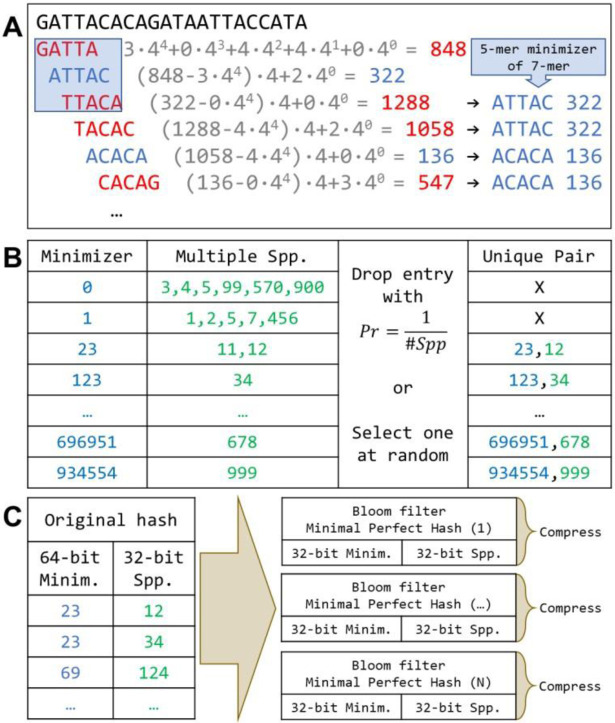
Portable genomic sequencers such as Oxford Nanopore's MinION enable real-time applications in clinical and environmental health. However, there is a bottleneck in the downstream analytics when bioinformatics pipelines are unavailable, e.g., when cloud processing is unreachable due to absence of Internet connection, or only low-end computing devices can be carried on site. Here we present a platform-friendly software for portable metagenomic analysis of Nanopore data, the Oligomer-based Classifier of Taxonomic Operational and Pan-genome Units via Singletons (OCTOPUS). OCTOPUS is written in Java, reimplements several features of the popular Kraken2 and KrakenUniq software, with original components for improving metagenomics classification on incomplete/sampled reference databases, making it ideal for running on smartphones or tablets. OCTOPUS obtains sensitivity and precision comparable to Kraken2, while dramatically decreasing (4- to 16-fold) the false positive rate, and yielding high correlation on real-word data. OCTOPUS is available along with customized databases at https://github.com/DataIntellSystLab/OCTOPUS and https://github.com/Ruiz-HCI-Lab/OctopusMobile.
Figures

References
Publication types
Grants and funding
LinkOut - more resources
Full Text Sources
Research Materials
Miscellaneous
