[Preprint]. 2024 Mar 14:2024.03.14.585064.
doi: 10.1101/2024.03.14.585064.

Pavlovian cue-evoked alcohol seeking is disrupted by ventral pallidal inhibition

Affiliations

Pavlovian cue-evoked alcohol seeking is disrupted by ventral pallidal inhibition

Jocelyn M Richard et al. bioRxiv. .

Update in

Abstract

Cues paired with alcohol can be potent drivers of craving, alcohol-seeking, consumption, and relapse. While the ventral pallidum is implicated in appetitive and consummatory responses across several reward classes and types of behaviors, its role in behavioral responses to Pavlovian alcohol cues has not previously been established. Here, we tested the impact of optogenetic inhibition of ventral pallidum on Pavlovian-conditioned alcohol-seeking in male Long Evans rats. Rats underwent Pavlovian conditioning with an auditory cue predicting alcohol delivery to a reward port and a control cue predicting no alcohol delivery, until they consistently entered the reward port more during the alcohol cue than the control cue. We then tested the within-session effects of optogenetic inhibition during 50% of cue presentations. We found that optogenetic inhibition of ventral pallidum during the alcohol cue reduced port entry likelihood and time spent in the port, and increased port entry latency. Overall, these results suggest that normal ventral pallidum activity is necessary for Pavlovian alcohol-seeking.


Figures
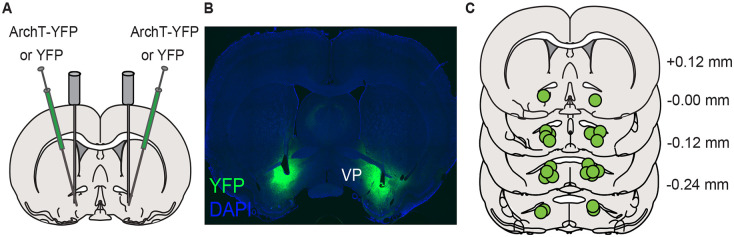
Figure 1.
Figure 1.. Viral approach and targeting.
A) AAVs coding for the expression of ArchT-YFP or YFP alone were bilaterally infused into the ventral pallidum (VP) and optic fibers were cemented in place over the injection sites. B) Representative YFP expression localized to the VP. C) Summary of optic fiber tip locations within the VP.
Figure 2.
Figure 2.. Pavlovian alcohol seeking training data.
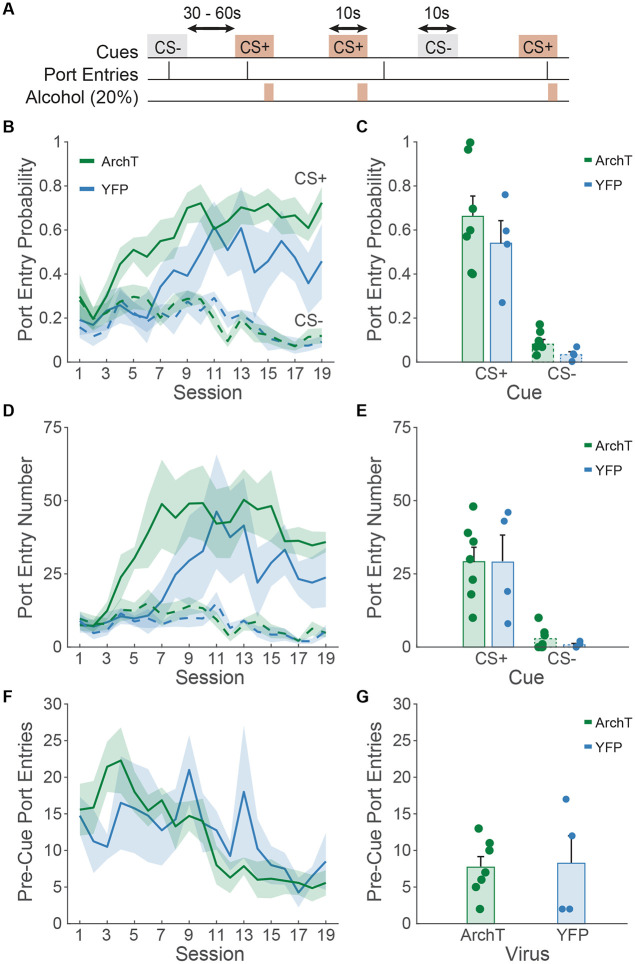
A) Schematic of the Pavlovian conditioned alcohol seeking task, where a CS+ cue predicts alcohol delivery into a reward port, and a CS− cue has no associated outcomes. B, D) Across training acquisition, rats in the ArchT and GYFP-only viral groups learned to discriminate the alcohol predictive CS+ from the CS−. C) Port entry probability and E) number of port entries during each cue type reached equal levels between the viral groups by the end of training. F) Pre-cue port entries decreased for both viral groups, and G) were equal by the end of training.
Figure 3.
Figure 3.. Ventral pallidum inhibition acutely disrupts Pavlovian conditioned alcohol seeking.
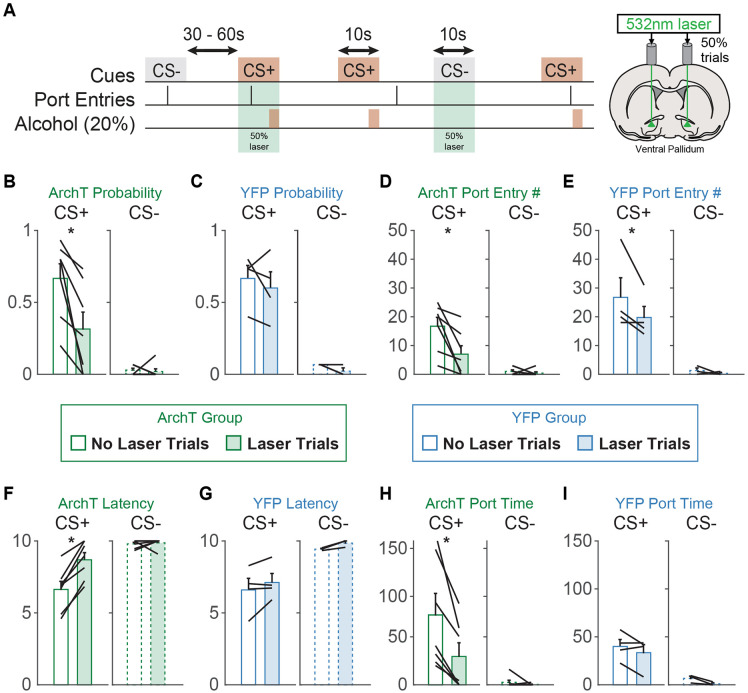
A) Schematic of the optogenetic manipulation. Green laser was delivered on 50% of CS+ and CS− trials. B) Port entry probability during the CS+ was reduced in the ArchT group on laser stimulation trials. C) Port entry probability was not affected by laser delivery in the YFP group. D) The number of port entries during the CS+ was reduced on laser trials for the ArchT group. E) The number of port entries during the CS+ was reduced on laser trials for the YFP group. F) The latency to make port entries during the CS+ was increased on laser trials for the ArchT group. G) There was no effect of laser delivery on port entry latency for the YFP group. H) The time rats spent in the alcohol port during the CS+ was also reduced during laser trials in the ArchT group. I) There was impact of laser on port entry time for the YFP group.

References

    1. Aguirre CG, Stolyarova A, Das K, Kolli S, Marty V, Ray L, Spigelman I, Izquierdo A (2020) Sex-dependent effects of chronic intermittent voluntary alcohol consumption on attentional, not motivational, measures during probabilistic learning and reversal. PLOS ONE 15:e0234729. - PMC - PubMed
    1. Armstrong A, Rosenthal H, Stout N, Richard JM (2023) Reinstatement of Pavlovian responses to alcohol cues by stress. Psychopharmacology 240:531–545. - PMC - PubMed
    1. Carpio MJ, Gao R, Wooner E, Cayton CA, Richard JM (2022) Alcohol availability during withdrawal gates the impact of alcohol vapor exposure on responses to alcohol cues. Psychopharmacology Available at: https://pubmed.ncbi.nlm.nih.gov/35881146/ [Accessed September 11, 2022]. - PMC - PubMed
    1. Chang SE, Smedley EB, Stansfield KJ, Stott JJ, Smith KS (2017) Optogenetic inhibition of ventral pallidum neurons impairs context-driven salt-seeking. Journal of Neuroscience 37:5670–5680. - PMC - PubMed
    1. de Wit H (2009) Impulsivity as a determinant and consequence of drug use: a review of underlying processes. Addict Biol 14:22–31. - PMC - PubMed

Publication types