


Effectiveness of Ketamine for the Treatment of Post-Traumatic Stress Disorder - A Systematic Review and Meta-Analysis
- PMID: 38559428
- PMCID: PMC10979792
- DOI: 10.36131/cnfioritieditore20240102
Effectiveness of Ketamine for the Treatment of Post-Traumatic Stress Disorder - A Systematic Review and Meta-Analysis
Abstract
Objective: Post-traumatic stress disorder (PTSD) is an enduring condition characterized by a chronic course and impairments across several areas. Despite its significance, treatment options remain limited, and remission rates are often low. Ketamine has demonstrated antidepressant properties and appears to be a promising agent in the management of PTSD.
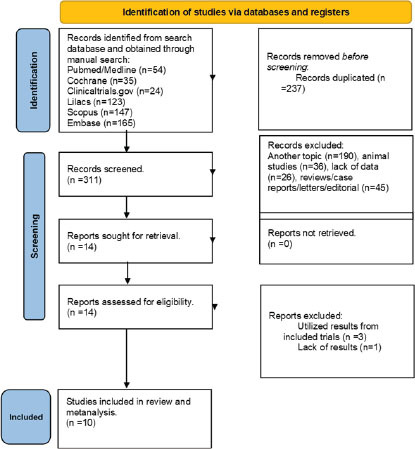
Method: A systematic review was conducted in PubMed/MEDLINE, Cochrane Library, Clinicaltrials.gov, Lilacs, Scopus, and Embase, covering studies published between 2012 and December 2022 to assess the effectiveness of ketamine in the treatment of PTSD. Ten studies, consisting of five RCTs, two crossover trials, and three non-randomized trials, were included in the meta-analysis.
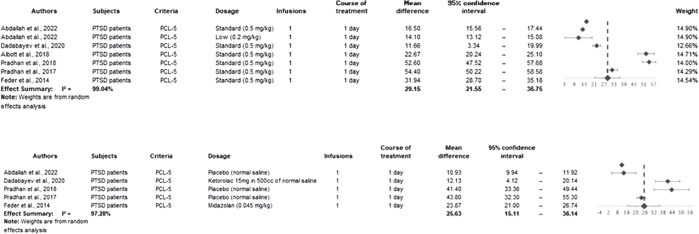
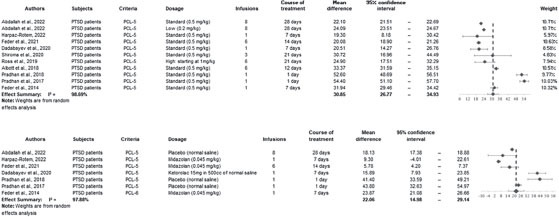
Results: Ketamine demonstrated significant improvements in PCL-5 scores, both 24 hours after the initial infusion and at the endpoint of the treatment course, which varied between 1 to 4 weeks in each study. Notably, the significance of these differences was assessed using the Two Sample T-test with pooled variance and the Two Sample Welch's T-test, revealing a statistically significant effect for ketamine solely at the endpoint of the treatment course (standardized effect size= 0.25; test power 0.9916; 95% CI = 0.57 to 17.02, p=0.0363). It is important to note that high heterogeneity was observed across all analyses.
Conclusions: Our findings suggest that ketamine holds promise as an effective treatment option for PTSD. However, further trials are imperative to establish robust data for this intervention.
Keywords: PTSD; ketamine; meta-analysis; post-traumatic stress disorder; systematic review.
© 2024 Giovanni Fioriti Editore s.r.l.
Conflict of interest statement
Competing interests: None.
Figures
References
-
- Abdallah, C. G., Roache, J. D., Gueorguieva, R., Averill, L. A., Young-McCaughan, S., Shiroma, P. R., Purohit, P., Brundige, A., Murff, W., Ahn, K. H., Sherif, M. A., Baltutis, E. J., Ranganathan, M., D'Souza, D., Martini, B., Southwick, S. M., Petrakis, I. L., Burson, R. R., Guthmiller, K. B., López-Roca, A. L., … Krystal, J. H. (2022). Dose-related effects of ketamine for antidepressant-resistant symptoms of posttraumatic stress disorder in veterans and active duty military: a double-blind, randomized, placebo-controlled multi-center clinical trial. Neuropsychopharmacology : official publication of the American College of Neuropsychopharmacology, 47(8), 1574–1581. 10.1038/s41386-022-01266-9 - DOI - PMC - PubMed
-
- Albott, C. S., Lim, K. O., Forbes, M. K., Erbes, C., Tye, S. J., Grabowski, J. G., Thuras, P., Batres-Y-Carr, T. M., Wels, J., & Shiroma, P. R. (2018). Efficacy, Safety, and Durability of Repeated Ketamine Infusions for Comorbid Posttraumatic Stress Disorder and Treatment-Resistant Depression. The Journal of clinical psychiatry, 79(3), 17m11634. 10.4088/JCP.17m11634 - DOI - PubMed
-
- Albuquerque, T. R., Macedo, L. F. R., Delmondes, G. A., Rolim Neto, M. L., Almeida, T. M., Uchida, R. R., Cordeiro, Q., Lisboa, K. W. S. C., & Menezes, I. R. A. (2022). Evidence for the beneficial effect of ketamine in the treatment of patients with post-traumatic stress disorder: A systematic review and meta-analysis. Journal of cerebral blood flow and metabolism: official journal of the International Society of Cerebral Blood Flow and Metabolism, 42(12), 2175–2187. 10.1177/0271678X221116477 - DOI - PMC - PubMed
Publication types
LinkOut - more resources
Full Text Sources