


Where the children play: Gender gaps in recess physical activity by age and playground area
- PMID: 38560596
- PMCID: PMC10981088
- DOI: 10.1016/j.pmedr.2024.102699
Where the children play: Gender gaps in recess physical activity by age and playground area
Abstract
Objective: Recess contributes meaningfully to physical activity (PA), but recess time has declined. The study's purpose was to report PA by age, gender, and playground feature to inform potential playground configurations more conducive to PA during recess.
Methods: Using the System for Observing Play and Leisure Activity in the Youth, kindergarten through 5th grade recesses were observed on at least four days at four schools in Little Rock, Arkansas, United States during May 2023. Target playground features were ball courts, grass, pavement, play structures, and swings. To provide inferential analysis, a comparison of conditional means across playground features, age, and gender was conducted using linear regression with robust standard errors clustered by school.
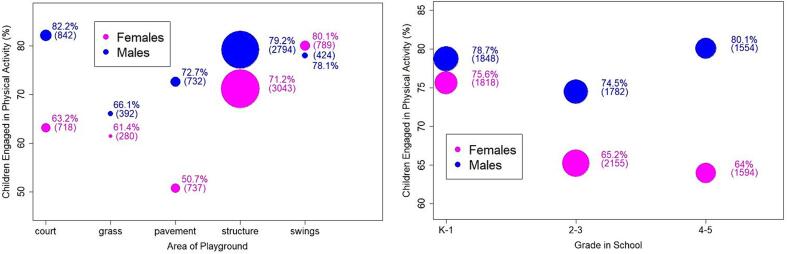
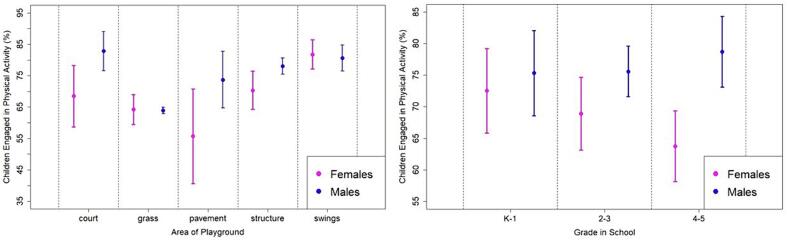
Results: 3,356 playground scans (intercoder correlation = 0.93) were collected and aggregated by school, day, gender, age (grade), and target feature for a sample size of 292 observations. The gender gap was widest among 4-5th graders, 79 % (95 % CI: 72, 86) for males and 64 % (95 % CI: 58, 70) for females. Among females, PA was highest on swings [82 % (95 % CI: 77, 86)] and lowest on paved areas [56 % (95 % CI: 43, 69)]. Among males, it was highest on both swings [81 % (95 % CI: 75, 86)] and ball courts [83 % (95 % CI: 77, 89)] and lowest on grassy areas [64 % (95 % CI: 60, 67)].
Conclusion: Swings, courts, and play structures were associated with a higher proportion of children being engaged in PA. Research is needed to identify whether physical improvements to facilitate access to these features increase PA.
Keywords: Child health; Childhood obesity; Environmental strategies; Pediatrics; Physical activity.
© 2024 The Authors.
Conflict of interest statement
The authors declare that they have no known competing financial interests or personal relationships that could have appeared to influence the work reported in this paper.
Figures
References
-
- Aletba S.R.O., Abdul Hassan N., Putra Jaya R., Aminudin E., Mahmud M.Z.H., Mohamed A., et al. Thermal performance of cooling strategies for asphalt pavement: a state-of-the-art review. J Traffic Transp Eng Engl Ed. 2021 Jun 1;8(3):356–373.
-
- Amholt T.T., Pawlowski C.S., Jespersen J.F., Schipperijn J. Investigating the use of playgrounds by tweens: a systematic observation study. Int. J. Play. 2022 Oct 2;11(4):363–381.
-
- Andersen H.B., Klinker C.D., Toftager M., Pawlowski C.S., Schipperijn J. Objectively measured differences in physical activity in five types of schoolyard area. Landsc. Urban Plan. 2015 Feb;1(134):83–92.
-
- Anthamatten P., Brink L., Kingston B., Kutchman E., Lampe S., Nigg C. An assessment of Schoolyard features and behavior patterns in children’s utilization and physical activity. J. Phys. Act. Health. 2014 Mar 1;11(3):564–573. - PubMed
Grants and funding
LinkOut - more resources
Full Text Sources
Miscellaneous
