


Target heart rate in heart failure with reduced ejection fraction and atrial fibrillation: Goldilocks zone
- PMID: 38560658
- PMCID: PMC10978401
- DOI: 10.1016/j.ahjo.2022.100218
Target heart rate in heart failure with reduced ejection fraction and atrial fibrillation: Goldilocks zone
Abstract
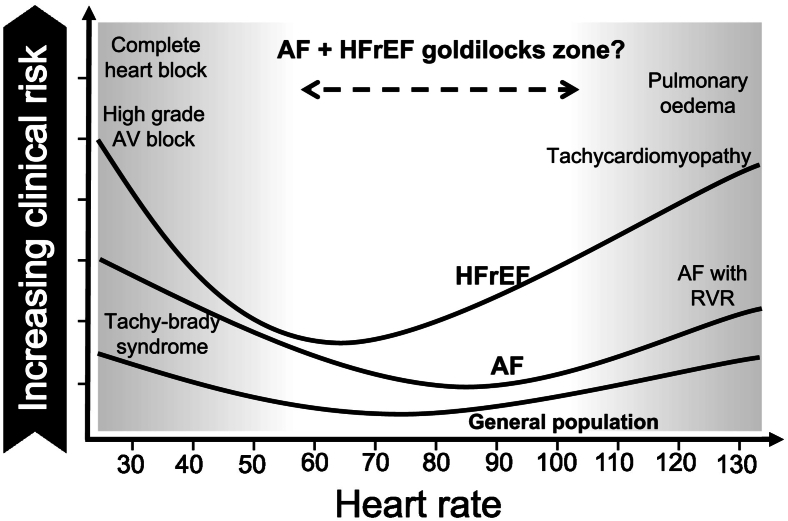
The rates of atrial fibrillation (AF) and heart failure with reduced ejection fraction (HFrEF) continue to grow with many patients suffering from their combined impact on quality of life and prognosis. A lower heart rate (HR) in HFrEF is associated with reduced morbidity and mortality due to beta-blocker and ivabradine therapy. Postulated mechanisms include reduced neurohumoral activation, increased diastolic filling time and myocardial energy conservation. In contrast, the landmark randomised controlled non-inferiority RACE II trial demonstrated that a lenient rate control strategy (target HR <110 beats per minute [bpm]) was more attainable and safer than a strict rate control strategy (resting HR <80 bpm) in permanent AF. Physiologically, a higher HR is needed to compensate for the lost 'atrial kick' that contributes to the cardiac output by coordinated atrial contractions in normal sinus rhythm. This leaves the not insignificant number of patients with HFrEF and AF in a conundrum over optimal HR control. Retrospective analyses of AF and HR control in landmark HFrEF trials (e.g. CHARM, PARADIGM and ATMOSPHERE) point towards better outcomes with a less stringent target HR. However, this association disappears after adjustment for known prognostic markers in HFrEF, including left ventricular ejection fraction, New York Heart Association class and NT-proBNP levels. There is a clear need for dedicated randomised controlled trials, investigating rate control strategies in this increasingly large subgroup of patients. Regardless of rate control strategy, effective anti-coagulation and guideline-directed medical therapy must not be forgotten in the treatment of patients with HFrEF and AF.
Keywords: Atrial fibrillation; Heart failure with reduced ejection fraction; Outcomes; Rate control; Symptoms; Target heart rate.
© 2022 The Author.
Conflict of interest statement
The authors declare that they have no known competing financial interests or personal relationships that could have appeared to influence the work reported in this paper.
Figures


References
-
- Heidenreich P.A., Bozkurt B., Aguilar D., Allen L.A., Byun J.J., Colvin M.M., Deswal A., Drazner M.H., Dunlay S.M., Evers L.R., Fang J.C., Fedson S.E., Fonarow G.C., Hayek S.S., Hernandez A.F., Khazanie P., Kittleson M.M., Lee C.S., Link M.S., Milano C.A., Nnacheta L.C., Sandhu A.T., Stevenson L.W., Vardeny O., Vest A.R., Yancy C.W. 2022 AHA/ACC/HFSA guideline for the Management of Heart Failure: a report of the american College of Cardiology/American Heart Association joint committee on clinical practice guidelines. Circulation. 2022 May 3;145(18):e895–e1032. - PubMed
-
- McDonagh T.A., Metra M., Adamo M., Gardner R.S., Baumbach A., Böhm M., Burri H., Butler J., Čelutkienė J., Chioncel O., Cleland J.G.F., Coats A.J.S., Crespo-Leiro M.G., Farmakis D., Gilard M., Heymans S., Hoes A.W., Jaarsma T., Jankowska E.A., Lainscak M., Lam C.S.P., Lyon A.R., McMurray J.J.V., Mebazaa A., Mindham R., Muneretto C., Francesco Piepoli M., Price S., Rosano G.M.C., Ruschitzka F., Kathrine Skibelund A., ESC Scientific Document Group. Authors/Task Force Members 2021 ESC Guidelines for the diagnosis and treatment of acute and chronic heart failure: developed by the Task Force for the diagnosis and treatment of acute and chronic heart failure of the European Society of Cardiology (ESC). With the special contribution of the Heart Failure Association (HFA) of the ESC. Eur. J. Heart Fail. 2022 Jan;24(1):4–131. - PubMed
-
- January C.T., Wann S.L., Alpert J.S., Calkins H., Cigarroa J.E., Cleveland J.C., et al. 2014 AHA/ACC/HRS guideline for the management of patients with atrial fibrillation: a report of the american College of Cardiology/American Heart Association task force on practice guidelines and the Heart Rhythm Society. J. Am. Coll. Cardiol. 2014 Dec 14;64(21):e1–e76. - PubMed
-
- Hindricks G., Potpara T., Dagres N., Arbelo E., Bax J.J., Blomström-Lundqvist C., ESC Scientific Document Group 2020 ESC Guidelines for the diagnosis and management of atrial fibrillation developed in collaboration with the European Association for Cardio-Thoracic Surgery (EACTS) Eur. Heart J. 2021 Feb 1;42(5):373–498. - PubMed
Publication types
LinkOut - more resources
Full Text Sources
Research Materials
