Review
. 2024 Apr 1;28(1):104.
doi: 10.1186/s13054-024-04893-4.

"NeuroVanguard": a contemporary strategy in neuromonitoring for severe adult brain injury patients

Affiliations
Review

"NeuroVanguard": a contemporary strategy in neuromonitoring for severe adult brain injury patients

Edith Elianna Rodriguez et al. Crit Care. .

Abstract

Severe acute brain injuries, stemming from trauma, ischemia or hemorrhage, remain a significant global healthcare concern due to their association with high morbidity and mortality rates. Accurate assessment of secondary brain injuries severity is pivotal for tailor adequate therapies in such patients. Together with neurological examination and brain imaging, monitoring of systemic secondary brain injuries is relatively straightforward and should be implemented in all patients, according to local resources. Cerebral secondary injuries involve factors like brain compliance loss, tissue hypoxia, seizures, metabolic disturbances and neuroinflammation. In this viewpoint, we have considered the combination of specific noninvasive and invasive monitoring tools to better understand the mechanisms behind the occurrence of these events and enhance treatment customization, such as intracranial pressure monitoring, brain oxygenation assessment and metabolic monitoring. These tools enable precise intervention, contributing to improved care quality for severe brain injury patients. The future entails more sophisticated technologies, necessitating knowledge, interdisciplinary collaboration and resource allocation, with a focus on patient-centered care and rigorous validation through clinical trials.

Keywords: Acute brain injury; Individualized care; Integrated physiology; Neuromonitoring.


Conflict of interest statement

FST received lecture fees from Integra Lifesciences and is Scientific Advisor for Neuroptics and Nihon Khoden. Other authors have no competing interests to declare.

Figures
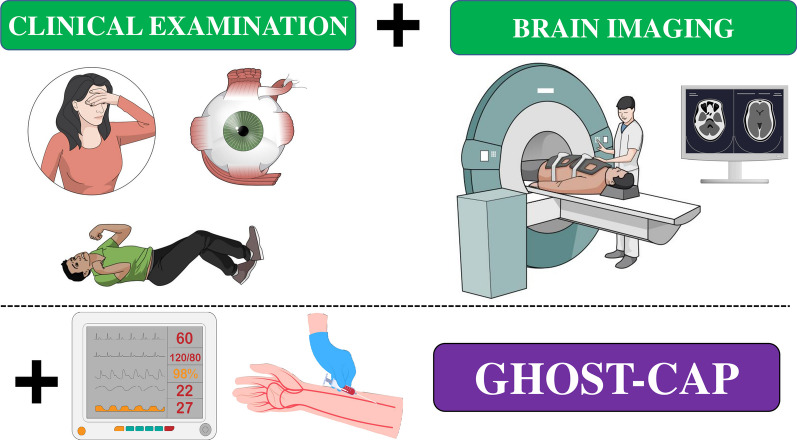
Fig. 1
Fig. 1
Initial assessment of the brain-injured patients, including clinical examination and brain imaging. For all patients, a rapid assessment of the presence of secondary systemic brain injuries using the GHOST-CAP acronym (i.e., via patient’ monitor and arterial gas analyses) is required
Fig. 2
Fig. 2
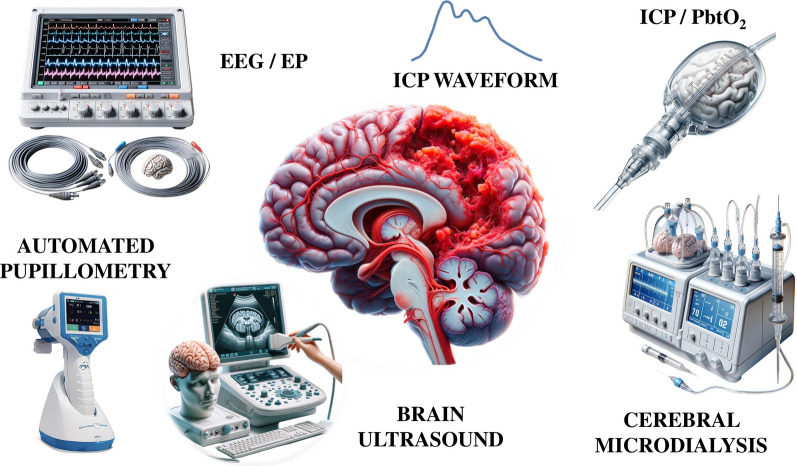
A comprehensive monitoring of brain function after an acute brain injury, including electroencephalography (EEG) and/or evoked potentials (EP), noninvasive assessment of intracranial pressure (ICP) waveform, invasive ICP and brain oxygen pressure (PbtO2) measurements, cerebral microdialysis, brain ultrasound (including cerebral blood flow velocities and optic nerve sheath diameter) and automated pupillometry
Fig. 3
Fig. 3
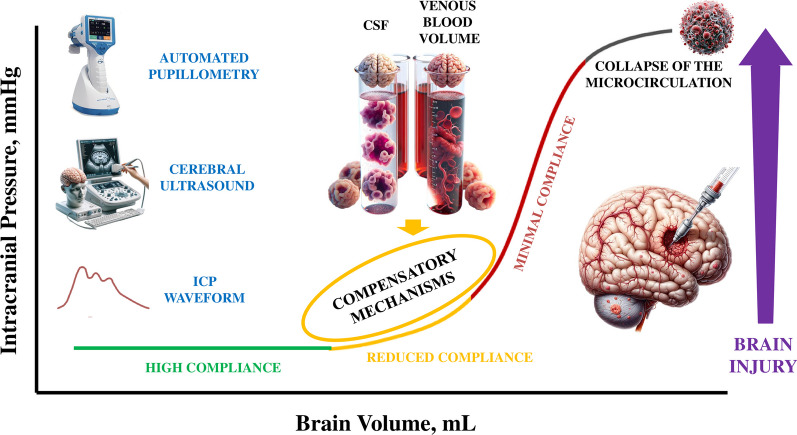
The correlation between intracranial pressure (ICP) and brain volume serves as a valuable metric for assessing brain compliance. In instances characterized by high compliance (green line), alterations in brain volume do not precipitate a corresponding elevation in ICP. However, as brain volume continues to expand, compensatory mechanisms come into play; these mechanisms encompass the displacement of cerebrospinal fluid (CSF, i.e., rostral movement outside the cranial vault) and the reduction in the venous blood volume. Over time, these compensatory processes become progressively depleted, leading to a transition from a state of reduced compliance (orange line) to minimal compliance (red line). In this latter state, even minor fluctuations in brain volume can elicit significant increases in ICP. The integration of automated pupillometry, cerebral ultrasound and evaluation of ICP waveform holds the potential to aid in gauging the extent of brain compliance, thereby facilitating a more comprehensive understanding of cerebral dynamics
Fig. 4
Fig. 4
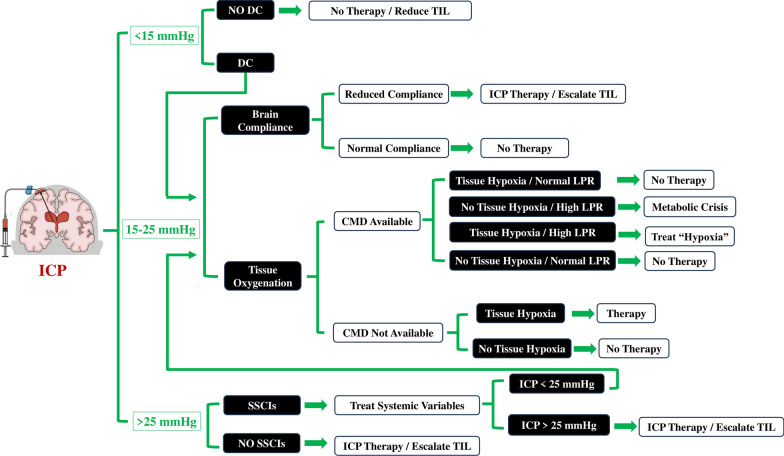
A diagnostic and therapeutic algorithm for severe brain-injured patients, initially guided by intracranial pressure (ICP) values, with subsequent individualized assessment of brain compliance or oxygenation for patients with ICP values ranging between 15 and 25 mmHg. At the end of each potential decision, the algorithm should circle back to ICP values. DC decompressive craniectomy, TIL therapy intensity level, CMD cerebral microdialysis, LPR lactate-to-pyruvate ratio, SSBI secondary systemic brain injuries
Fig. 5
Fig. 5
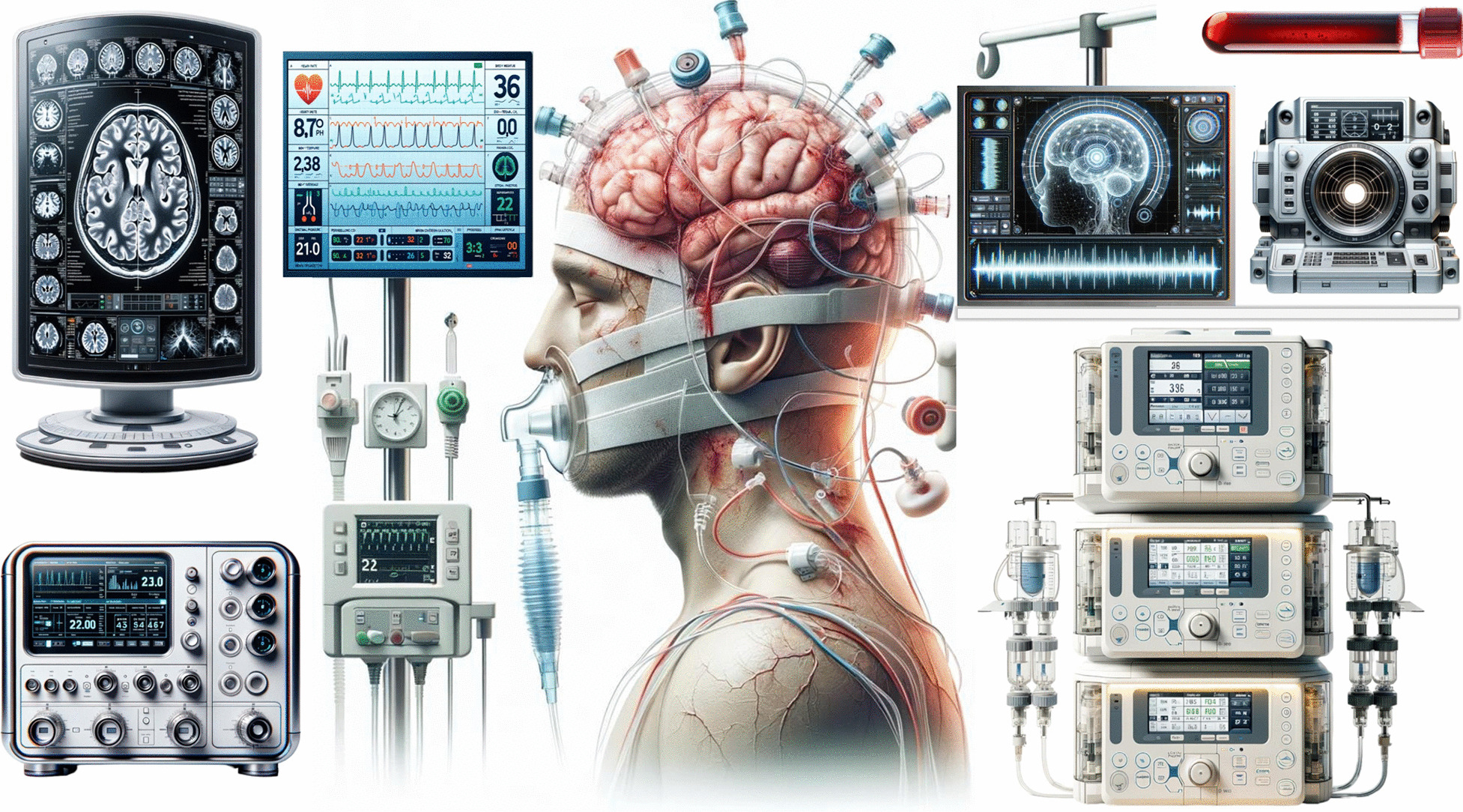
A futuristic and comprehensive neuromonitoring in brain-injured patients, encompassing (clockwise order from the top left) advanced bedside neuroimaging, systemic hemodynamics, quantitative electroencephalography, biomarkers, continuous pupillometry, personalized anesthetic management, intracranial pressure, brain oxygenation and metabolism

Comment in

References

    1. McCrea MA, Giacino JT, Barber J, Temkin NR, Nelson LD, Levin HS, et al. Functional outcomes over the first year after moderate to severe traumatic brain injury in the prospective, longitudinal TRACK-TBI study. JAMA Neurol. 2021;78(8):982–992. doi: 10.1001/jamaneurol.2021.2043. - DOI - PMC - PubMed
    1. Gouvêa Bogossian E, Diaferia D, Minini A, Ndieugnou Djangang N, Menozzi M, et al. Time course of outcome in poor grade subarachnoid hemorrhage patients: a longitudinal retrospective study. BMC Neurol. 2021;21(1):196. doi: 10.1186/s12883-021-02229-1. - DOI - PMC - PubMed
    1. Rass V, Helbok R. Early brain injury after poor-grade subarachnoid hemorrhage. Curr Neurol Neurosci Rep. 2019;19(10):78. doi: 10.1007/s11910-019-0990-3. - DOI - PMC - PubMed
    1. Rizoli S, Petersen A, Bulger E, Coimbra R, Kerby JD, Minei J, et al. Early prediction of outcome after severe traumatic brain injury: a simple and practical model. BMC Emerg Med. 2016;16(1):32. doi: 10.1186/s12873-016-0098-x. - DOI - PMC - PubMed
    1. Sharshar T, Citerio G, Andrews PJ, Chieregato A, Latronico N, Menon DK, et al. Neurological examination of critically ill patients: a pragmatic approach. Report of an ESICM expert panel. Intensive Care Med. 2014;40(4):484–495. doi: 10.1007/s00134-014-3214-y. - DOI - PubMed