Review
. 2024 Apr 2;13(1):17.
doi: 10.1186/s40035-024-00406-z.

Dietary fasting and time-restricted eating in Huntington's disease: therapeutic potential and underlying mechanisms

Affiliations
Review

Dietary fasting and time-restricted eating in Huntington's disease: therapeutic potential and underlying mechanisms

Russell G Wells et al. Transl Neurodegener. .

Abstract

Huntington's disease (HD) is a devastating neurodegenerative disorder caused by aggregation of the mutant huntingtin (mHTT) protein, resulting from a CAG repeat expansion in the huntingtin gene HTT. HD is characterized by a variety of debilitating symptoms including involuntary movements, cognitive impairment, and psychiatric disturbances. Despite considerable efforts, effective disease-modifying treatments for HD remain elusive, necessitating exploration of novel therapeutic approaches, including lifestyle modifications that could delay symptom onset and disease progression. Recent studies suggest that time-restricted eating (TRE), a form of intermittent fasting involving daily caloric intake within a limited time window, may hold promise in the treatment of neurodegenerative diseases, including HD. TRE has been shown to improve mitochondrial function, upregulate autophagy, reduce oxidative stress, regulate the sleep-wake cycle, and enhance cognitive function. In this review, we explore the potential therapeutic role of TRE in HD, focusing on its underlying physiological mechanisms. We discuss how TRE might enhance the clearance of mHTT, recover striatal brain-derived neurotrophic factor levels, improve mitochondrial function and stress-response pathways, and synchronize circadian rhythm activity. Understanding these mechanisms is critical for the development of targeted lifestyle interventions to mitigate HD pathology and improve patient outcomes. While the potential benefits of TRE in HD animal models are encouraging, future comprehensive clinical trials will be necessary to evaluate its safety, feasibility, and efficacy in persons with HD.

Keywords: Autophagy; Circadian rhythm; Dietary fasting; Huntington’s disease; Intermittent fasting; Lifestyle intervention; Mitochondrial biogenesis; Neuroprotection; Time-restricted eating.


Conflict of interest statement

The authors declare that they have no competing interests.

Figures
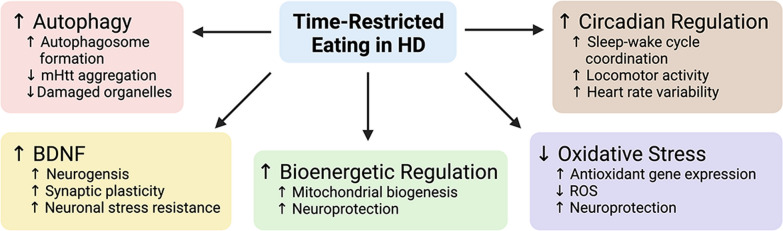
Fig. 1
Fig. 1
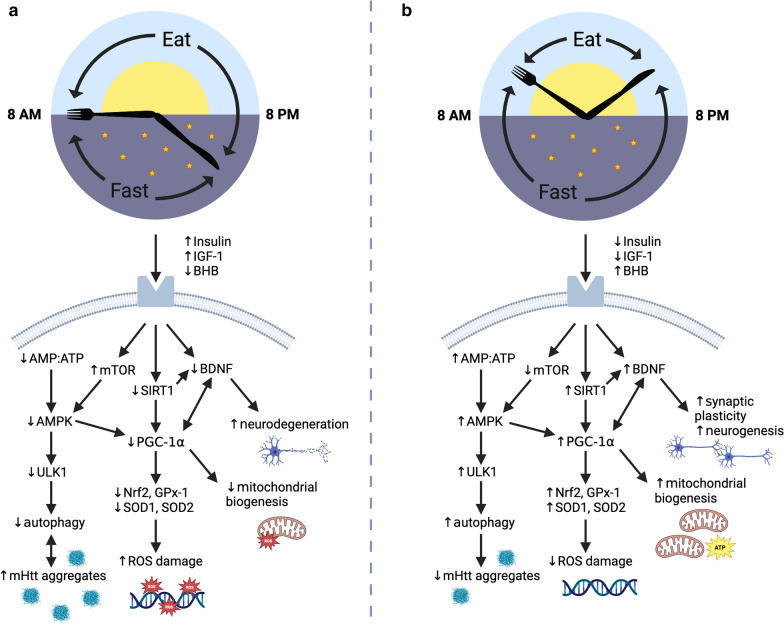
Model of mechanisms underlying the therapeutic potential of time-restricted eating in Huntington’s disease (HD). Scheduled daily eating and fasting, known as time-restricted eating (TRE), in HD and non-HD human and animal studies reveals that the practice increases autophagic activity which is thought to decrease aggregation of the mutant huntingtin protein (mHTT), stimulates production of brain-derived neurotrophic factor (BDNF), improves metabolic functions, promotes oxidative stress resistance, decreases reactive oxygen species (ROS), and improves measures of circadian rhythm function. Created with BioRender.com
Fig. 2
Fig. 2
Potential neuroprotective effects mediated by time-restricted eating in Huntington’s disease (HD). a Chronic caloric exposure increases levels of insulin and IGF-1 and decreases the cellular AMP/ATP ratio, leading to activation of mTOR and downregulation of AMPK activity, respectively. As a result, autophagic processes are not stimulated and mHTT protein aggregates accumulate, which further inhibit cellular autophagic activity. Decreased SIRT1 in a fed state and decreased BDNF expression seen in HD pathology result in downregulation of PGC-1α and subsequent oxidative stress, neurodegeneration, and metabolic dysregulation. b Fasting in TRE downregulates mTOR and upregulates AMPK, which stimulate autophagy through ULK1 activation. Increased autophagy is known to reduce mHTT aggregate formation in neurons. Fasting in TRE also upregulates SIRT1, which has been shown to potentiate PGC-1α and promote oxidative stress resistance and mitochondrial biogenesis. States of fasting additionally result in increased peripheral blood levels of BHB which upregulate BDNF expression. BDNF induces neurogenesis and synaptic plasticity and activates PGC-1α for further metabolic regulation and antioxidant effects. Created with BioRender.com

References

    1. Huntington G. On chorea. J Neuropsychiatry Clin Neurosci. 1872;15(1):109–112. doi: 10.1176/jnp.15.1.109. - DOI - PubMed
    1. MacDonald ME, AMbrose CM, Duyao MP, Datson N. A novel gene containing a trinucleotide repeat that is expanded and unstable on Huntington's disease chromosomes The Huntington's Disease Collaborative Research Group. Cell. 1993;72(6):971–983. doi: 10.1016/0092-8674(93)90585-e. - DOI - PubMed
    1. Kay C, Collins JA, Miedzybrodzka Z, Madore SJ, Gordon ES, Gerry N, et al. Huntington disease reduced penetrance alleles occur at high frequency in the general population. Neurology. 2016;87(3):282–288. doi: 10.1212/wnl.0000000000002858. - DOI - PMC - PubMed
    1. Reilmann R, Leavitt BR, Ross CA. Diagnostic criteria for Huntington's disease based on natural history. Mov Disord. 2014;29(11):1335–1341. doi: 10.1002/mds.26011. - DOI - PubMed
    1. Swami M, Hendricks AE, Gillis T, Massood T, Mysore J, Myers RH, Wheeler VC. Somatic expansion of the Huntington's disease CAG repeat in the brain is associated with an earlier age of disease onset. Hum Mol Genet. 2009;18(16):3039–3047. doi: 10.1093/hmg/ddp242. - DOI - PMC - PubMed

Publication types