


This is a preprint.
Quantitating SARS-CoV-2 Neutralizing Antibodies from Human Dried Blood Spots
- PMID: 38562708
- PMCID: PMC10983952
- DOI: 10.1101/2024.03.18.585599
Quantitating SARS-CoV-2 Neutralizing Antibodies from Human Dried Blood Spots
Update in
-
Quantitating SARS-CoV-2 neutralizing antibodies from human dried blood spots.Microbiol Spectr. 2024 Oct 29;12(12):e0084624. doi: 10.1128/spectrum.00846-24. Online ahead of print. Microbiol Spectr. 2024. PMID: 39470282 Free PMC article.
Abstract
Background: In the earliest days of COVID-19 pandemic, the collection of dried blood spots (DBS) enabled public health laboratories to undertake population-scale seroprevalence studies to estimate rates of SARS-CoV-2 exposure. With SARS-CoV-2 seropositivity levels now estimated to exceed 94% in the United States, attention has turned to using DBS to assess functional (neutralizing) antibodies within cohorts of interest.
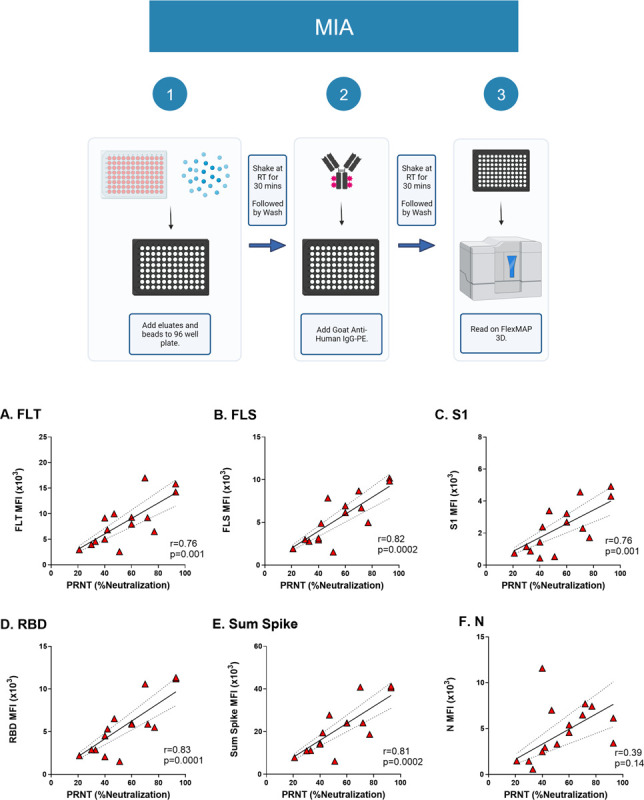
Methods: Contrived DBS eluates from convalescent, fully vaccinated and pre-COVID-19 serum samples were evaluated in SARS-CoV-2 plaque reduction neutralization titer (PRNT) assays, a SARS-CoV-2 specific 8-plex microsphere immunoassay, a cell-based pseudovirus assay, and two different spike-ACE2 inhibition assays, an in-house Luminex-based RBD-ACE2 inhibition assay and a commercial real-time PCR-based inhibition assay (NAB-Sure™).
Results: DBS eluates from convalescent individuals were compatible with the spike-ACE2 inhibition assays, but not cell-based pseudovirus assays or PRNT. However, the insensitivity of cell-based pseudovirus assays was overcome with DBS eluates from vaccinated individuals with high SARS-CoV-2 antibody titers.
Conclusion: SARS-CoV-2 neutralizing titers can be derived with confidence from DBS eluates, thereby opening the door to the use of these biospecimens for the analysis of vulnerable populations and normally hard to reach communities.
Keywords: Antibody; COVID-19; Human; Neutralizing; Serology.
Conflict of interest statement
Conflicts of Interests (COI). The authors have no conflicts of interest to declare.
Figures



References
-
- Rosenberg ES, Tesoriero JM, Rosenthal EM, Chung R, Barranco MA, Styer LM, Parker MM, John Leung SY, Morne JE, Greene D, Holtgrave DR, Hoefer D, Kumar J, Udo T, Hutton B, Zucker HA. 2020. Cumulative incidence and diagnosis of SARS-CoV-2 infection in New York. Ann Epidemiol doi:10.1016/j.annepidem.2020.06.004. - DOI - PMC - PubMed
-
- Damjanovic A, Styer LM, Nemeth K, Yauney E, Rock JM, Bievenue R, Hoen R, Ehrbar D, Kay DM, Caggana M, Parker MM. 2022. Utility of Newborn Dried Blood Spots to Ascertain Seroprevalence of SARS-CoV-2 Antibodies Among Individuals Giving Birth in New York State, November 2019 to November 2021. JAMA Netw Open 5:e2227995. - PMC - PubMed
-
- Amendola A, Bianchi S, Gori M, Barcellini L, Colzani D, Canuti M, Giacomet V, Fabiano V, Folgori L, Zuccotti GV, Tanzi E. 2021. Dried Blood Spot as an Alternative to Plasma/Serum for SARS-CoV-2 IgG Detection, an Opportunity to Be Sized to Facilitate COVID-19 Surveillance Among Schoolchildren. Pediatr Infect Dis J 40:e46–e47. - PubMed
-
- Basto-Abreu A, Carnalla M, Torres-Ibarra L, Sanchez-Pajaro A, Romero-Martinez M, Martinez-Barnetche J, Lopez-Martinez I, Aparicio-Antonio R, Shamah-Levy T, Alpuche-Aranda C, Rivera JA, Barrientos-Gutierrez T, Ensanut-Covid C. 2023. SARS-CoV-2 seroprevalence and vaccine coverage from August to November 2021: A nationally representative survey in Mexico. J Med Virol 95:e29038. - PubMed
-
- Matias WR, Fulcher IR, Sauer SM, Nolan CP, Guillaume Y, Zhu J, Molano FJ, Uceta E, Collins S, Slater DM, Sanchez VM, Moheed S, Harris JB, Charles RC, Paxton RM, Gonsalves SF, Franke MF, Ivers LC. 2023. Disparities in SARS-CoV-2 Infection by Race, Ethnicity, Language, and Social Vulnerability: Evidence from a Citywide Seroprevalence Study in Massachusetts, USA. J Racial Ethn Health Disparities doi:10.1007/s40615-022-01502-4:1–11. - DOI - PMC - PubMed
Publication types
Grants and funding
LinkOut - more resources
Full Text Sources
Miscellaneous
