This is a preprint.
Does diversity beget diversity? A scientometric analysis of over 150,000 studies and 49,000 authors published in high-impact medical journals between 2007 and 2022
- PMID: 38562711
- PMCID: PMC10984076
- DOI: 10.1101/2024.03.21.24304695
Does diversity beget diversity? A scientometric analysis of over 150,000 studies and 49,000 authors published in high-impact medical journals between 2007 and 2022
Update in
-
Diversity in the medical research ecosystem: a descriptive scientometric analysis of over 49 000 studies and 150 000 authors published in high-impact medical journals between 2007 and 2022.BMJ Open. 2025 Jan 22;15(1):e086982. doi: 10.1136/bmjopen-2024-086982. BMJ Open. 2025. PMID: 39843370 Free PMC article.
Abstract
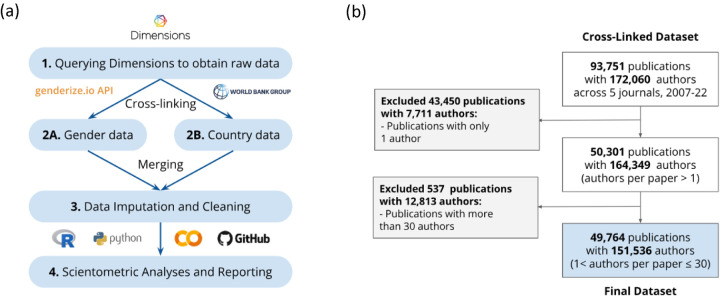
Background: Health research that significantly impacts global clinical practice and policy is often published in high-impact factor (IF) medical journals. These outlets play a pivotal role in the worldwide dissemination of novel medical knowledge. However, researchers identifying as women and those affiliated with institutions in low- and middle-income countries (LMIC) have been largely underrepresented in high-IF journals across multiple fields of medicine. To evaluate disparities in gender and geographical representation among authors who have published in any of five top general medical journals, we conducted scientometric analyses using a large-scale dataset extracted from the New England Journal of Medicine (NEJM), Journal of the American Medical Association (JAMA), The British Medical Journal (BMJ), The Lancet, and Nature Medicine.
Methods: Author metadata from all articles published in the selected journals between 2007 and 2022 were collected using the DimensionsAI platform. The Genderize.io API was then utilized to infer each author's likely gender based on their extracted first name. The World Bank country classification was used to map countries associated with researcher affiliations to the LMIC or the high-income country (HIC) category. We characterized the overall gender and country income category representation across the medical journals. In addition, we computed article-level diversity metrics and contrasted their distributions across the journals.
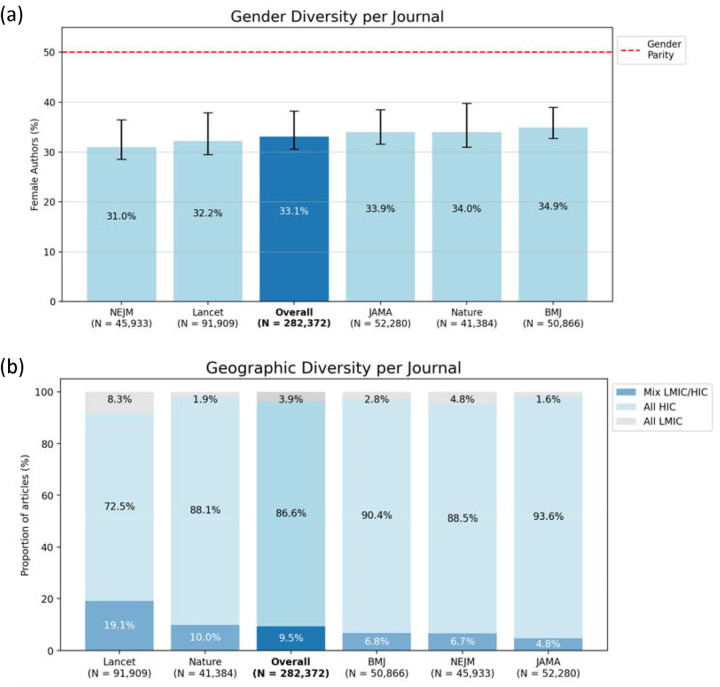
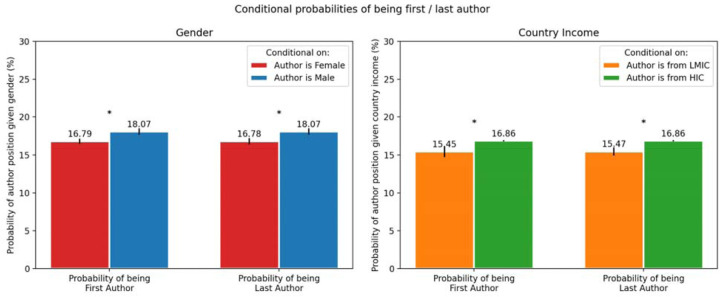
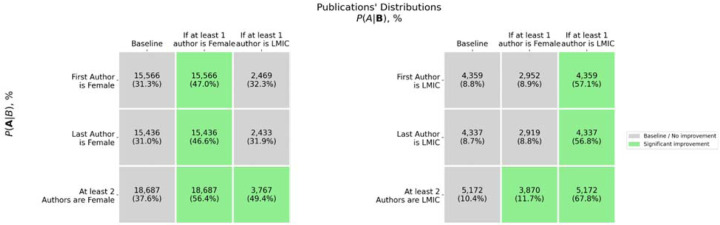
Findings: We studied 151,536 authors across 49,764 articles published in five top medical journals, over a long period spanning 15 years. On average, approximately one-third (33.1%) of the authors of a given paper were inferred to be women; this result was consistent across the journals we studied. Further, 86.6% of the teams were exclusively composed of HIC authors; in contrast, only 3.9% were exclusively composed of LMIC authors. The probability of serving as the first or last author was significantly higher if the author was inferred to be a man (18.1% vs 16.8%, P < .01) or was affiliated with an institution in a HIC (16.9% vs 15.5%, P < .01). Our primary finding reveals that having a diverse team promotes further diversity, within the same dimension (i.e., gender or geography) and across dimensions. Notably, papers with at least one woman among the authors were more likely to also involve at least two LMIC authors (11.7% versus 10.4% in baseline, P < .001; based on inferred gender); conversely, papers with at least one LMIC author were more likely to also involve at least two women (49.4% versus 37.6%, P < .001; based on inferred gender).
Conclusion: We provide a scientometric framework to assess authorship diversity. Our research suggests that the inclusiveness of high-impact medical journals is limited in terms of both gender and geography. We advocate for medical journals to adopt policies and practices that promote greater diversity and collaborative research. In addition, our findings offer a first step towards understanding the composition of teams conducting medical research globally and an opportunity for individual authors to reflect on their own collaborative research practices and possibilities to cultivate more diverse partnerships in their work.
Conflict of interest statement
Conflicts of interest None of the authors have any conflicts of interest to declare.
Figures
Similar articles
-
Diversity in the medical research ecosystem: a descriptive scientometric analysis of over 49 000 studies and 150 000 authors published in high-impact medical journals between 2007 and 2022.BMJ Open. 2025 Jan 22;15(1):e086982. doi: 10.1136/bmjopen-2024-086982. BMJ Open. 2025. PMID: 39843370 Free PMC article.
-
Bibliometric analysis of authorship patterns in publications from a research group at the London School of Hygiene & Tropical Medicine, 2016-2020.BMJ Glob Health. 2023 Feb;8(2):e011053. doi: 10.1136/bmjgh-2022-011053. BMJ Glob Health. 2023. PMID: 36792228 Free PMC article.
-
Academic medicine's glass ceiling: Author's gender in top three medical research journals impacts probability of future publication success.PLoS One. 2022 Apr 20;17(4):e0261209. doi: 10.1371/journal.pone.0261209. eCollection 2022. PLoS One. 2022. PMID: 35442998 Free PMC article.
-
Neuro-oncology authorship trends in gender since 1944: a systematic review of 14,020 articles from five top-tier academic journals.J Neurosurg. 2022 Nov 25;139(1):1-10. doi: 10.3171/2022.10.JNS221183. Print 2023 Jul 1. J Neurosurg. 2022. PMID: 36433875
-
The gender and geography of publishing: a review of sex/gender reporting and author representation in leading general medical and global health journals.BMJ Glob Health. 2021 May;6(5):e005672. doi: 10.1136/bmjgh-2021-005672. BMJ Glob Health. 2021. PMID: 33986001 Free PMC article. Review.
References
Publication types
Grants and funding
LinkOut - more resources
Full Text Sources
Miscellaneous