


Impact of pulmonary hypertension on outcomes after TEER in patients suffering from mitral regurgitation
- PMID: 38565712
- PMCID: PMC11839688
- DOI: 10.1007/s00392-024-02442-1
Impact of pulmonary hypertension on outcomes after TEER in patients suffering from mitral regurgitation
Abstract
Aim: Data on associations of invasively determined hemodynamic parameters with procedural success and outcomes in patients suffering from mitral regurgitation (MR) undergoing transcatheter edge-to-edge repair of the mitral valve (M-TEER) is limited.
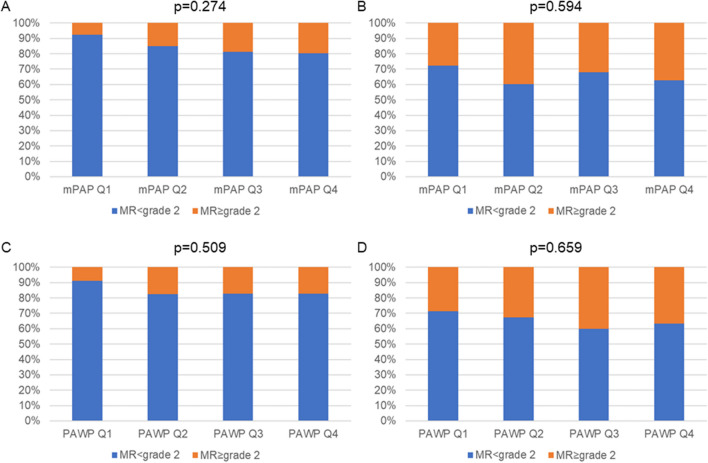
Methods and results: We enrolled 239 patients with symptomatic MR of grade 2 + , who received M-TEER. All patients underwent extensive pre-interventional invasive hemodynamic measurements via right heart catheterization (mean pulmonary arterial pressure (mPAP), systolic- (PAPsys) and diastolic pulmonary arterial pressure (PAPdia), pulmonary arterial wedge pressure (PAWP), a-wave, v-wave, pulmonary vascular resistance (PVR), transpulmonary pressure gradient (TPG), cardiac index (CI), stroke volume index (SVI)). mPAP and PAWP at baseline were neither associated with procedural success, immediate reduction of MR, nor residual MR after 6 months of follow-up. The composite outcome (All-cause mortality (ACM) and/or heart failure induced rehospitalization (HFH)) and HFH differed significantly after M-TEER when stratified according to mPAP, PAWP, PAPdia, a-wave and v-wave. ACM was not associated with the afore mentioned parameters. Neither PVR, TPG, CI nor SVI were associated with the composite outcome and HFH, respectively. In multivariable analyses, PAWP was independently associated with the composite outcome and HFH. PVR and SVI were not associated with outcomes.
Conclusion: PAWP at baseline was significantly and independently associated with HFH and might serve as a valuable parameter for identifying patients at high risk for HFH after M-TEER. ACM and procedural success were not affected by pulmonary arterial pressure before M-TEER. We suggest that the post-capillary component of PH serves as the driving force behind the risk of HFH.
Keywords: Mitral valve transcatheter edge-to-edge repair; Outcome Assessment; Pulmonary Arterial Hypertension.
© 2024. The Author(s).
Conflict of interest statement
Declarations. Conflicts of interest: The authors have no conflicts of interest to disclose.
Figures



References
-
- Stone GW, Lindenfeld J, Abraham WT, Kar S, Lim DS, Mishell JM et al (2018) Transcatheter Mitral-Valve Repair in Patients with Heart Failure. N Engl J Med 379(24):2307–2318. 10.1056/NEJMoa1806640 - PubMed
-
- Otto CM, Nishimura RA, Bonow RO, Carabello BA, Erwin JP 3rd, Gentile F et al (2021) 2020 ACC/AHA Guideline for the Management of Patients With Valvular Heart Disease: A Report of the American College of Cardiology/American Heart Association Joint Committee on Clinical Practice Guidelines. Circulation 143(5):e72–e227. 10.1161/CIR.0000000000000923 - PubMed
-
- Geisler T, Jorbenadze R, Popov AF, Mueller KL, Rath D, Droppa M et al (2019) Thrombogenicity and Antithrombotic Strategies in Structural Heart Interventions and Nonaortic Cardiac Device Therapy-Current Evidence and Practice. Thromb Haemost 119(10):1590–1605. 10.1055/s-0039-1694751 - PubMed
-
- Kar S, Feldman T, Qasim A, Trento A, Kapadia S, Pedersen W et al (2019) Five-year outcomes of transcatheter reduction of significant mitral regurgitation in high-surgical-risk patients. Heart 105(21):1622–1628. 10.1136/heartjnl-2017-312605 - PubMed
-
- Lombard FW, Liang Y (2019) Risk Factors for Mitral Valve Surgery: Atrial Fibrillation and Pulmonary Hypertension. Semin Cardiothorac Vasc Anesth 23(1):57–69. 10.1177/1089253218821694 - PubMed
MeSH terms
LinkOut - more resources
Full Text Sources
Medical
Research Materials
