


A new clinical model for predicting lymph node metastasis in T1 colorectal cancer
- PMID: 38565736
- PMCID: PMC10987358
- DOI: 10.1007/s00384-024-04621-y
A new clinical model for predicting lymph node metastasis in T1 colorectal cancer
Abstract
Purpose: Lymph node metastasis (LNM) is a crucial factor that determines the prognosis of T1 colorectal cancer (CRC) patients. We aimed to develop a practical prediction model for LNM in T1 CRC.
Methods: We conducted a retrospective analysis of data from 825 patients with T1 CRC who underwent radical resection at a single center in China. All enrolled patients were randomly divided into a training set and a validation set at a ratio of 7:3 using R software. Risk factors for LNM were identified through multivariate logistic regression analyses. Subsequently, a prediction model was developed using the selected variables.
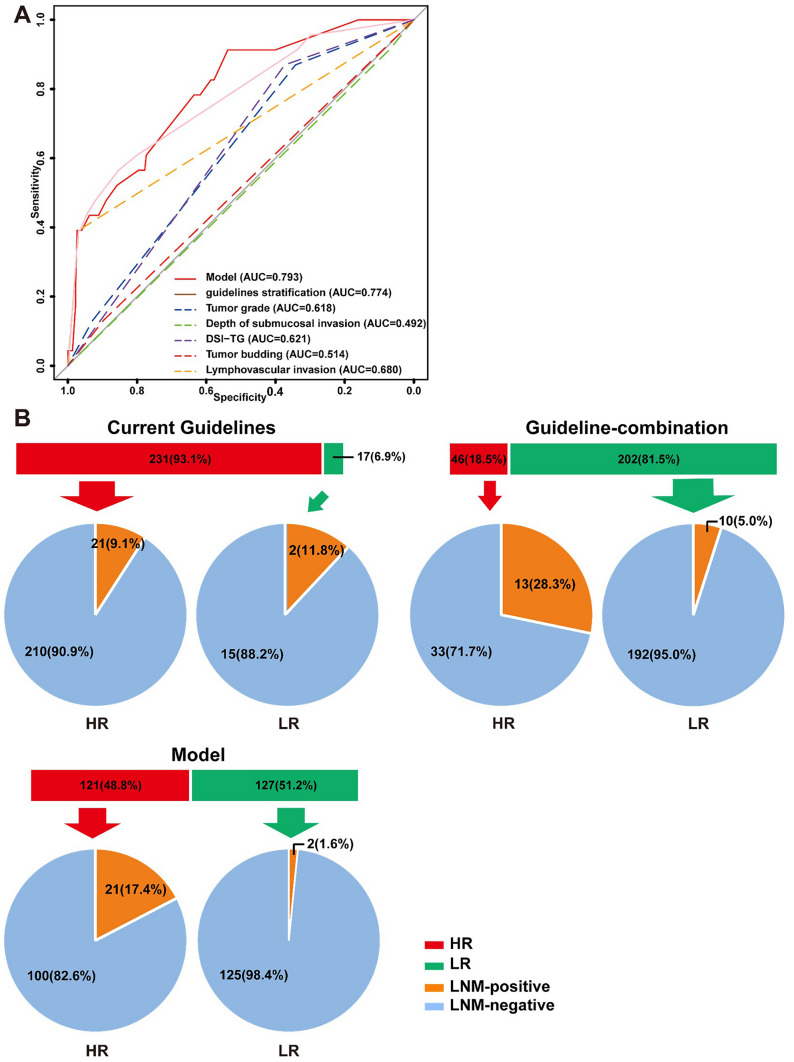
Results: The lymph node metastasis (LNM) rate was 10.1% in the training cohort and 9.3% in the validation cohort. In the training set, risk factors for LNM in T1 CRC were identified, including depressed endoscopic gross appearance, sex, submucosal invasion combined with tumor grade (DSI-TG), lymphovascular invasion (LVI), and tumor budding. LVI emerged as the most potent predictor for LNM. The prediction model based on these factors exhibited good discrimination ability in the validation sets (AUC: 79.3%). Compared to current guidelines, the model could potentially reduce over-surgery by 48.9%. Interestingly, we observed that sex had a differential impact on LNM between early-onset and late-onset CRC patients.
Conclusions: We developed a clinical prediction model for LNM in T1 CRC using five factors that are easily accessible in clinical practice. The model has better predictive performance and practicality than the current guidelines and can assist clinicians in making treatment decisions for T1 CRC patients.
Keywords: Depth of submucosal invasion (DSI); Lymph node metastasis (LNM); Prediction; Sex; T1 colorectal cancer (CRC).
© 2024. The Author(s).
Conflict of interest statement
The authors declare no competing interests.
Figures

References
-
- Morgan E, Arnold M, Gini A et al (2023) Global burden of colorectal cancer in 2020 and 2040: incidence and mortality estimates from GLOBOCAN. Gut 72:338–344. 10.1136/gutjnl-2022-327736 - PubMed
-
- Keum N, Giovannucci E (2019) Global burden of colorectal cancer: emerging trends, risk factors and prevention strategies. Nat Rev Gastroenterol Hepatol 16:713–732. 10.1038/s41575-019-0189-8 - PubMed
-
- Qu R, Ma Y, Zhang Z, Fu W (2022) Increasing burden of colorectal cancer in China. Lancet Gastroenterol Hepatol 7:700. 10.1016/S2468-1253(22)00156-X - PubMed
-
- Ladabaum U, Dominitz JA, Kahi C, Schoen RE (2020) Strategies for colorectal cancer screening. Gastroenterology 158:418–432. 10.1053/j.gastro.2019.06.043 - PubMed
Publication types
MeSH terms
Supplementary concepts
Grants and funding
- 82172561/National Natural Science Foundation of China
- 82172561/National Natural Science Foundation of China
- 82172561/National Natural Science Foundation of China
- 82172561/National Natural Science Foundation of China
- 82172561/National Natural Science Foundation of China
- 82172561/National Natural Science Foundation of China
- 82172561/National Natural Science Foundation of China
- 2021A1515110987/National Natural Science Foundation of China-Guangdong Joint Fund
- 2021A1515110987/National Natural Science Foundation of China-Guangdong Joint Fund
- 2021A1515110987/National Natural Science Foundation of China-Guangdong Joint Fund
- 2021A1515110987/National Natural Science Foundation of China-Guangdong Joint Fund
- 2021A1515110987/National Natural Science Foundation of China-Guangdong Joint Fund
- 2021A1515110987/National Natural Science Foundation of China-Guangdong Joint Fund
- 2021A1515110987/National Natural Science Foundation of China-Guangdong Joint Fund
- 2022B1515020022/Guangdong Special Young Talent Plan of Scientific and Technological Innovation
- 2022B1515020022/Guangdong Special Young Talent Plan of Scientific and Technological Innovation
- 2022B1515020022/Guangdong Special Young Talent Plan of Scientific and Technological Innovation
- 2022B1515020022/Guangdong Special Young Talent Plan of Scientific and Technological Innovation
- 2022B1515020022/Guangdong Special Young Talent Plan of Scientific and Technological Innovation
- 2022B1515020022/Guangdong Special Young Talent Plan of Scientific and Technological Innovation
- 2022B1515020022/Guangdong Special Young Talent Plan of Scientific and Technological Innovation
LinkOut - more resources
Full Text Sources
Medical
Miscellaneous
