


Elucidating the ecophysiology of soybean pod-sucking stinkbug Riptortus pedestris (Hemiptera: Alydidae) based on de novo genome assembly and transcriptome analysis
- PMID: 38565997
- PMCID: PMC10985886
- DOI: 10.1186/s12864-024-10232-2
Elucidating the ecophysiology of soybean pod-sucking stinkbug Riptortus pedestris (Hemiptera: Alydidae) based on de novo genome assembly and transcriptome analysis
Abstract
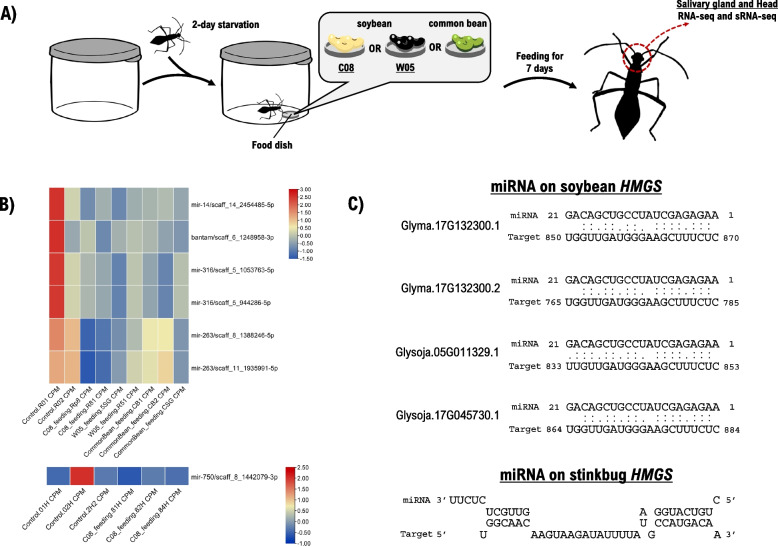
Food security is important for the ever-growing global population. Soybean, Glycine max (L.) Merr., is cultivated worldwide providing a key source of food, protein and oil. Hence, it is imperative to maintain or to increase its yield under different conditions including challenges caused by abiotic and biotic stresses. In recent years, the soybean pod-sucking stinkbug Riptortus pedestris has emerged as an important agricultural insect pest in East, South and Southeast Asia. Here, we present a genomics resource for R. pedestris including its genome assembly, messenger RNA (mRNA) and microRNA (miRNA) transcriptomes at different developmental stages and from different organs. As insect hormone biosynthesis genes (genes involved in metamorphosis) and their regulators such as miRNAs are potential targets for pest control, we analyzed the sesquiterpenoid (juvenile) and ecdysteroid (molting) hormone biosynthesis pathway genes including their miRNAs and relevant neuropeptides. Temporal gene expression changes of these insect hormone biosynthesis pathways were observed at different developmental stages. Similarly, a diet-specific response in gene expression was also observed in both head and salivary glands. Furthermore, we observed that microRNAs (bantam, miR-14, miR-316, and miR-263) of R. pedestris fed with different types of soybeans were differentially expressed in the salivary glands indicating a diet-specific response. Interestingly, the opposite arms of miR-281 (-5p and -3p), a miRNA involved in regulating development, were predicted to target Hmgs genes of R. pedestris and soybean, respectively. These observations among others highlight stinkbug's responses as a function of its interaction with soybean. In brief, the results of this study not only present salient findings that could be of potential use in pest management and mitigation but also provide an invaluable resource for R. pedestris as an insect model to facilitate studies on plant-pest interactions.
Keywords: Ecdysteroid; MicroRNA; Neuropeptide; Sesquiterpenoid; Soybean; Stinkbug; Transcriptome.
© 2024. The Author(s).
Conflict of interest statement
The authors declare no competing interests.
Figures


References
-
- Do Bae S, Kim HJ, Mainali BP. Infestation of Riptortus pedestris (Fabricius) decreases the nutritional quality and germination potential of soybean seeds. Journal of Asia-Pacific Entomology. 2014;17(3):477–481. doi: 10.1016/j.aspen.2014.04.006. - DOI
-
- Kobayashi T. Biology of insect pests of soybean and their control. Japan Agricultural Research Quarterly. 1972;6(4):212–218.
-
- Painter RH. Insect resistance in crop plants. LWW. 1951;Vol 72(NO 6):p 481.
-
- Stout MJ. Chapter 1 - Host-Plant Resistance in Pest Management. In: Abrol DP, editor. Integrated Pest Management. San Diego: Academic Press; 2014. p. 1–21. 10.1016/B978-0-12-398529-3.00002-6.
-
- Van Emden HF, Harrington R, editors. Aphids as crop pests. Cabi; 2017. 10.1079/9781780647098.000017.
MeSH terms
Substances
LinkOut - more resources
Full Text Sources
Research Materials
