Review
. 2022 Dec 29;2(1):kyac012.
doi: 10.1093/discim/kyac012. eCollection 2023.

Review: Unravelling the Role of DNA Sensing in Alum Adjuvant Activity

Affiliations
Review

Review: Unravelling the Role of DNA Sensing in Alum Adjuvant Activity

Zara Gatt et al. Discov Immunol. .

Abstract

Public interest in vaccines is at an all-time high following the SARS-CoV-2 global pandemic. Currently, over 6 billion doses of various vaccines are administered globally each year. Most of these vaccines contain Aluminium-based adjuvants (alum), which have been known and used for almost 100 years to enhance vaccine immunogenicity. However, despite the historical use and importance of alum, we still do not have a complete understanding of how alum works to drive vaccine immunogenicity. In this article, we critically review studies investigating the mechanisms of action of alum adjuvants, highlighting some of the misconceptions and controversies within the area. Although we have emerged with a clearer understanding of how this ubiquitous adjuvant works, we have also highlighted some of the outstanding questions in the field. While these may seem mainly of academic interest, developing a more complete understanding of these mechanisms has the potential to rationally modify and improve the immune response generated by alum-adjuvanted vaccines.

Keywords: DNA sensing; adjuvants; alum; mechanism; vaccines.


Conflict of interest statement

JMB is in receipt of funding from GSK in support of ARs PhD project. Outside of this submitted work, Arianna Raponi participates in a post-graduate studentship program at GSK.

Figures
Graphical Abstract
Graphical Abstract
Figure 1:
Figure 1:
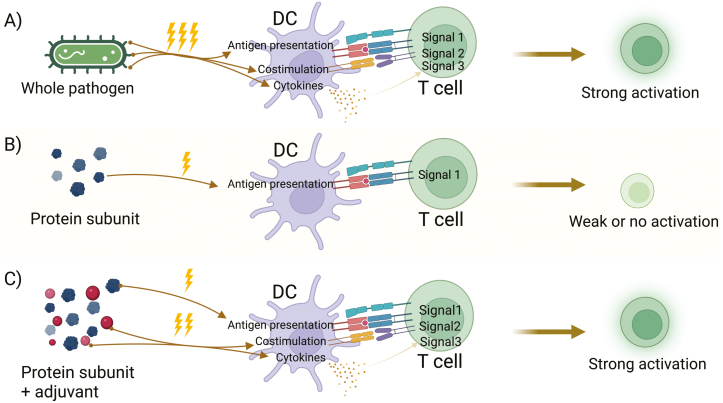
Refined vaccines have a reduced ability to stimulate immune responses, which can be restored by the addition of adjuvants. (a) Attenuated or killed pathogen vaccines contain a variety of PAMPs that can stimulate DCs resulting in strong T cell responses. (b) Dendritic cells that take up purified protein subunit vaccines can provide cognate antigen signals to T cells, but lack PAMPs and therefore fail to induce the costimulatory and cytokine signalling required for strong T cell responses. (c) The addition of adjuvants to protein subunit vaccines can restore the costimulatory and cytokine signals, resulting in stronger activation of T cells. Created with BioRender.com.
Figure 2:
Figure 2:
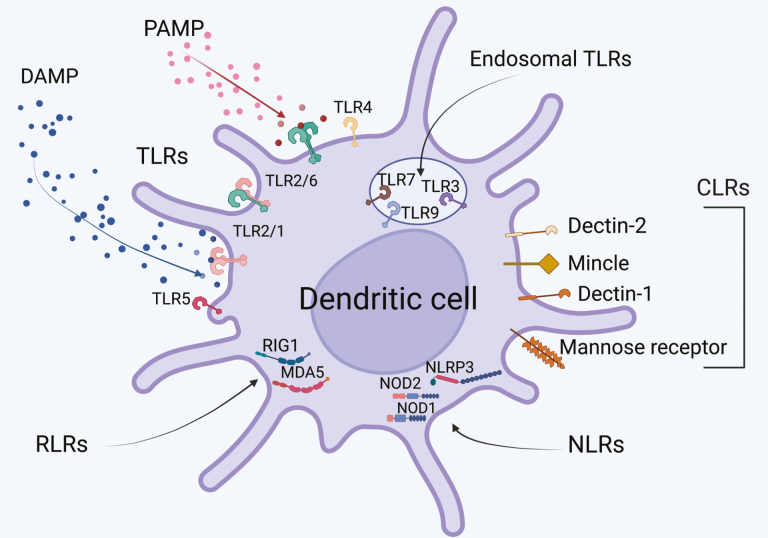
PRRs sense pathogen and danger signals, leading to Dendritic cell activation. Pathogen or Danger-associated molecular patterns (PAMPs or DAMPs, respectively) are recognised by a constellation of pattern recognition receptors (PRRs) on the surface or inside DCs. These PRRs are also the targets of vaccine adjuvants, which trigger PRRs to activate the DCs to increase antigen presentation via MHC, induce costimulatory molecule expression and drive cytokine production to enhance the activation of vaccine specific T cells. Created with BioRender.com.
Figure 3:
Figure 3:
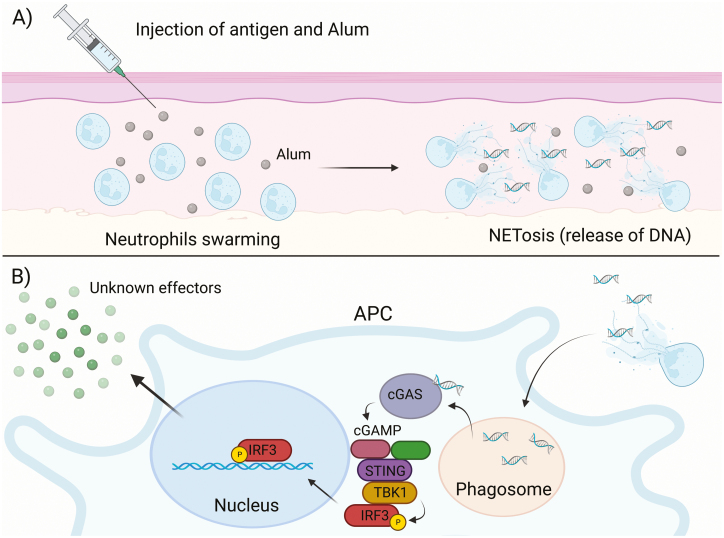
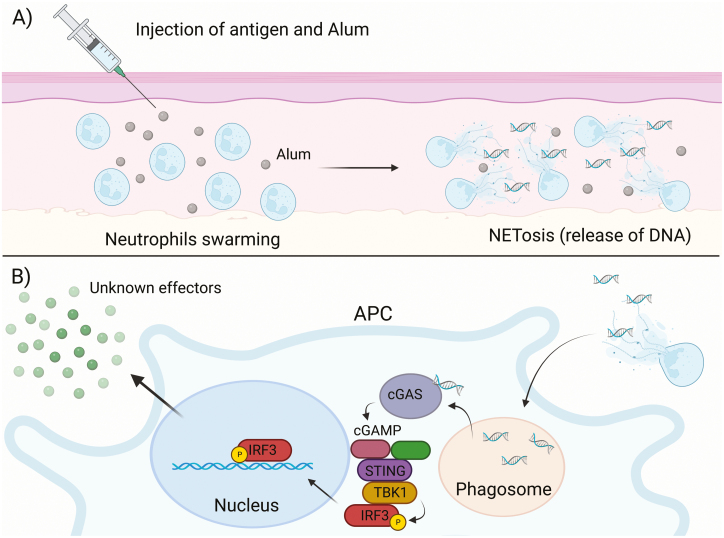
Alum induces rapid neutrophil swarming and NETosis that activates the cGAS-STING signalling pathway and confers its adjuvant activity. (a) Neutrophils are rapidly recruited to the site of injection and form neutrophil swarms around the deposited alum. The presence of alum induces the recruited neutrophils to undergo rapid NETosis that releases host DNA into the extracellular space. (b) Antigen presenting cells engulf the released NETs and the host DNA that was expelled with them. After exiting the phagosome (facilitated by the neutrophil elastase protein), the DNA is recognised in the cytosol by cyclic GMP-AMP (cGAMP) synthase (cGAS) receptor. cGAS generates cGAMP, which recruits the adaptor protein, stimulator of interferon (IFN) genes (STING). STING recruits TANK-binding kinase 1 (TBK1) which then recruits and phosphorylates IFN regulatory factor 3 (IRF3). Although IRF3 is a known transcription factor responsible for type I IFN production, it is unlikely that alum adjuvant function is dependent of these cytokines, so the final effector responses induced by IRF3 remains unclear. Created with BioRender.com.

References

    1. Greenwood B. The contribution of vaccination to global health: past, present and future. Philos Trans R Soc Lond B Biol Sci 2014, 369, 20130433. - PMC - PubMed
    1. Duclos P, Okwo-Bele JM, Gacic-Dobo M, Cherian Tet al. . Global immunization: status, progress, challenges and future. BMC Int Health Hum Rights 2009, 9(Suppl 1), S2. - PMC - PubMed
    1. Pollard AJ, Bijker EM.. A guide to vaccinology: from basic principles to new developments. Nat Rev Immunol 2021, 21, 83–100. - PMC - PubMed
    1. Sallusto F, Lanzavecchia A, Araki K, Ahmed R.. From vaccines to memory and back. Immunity 2010, 33, 451–63. doi:10.1016/j.immuni.2010.10.008 - DOI - PMC - PubMed
    1. Sette A, Crotty S.. Immunological memory to SARS-CoV-2 infection and COVID-19 vaccines. Immunol Rev 2022, 310, 27–46. - PMC - PubMed

LinkOut - more resources