


Investigating impacts of the mycothiazole chemotype as a chemical probe for the study of mitochondrial function and aging
- PMID: 38570396
- PMCID: PMC11493899
- DOI: 10.1007/s11357-024-01144-w
Investigating impacts of the mycothiazole chemotype as a chemical probe for the study of mitochondrial function and aging
Abstract
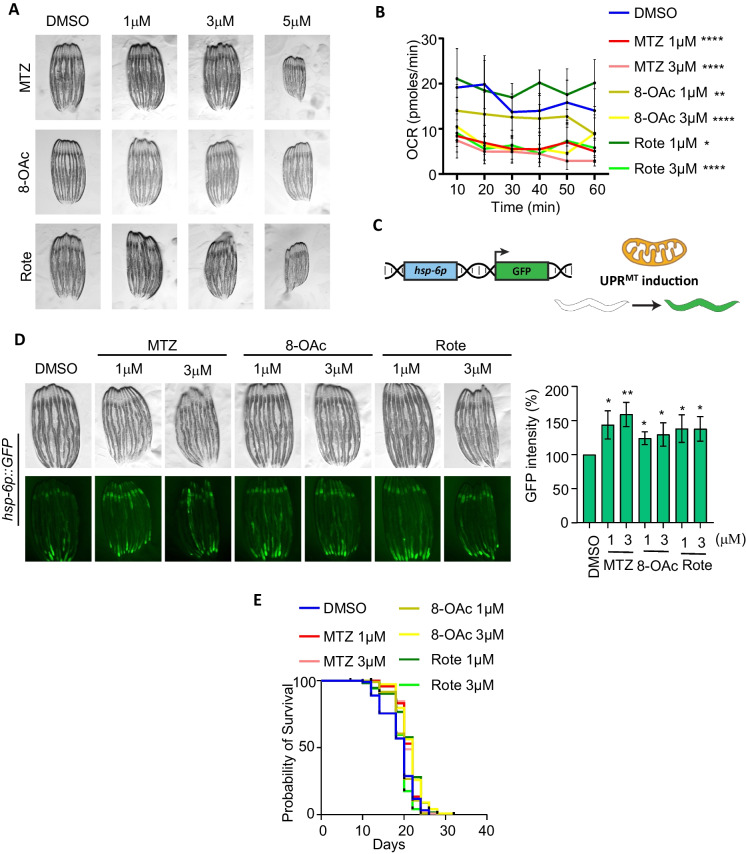
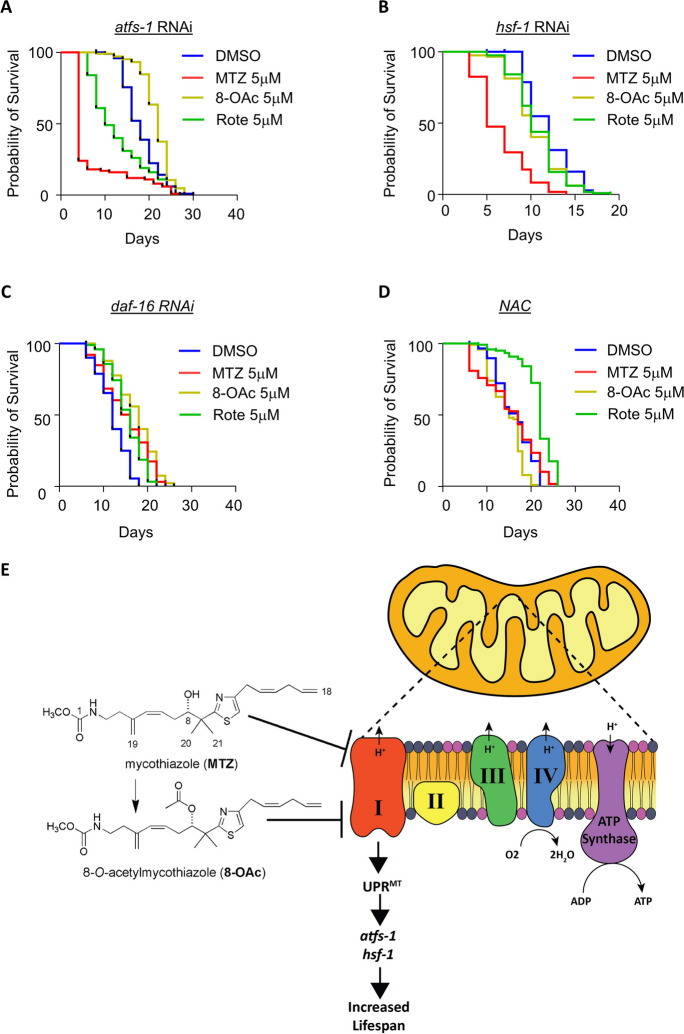
Small molecule inhibitors of the mitochondrial electron transport chain (ETC) hold significant promise to provide valuable insights to the field of mitochondrial research and aging biology. In this study, we investigated two molecules: mycothiazole (MTZ) - from the marine sponge C. mycofijiensis and its more stable semisynthetic analog 8-O-acetylmycothiazole (8-OAc) as potent and selective chemical probes based on their high efficiency to inhibit ETC complex I function. Similar to rotenone (Rote), MTZ, a newly employed ETC complex I inhibitor, exhibited higher cytotoxicity against cancer cell lines compared to certain non-cancer cell lines. Interestingly, 8-OAc demonstrated greater selectivity for cancer cells when compared to both MTZ and Rote, which has promising potential for anticancer therapeutic development. Furthermore, in vivo experiments with these small molecules utilizing a C. elegans model demonstrate their unexplored potential to investigate aging studies. We observed that both molecules have the ability to induce a mitochondria-specific unfolded protein response (UPRMT) pathway, that extends lifespan of worms when applied in their adult stage. We also found that these two molecules employ different pathways to extend lifespan in worms. Whereas MTZ utilizes the transcription factors ATFS-1 and HSF1, which are involved in the UPRMT and heat shock response (HSR) pathways respectively, 8-OAc only required HSF1 and not ATFS-1 to mediate its effects. This observation underscores the value of applying stable, potent, and selective next generation chemical probes to elucidate an important insight into the functional roles of various protein subunits of ETC complexes and their regulatory mechanisms associated with aging.
Keywords: C. elegans; aging; cancer; mitochondria; stress.
© 2024. The Author(s).
Conflict of interest statement
All authors of the manuscript declare that they have no competing interests.
Figures



References
MeSH terms
Substances
Grants and funding
- 2022-A-010-SUP/Larry L. Hillblom Foundation
- T32AG052374/AG/NIA NIH HHS/United States
- R25 AG076400/AG/NIA NIH HHS/United States
- CHE-1427922/National Science Foundation
- P41 HG002223/HG/NHGRI NIH HHS/United States
- U41 HG002223/HG/NHGRI NIH HHS/United States
- R00AG065200/AG/NIA NIH HHS/United States
- U24 HG002223/HG/NHGRI NIH HHS/United States
- P40 OD010440/OD/NIH HHS/United States
- T32 AG052374/AG/NIA NIH HHS/United States
- S10 OD024998/OD/NIH HHS/United States
- R00 AG065200/AG/NIA NIH HHS/United States
- R01 AG075130/AG/NIA NIH HHS/United States
- R01AG075130/AG/NIA NIH HHS/United States
LinkOut - more resources
Full Text Sources
Medical
