


Disparities in Place of Death Among Malnourished Individuals in the United States
- PMID: 38571833
- PMCID: PMC10990269
- DOI: 10.7759/cureus.55503
Disparities in Place of Death Among Malnourished Individuals in the United States
Abstract
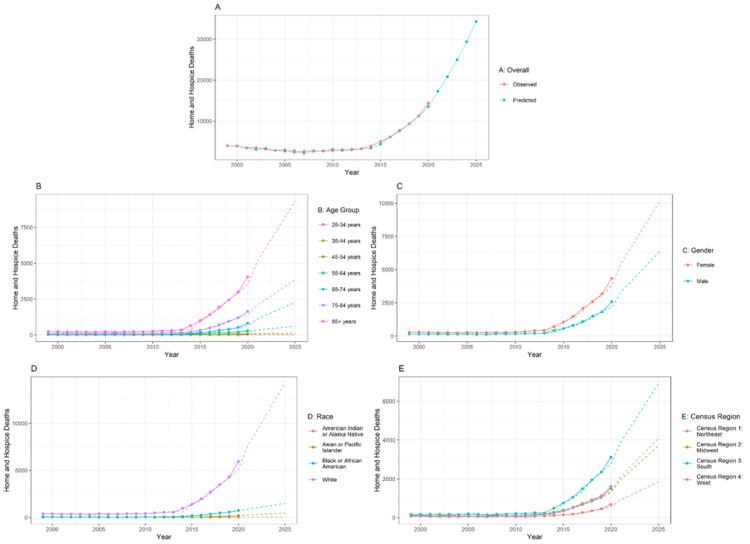
Background: Deficiencies or imbalances in a person's intake of nutrients are referred to as malnutrition. Malnutrition remains a significant public health concern in the United States, with potential consequences ranging from chronic disease to mortality. This study aims to assess the disparities in place of death due to malnutrition in the United States from 1999 to 2020, based on variables like age, gender, race, and location, utilizing the Centers for Disease Control and Prevention Information and Communication Wide-Ranging Online Data for Epidemiologic Research (CDC WONDER) database.
Methodology: Data regarding mortality due to malnutrition was extracted for the years 1999-2020 from the CDC WONDER database. Univariate regression analysis was performed to investigate disparities in the place of death based on variables.
Results: Between 1999 and 2020, a total of 1,03,962 malnutrition-related deaths were recorded, with 31,023 in home and hospice care, 68,173 in medical and nursing facilities, and 4,766 in other places. The odds of death due to malnutrition at home or hospice were highest for the 85+ age group, female gender, census region 4 (West), and Asian or Pacific Islander race.
Conclusions: This study reveals a rising trend in mortality due to malnutrition in the United States, especially among certain demographic groups and in medical facilities and nursing homes. It emphasizes the need to understand the factors contributing to this increase in mortality rates. Future research should focus on these contributors to combat the rising burden of malnutrition-related mortality in the United States.
Keywords: cdc wonder database; death; end-of-life care; healthcare disparities; home care; hospice care; malnutrition; mortality trends; palliative care.
Copyright © 2024, Chamanoor et al.
Conflict of interest statement
The authors have declared that no competing interests exist.
Figures
References
-
- Malnutrition and national development. Berg AD. Foreign Aff. 1967;46:126–136. - PubMed
-
- CDC WONDER. 2010. https://wonder.cdc.gov/ https://wonder.cdc.gov/
LinkOut - more resources
Full Text Sources