


Impact of immune evasion, waning and boosting on dynamics of population mixing between a vaccinated majority and unvaccinated minority
- PMID: 38574059
- PMCID: PMC10994315
- DOI: 10.1371/journal.pone.0297093
Impact of immune evasion, waning and boosting on dynamics of population mixing between a vaccinated majority and unvaccinated minority
Abstract
Background: We previously demonstrated that when vaccines prevent infection, the dynamics of mixing between vaccinated and unvaccinated sub-populations is such that use of imperfect vaccines markedly decreases risk for vaccinated people, and for the population overall. Risks to vaccinated people accrue disproportionately from contact with unvaccinated people. In the context of the emergence of Omicron SARS-CoV-2 and evolving understanding of SARS-CoV-2 epidemiology, we updated our analysis to evaluate whether our earlier conclusions remained valid.
Methods: We modified a previously published Susceptible-Infectious-Recovered (SIR) compartmental model of SARS-CoV-2 with two connected sub-populations: vaccinated and unvaccinated, with non-random mixing between groups. Our expanded model incorporates diminished vaccine efficacy for preventing infection with the emergence of Omicron SARS-CoV-2 variants, waning immunity, the impact of prior immune experience on infectivity, "hybrid" effects of infection in previously vaccinated individuals, and booster vaccination. We evaluated the dynamics of an epidemic within each subgroup and in the overall population over a 10-year time horizon.
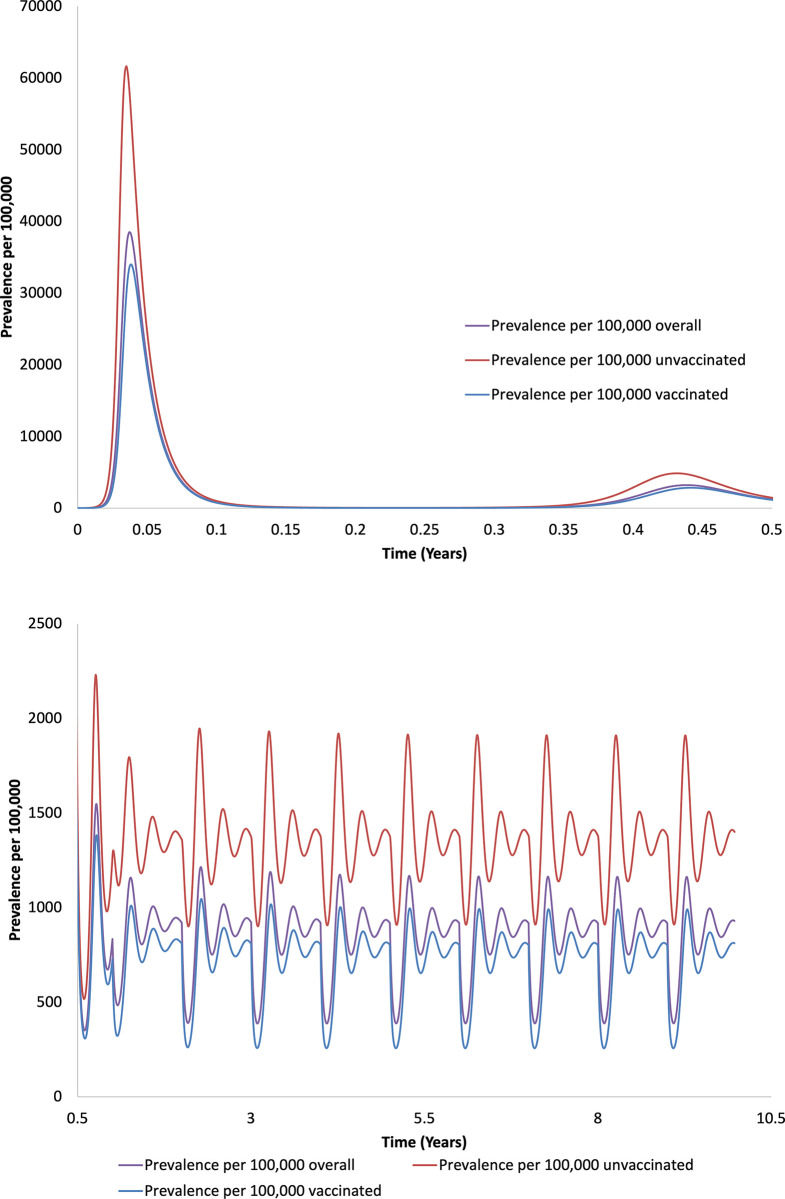
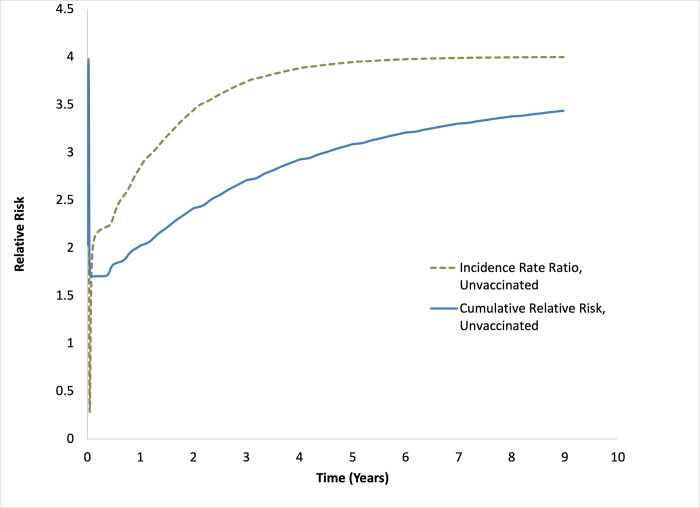
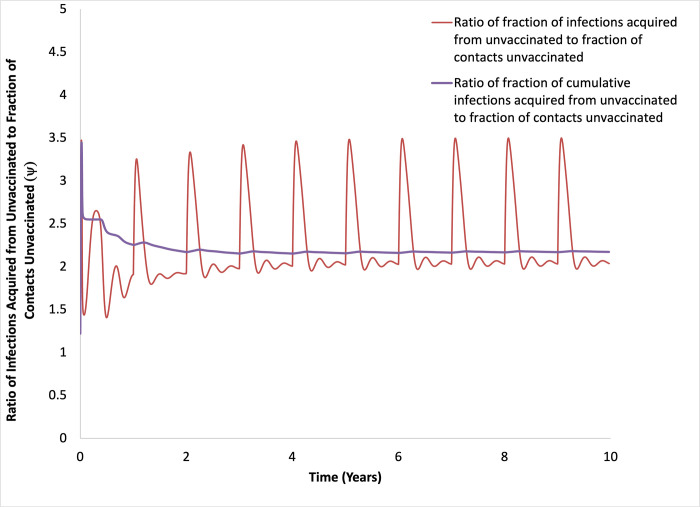
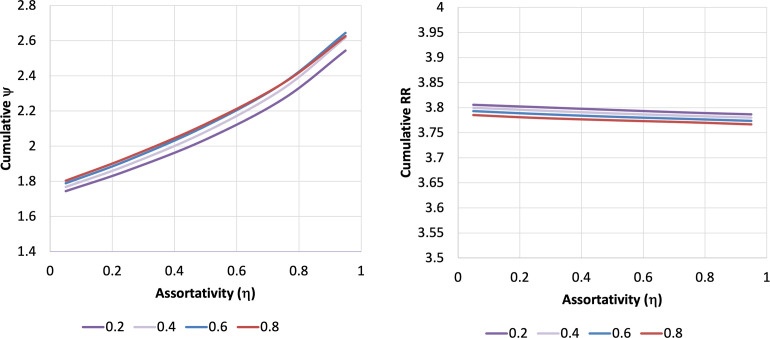
Results: Even with vaccine efficacy as low as 20%, and in the presence of waning immunity, the incidence of COVID-19 in the vaccinated subpopulation was lower than that among the unvaccinated population across the full 10-year time horizon. The cumulative risk of infection was 3-4 fold higher among unvaccinated people than among vaccinated people, and unvaccinated people contributed to infection risk among vaccinated individuals at twice the rate that would have been expected based on the frequency of contacts. These findings were robust across a range of assumptions around the rate of waning immunity, the impact of "hybrid immunity", frequency of boosting, and the impact of prior infection on infectivity in unvaccinated people.
Interpretation: Although the emergence of the Omicron variants of SARS-CoV-2 has diminished the protective effects of vaccination against infection with SARS-CoV-2, updating our earlier model to incorporate loss of immunity, diminished vaccine efficacy and a longer time horizon, does not qualitatively change our earlier conclusions. Vaccination against SARS-CoV-2 continues to diminish the risk of infection among vaccinated people and in the population as a whole. By contrast, the risk of infection among vaccinated people accrues disproportionately from contact with unvaccinated people.
Copyright: © 2024 Fisman et al. This is an open access article distributed under the terms of the Creative Commons Attribution License, which permits unrestricted use, distribution, and reproduction in any medium, provided the original author and source are credited.
Figures
Similar articles
-
Impact of population mixing between vaccinated and unvaccinated subpopulations on infectious disease dynamics: implications for SARS-CoV-2 transmission.CMAJ. 2022 Apr 25;194(16):E573-E580. doi: 10.1503/cmaj.212105. CMAJ. 2022. PMID: 35470204 Free PMC article.
-
COVID-19 Cases and Hospitalizations by COVID-19 Vaccination Status and Previous COVID-19 Diagnosis - California and New York, May-November 2021.MMWR Morb Mortal Wkly Rep. 2022 Jan 28;71(4):125-131. doi: 10.15585/mmwr.mm7104e1. MMWR Morb Mortal Wkly Rep. 2022. PMID: 35085222 Free PMC article.
-
BNT162b2 vaccine protection against omicron and effect of previous infection variant and vaccination sequence among children and adolescents in Singapore: a population-based cohort study.Lancet Child Adolesc Health. 2023 Jul;7(7):463-470. doi: 10.1016/S2352-4642(23)00101-3. Epub 2023 May 15. Lancet Child Adolesc Health. 2023. PMID: 37201540 Free PMC article.
-
A Complementary Union of SARS-CoV2 Natural and Vaccine Induced Immune Responses.Front Immunol. 2022 Jul 13;13:914167. doi: 10.3389/fimmu.2022.914167. eCollection 2022. Front Immunol. 2022. PMID: 35911696 Free PMC article. Review.
-
Effectiveness of vaccination against SARS-CoV-2 Omicron variant infection, symptomatic disease, and hospitalization: a systematic review and meta-analysis.Expert Rev Vaccines. 2022 Dec;21(12):1831-1841. doi: 10.1080/14760584.2022.2130773. Epub 2022 Oct 14. Expert Rev Vaccines. 2022. PMID: 36242513
Cited by
-
COVID-19 Vaccine Timing and Co-Administration with Influenza Vaccines in Canada: A Systematic Review with Comparative Insights from G7 Countries.Vaccines (Basel). 2025 Jun 21;13(7):670. doi: 10.3390/vaccines13070670. Vaccines (Basel). 2025. PMID: 40733647 Free PMC article. Review.
-
Viral Respiratory Epidemic Modeling of Societal Segregation Based on Vaccination Status.Cureus. 2023 Dec 14;15(12):e50520. doi: 10.7759/cureus.50520. eCollection 2023 Dec. Cureus. 2023. PMID: 38098739 Free PMC article.
References
-
- Bardosh K, de Figueiredo A, Gur-Arie R, Jamrozik E, Doidge J, Lemmens T, et al.. The unintended consequences of COVID-19 vaccine policy: why mandates, passports and restrictions may cause more harm than good. BMJ Glob Health. 2022;7(5). doi: 10.1136/bmjgh-2022-008684 ; PubMed Central PMCID: PMC9136690. - DOI - PMC - PubMed
-
- Fisman DN, Amoako A, Tuite AR. Impact of population mixing between vaccinated and unvaccinated subpopulations on infectious disease dynamics: implications for SARS-CoV-2 transmission. CMAJ. 2022;194(16):E573–E80. Epub 2022/04/27. doi: 10.1503/cmaj.212105 ; PubMed Central PMCID: PMC9054088. - DOI - PMC - PubMed
MeSH terms
Substances
LinkOut - more resources
Full Text Sources
Medical
Miscellaneous
