. 2024 Apr 4;15(1):2925.
doi: 10.1038/s41467-024-47341-1.

Flash healing of laser-induced graphene

Affiliations

Flash healing of laser-induced graphene

Le Cheng et al. Nat Commun. .

Abstract

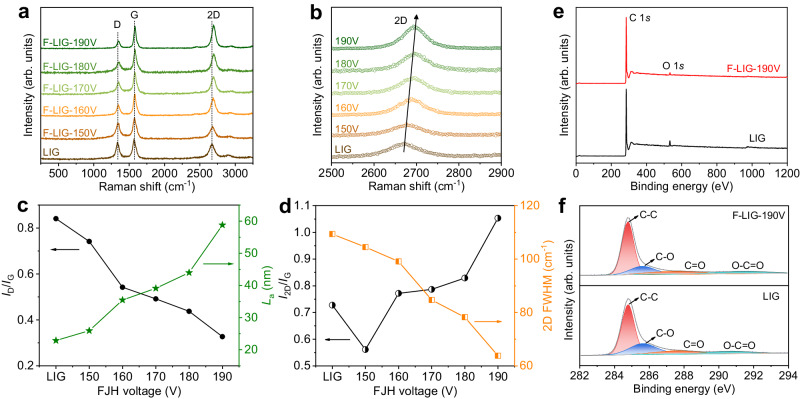
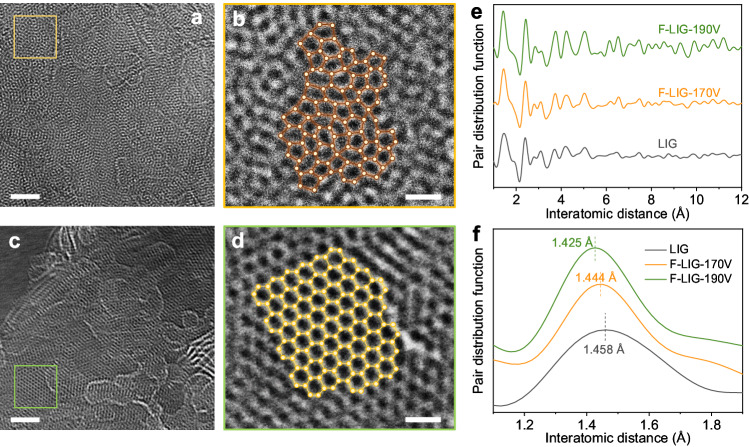
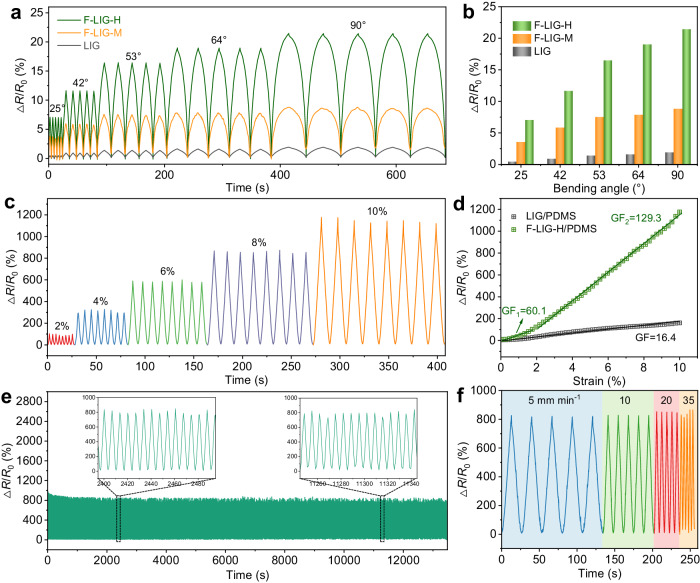
The advancement of laser-induced graphene (LIG) technology has streamlined the fabrications of flexible graphene devices. However, the ultrafast kinetics triggered by laser irradiation generates intrinsic amorphous characteristics, leading to high resistivity and compromised performance in electronic devices. Healing graphene defects in specific patterns is technologically challenging by conventional methods. Herein, we report the rapid rectification of LIG's topological defects by flash Joule heating in milliseconds (referred to as F-LIG), whilst preserving its overall structure and porosity. The F-LIG exhibits a decreased ID/IG ratio from 0.84 - 0.33 and increased crystalline domain from Raman analysis, coupled with a 5-fold surge in conductivity. Pair distribution function and atomic-resolution imaging delineate a broader-range order of F-LIG with a shorter C-C bond of 1.425 Å. The improved crystallinity and conductivity of F-LIG with excellent flexibility enables its utilization in high-performance soft electronics and low-voltage disinfections. Notably, our F-LIG/polydimethylsiloxane strain sensor exhibits a gauge factor of 129.3 within 10% strain, which outperforms pristine LIG by 800%, showcasing significant potential for human-machine interfaces.


Conflict of interest statement

R.Y. and L.C. have filed a Chinese Patent Application through City University of Hong Kong Shenzhen Research Institute. The patent application encompasses the fabrication methods and applications of F-LIG in this manuscript. The remaining authors declare no competing interests.

Figures

Fig. 1
Fig. 1. Fabrication of flash Joule heated laser-induced graphene (F-LIG) and investigation of the flash Joule heating (FJH) progress.
a Schematic diagram of the F-LIG fabrication. b Digital photograph of LIG patterns (1 mm × 10 mm) during the FJH process under different voltages with a pulse duration of 20 ms. Scale bars are 3 mm. c Temperature reached and areal energy density during the FJH process. d Resistance and the resistance reduction ratio (R/R0) of F-LIG samples compared to original LIG. Error bars represent the standard deviation of three independent measurements. e Voltage, (f) current, and (g) areal power density profiles during the FJH process.
Fig. 2
Fig. 2. Investigation of the defect structure and atomic binding state.
a Raman spectrum of LIG and F-LIG samples. The vertical dashed lines indicate the positions of the D band, G band, and 2D band of LIG. b is the enlarged view of the 2D band region. The arrow indicates the blue shift of the 2D band with the FJH voltage. c ID/IG and corresponding La, d I2D/IG and 2D band FWHM of LIG and F-LIG samples. e X-ray photoelectron spectroscopy (XPS) survey spectra and (f) C 1 s spectra of LIG and F-LIG-190 V. The black solid lines are the raw profiles, and the shaded curves represent carbon species with different atomic binding states.
Fig. 3
Fig. 3. Investigation of topological structure at atomic level.
High-resolution transmission electron microscopy (HRTEM) images of (a) LIG and (c) F-LIG-190 V. Scale bars are 5 nm. b and (d) are the enlarged view of the selected area in (a) and (c) respectively. The atomic ring structures are highlighted. Scale bars are 0.5 nm. e Pair distribution functions (PDFs) of LIG and F-LIG samples treated under different voltages. f is the enlarged view of the region in (e) from 1.1 – 1.9 Å.
Fig. 4
Fig. 4. Performance of LIG- and F-LIG-based strain sensors.
a Relative resistance variation of LIG, F-LIG with a high degree of defect healing (F-LIG-H), and F-LIG with a moderate degree of defect healing (F-LIG-M) during the cyclic bending test. b ΔR/R0 value of LIG, F-LIG-H, and F-LIG-M sensors under different bending angles. c Relative resistance variation of F-LIG-H/polydimethylsiloxane (PDMS) stretchable sensors at different strain loadings. d ΔR/R0-to-strain relationship of LIG/PDMS and F-LIG-H/PDMS. The gauge factor (GF) was determined for LIG/PDMS as GF, while for F-LIG-H/PDMS it was determined as GF1 and GF2 in different loading regions. e Stability test of F-LIG-H/PDMS under 8% strain. Insets are enlarged views of the relative resistance variation during time intervals of 2395 – 2495 s and 11245 to 11345 s. f Relative resistance variation of F-LIG-H/PDMS under 8% strain with different stretching rates.
Fig. 5
Fig. 5. Application demonstration of F-LIG-based strain sensors.
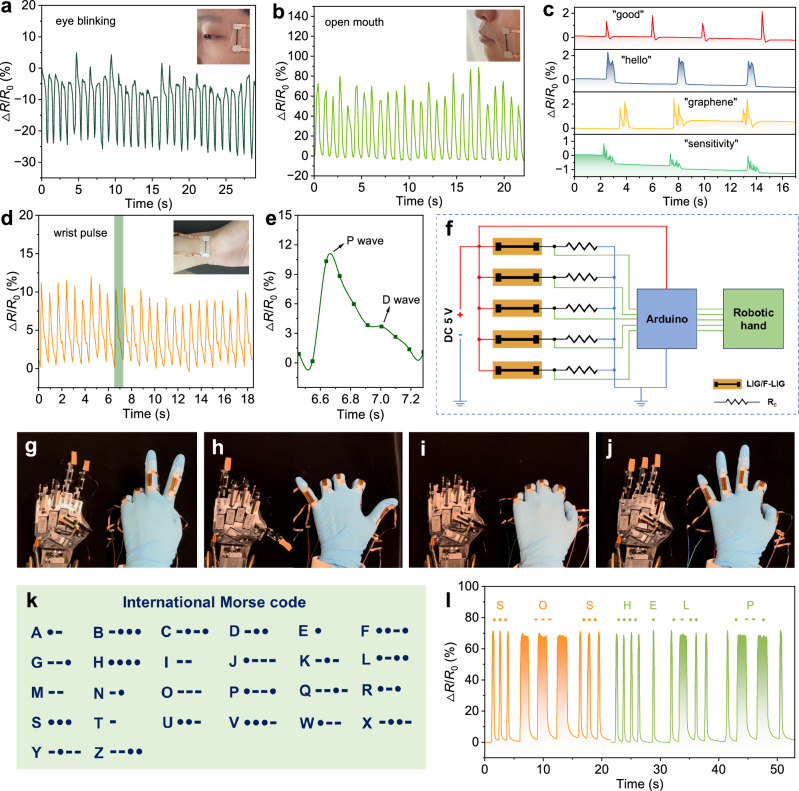
Real-time resistance response of the F-LIG-H/PDMS sensor for the detection of (a) eye blinking, (b) mouth opening, (c) microphone phonation, and (d) wrist pulses. Insets are the photographs of the sensor attached to different parts of the subject’s body. e Enlarged view of the shaded area in (d) demonstrating the distinguishable P-wave and D-wave. f Schematic diagram of the testing circuit of robotic hand controlling. gj Digital photographs illustrating the control of a robotic hand to make various gestures by the F-LIG-H sensors-integrated smart glove. k International Morse code. l Morse code for “SOS” and “HELP” produced by finger bending.

References

    1. Novoselov KS, et al. A roadmap for graphene. Nature. 2012;490:192–200. doi: 10.1038/nature11458. - DOI - PubMed
    1. Rao CNR, Biswas K, Subrahmanyam KS, Govindaraj A. Graphene, the new nanocarbon. J. Mater. Chem. 2009;19:2457–2469. doi: 10.1039/b815239j. - DOI
    1. Novoselov KS, et al. Electric field effect in atomically thin carbon films. Science. 2004;306:666–669. doi: 10.1126/science.1102896. - DOI - PubMed
    1. Zhang Y, Zhang L, Zhou C. Review of chemical vapor deposition of graphene and related applications. Acc. Chem. Res. 2013;46:2329–2339. doi: 10.1021/ar300203n. - DOI - PubMed
    1. Yu Q, et al. Graphene segregated on Ni surfaces and transferred to insulators. Appl. Phys. Lett. 2008;93:113103. doi: 10.1063/1.2982585. - DOI