


Recent trends in the epidemiology and clinical outcomes of inflammatory bowel disease in South Korea, 2010-2018
- PMID: 38577186
- PMCID: PMC10989502
- DOI: 10.3748/wjg.v30.i9.1154
Recent trends in the epidemiology and clinical outcomes of inflammatory bowel disease in South Korea, 2010-2018
Abstract
Background: Inflammatory bowel disease (IBD) was previously regarded as a Western disease; however, its incidence is increasing in the East. The epidemiology of IBD in Asia differs significantly from the patterns in the West.
Aim: To comprehensively investigate the epidemiology of IBD in South Korea, including its incidence, prevalence, medication trends, and outcomes.
Methods: We analyzed claims data from the Health Insurance Review and Assessment Service and Rare and Intractable Diseases (RIDs), operated by the National Health Insurance Service of South Korea. Patients with IBD were identified based on the International Classification of Diseases, Tenth Revision, and RID diagnostic codes for Crohn's disease (CD) and ulcerative colitis (UC) from 2010 to 2018.
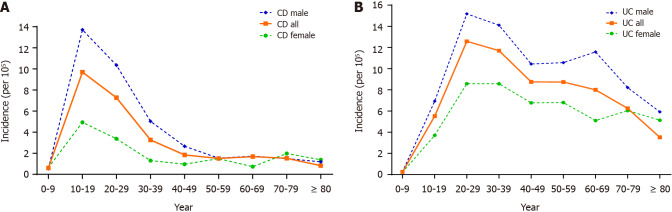
Results: In total, 14498 and 31409 patients were newly diagnosed with CD and UC, respectively, between 2010 and 2018. The annual average incidence of CD was 3.11 cases per 105 person-years, and that of UC was 6.74 cases per 105 person-years. Since 2014, the incidence rate of CD has been stable, while that of UC has steadily increased, shifting the peak age group from 50-year-olds in 2010 to 20-year-olds in 2018. The CD and UC prevalence increased consistently over the study period; the use of 5-aminosalicylates and corticosteroids gradually decreased, while that of immunomodulators and biologics steadily increased in both CD and UC. The clinical outcomes of IBD, such as hospitalization and surgery, decreased during the study period.
Conclusion: The CD incidence has been stable since 2014, but that of UC has increased with a shift to a younger age at peak incidence between 2010 and 2018. IBD clinical outcomes improved over time, with increased use of immunomodulators and biologics.
Keywords: Crohn’s disease; Incidence; Inflammatory bowel disease; Prevalence; Ulcerative colitis.
©The Author(s) 2024. Published by Baishideng Publishing Group Inc. All rights reserved.
Conflict of interest statement
Conflict-of-interest statement: There are no conflicts of interest to report.
Figures




References
-
- Ng SC, Shi HY, Hamidi N, Underwood FE, Tang W, Benchimol EI, Panaccione R, Ghosh S, Wu JCY, Chan FKL, Sung JJY, Kaplan GG. Worldwide incidence and prevalence of inflammatory bowel disease in the 21st century: a systematic review of population-based studies. Lancet. 2017;390:2769–2778. - PubMed
-
- Jung YS, Han M, Kim WH, Park S, Cheon JH. Incidence and Clinical Outcomes of Inflammatory Bowel Disease in South Korea, 2011-2014: A Nationwide Population-Based Study. Dig Dis Sci. 2017;62:2102–2112. - PubMed
-
- Park SH, Kim YJ, Rhee KH, Kim YH, Hong SN, Kim KH, Seo SI, Cha JM, Park SY, Jeong SK, Lee JH, Park H, Kim JS, Im JP, Yoon H, Kim SH, Jang J, Kim JH, Suh SO, Kim YK, Ye BD, Yang SK Songpa-Kangdong Inflammatory Bowel Disease [SK-IBD] Study Group. A 30-year Trend Analysis in the Epidemiology of Inflammatory Bowel Disease in the Songpa-Kangdong District of Seoul, Korea in 1986-2015. J Crohns Colitis. 2019;13:1410–1417. - PubMed
-
- Kim HJ, Hann HJ, Hong SN, Kim KH, Ahn IM, Song JY, Lee SH, Ahn HS. Incidence and natural course of inflammatory bowel disease in Korea, 2006-2012: a nationwide population-based study. Inflamm Bowel Dis. 2015;21:623–630. - PubMed
MeSH terms
Substances
LinkOut - more resources
Full Text Sources
Medical
